Can you answer this?
On 4 October 2026, two captive-bred male Great Indian Bustards were released into the wild for the first time. Where were they released?
- Desert National Park, Rajasthan
- Kuno National Park, Madhya Pradesh
- Ranthambore National Park, Rajasthan
- Gir National Park, Gujarat
Answer at the end of the post. Send it to a friend and see who gets it right.
Here are the Bihar current affairs for 5 October 2026 that matter for BPSC Prelims and Mains: a new double-line rail bridge over the Ganga at Mokama, fresh industrial land allotments, a makhana export to Europe and more.
In this post: 8 updates
- Bihar
- 1. New double-line Ganga rail bridge at Mokama gets CRS safety inspection
- 2. BIADA allots 9.14 acres to 12 industrial units across Bihar
- 3. Purnea makhana reaches Greece in an APEDA-backed export
- 4. Seemanchal JEEViKA goat producer company: 20,000 women, Rs 15 crore turnover
- 5. Gandak floods: seven Water Resources Department engineers suspended in Saran and Gopalganj
- National
- 6. Centres of Excellence approved for Classical Pali, Prakrit, Assamese, Bengali and Marathi
- Economy
- 7. NABKISAN lists India’s first WASH-focused social bond on NSE
- Environment / Science
- 8. Two captive-bred male Great Indian Bustards released in Jaisalmer’s Desert National Park
- Revise
- Quick revision
- Today’s Mains question
Bihar
1. New double-line Ganga rail bridge at Mokama gets CRS safety inspection
The Commissioner of Railway Safety (Eastern Circle, Kolkata), Guru Prakash, carried out a two-day inspection on 3–4 October of the new rail bridge over the Ganga between Rajendrapul and Hathidah in East Central Railway’s Danapur division. The 13-km Mokama–Rampur Dumra stretch has been fitted with electronic interlocking at Tal, Hathidah and Rampur Dumra stations, automatic signalling and two interlocked level crossings. The double-line bridge runs beside the 1959 Rajendra Setu, which carries only a single rail track, so it should ease the main north–south rail bottleneck in Bihar once train services are cleared.
Why it matters for BPSC: Prelims (Bihar geography and transport) and Mains GS Paper II (infrastructure and Bihar economy). Ganga bridges decide how goods and people move between north and south Bihar; link this to the Ganga’s role in dividing the state’s plains.
Prelims fact: Rajendra Setu, opened in 1959, links Hathidah (Patna district) with Simaria (Begusarai) and was the first bridge to join north and south Bihar.
Source: RailPost
2. BIADA allots 9.14 acres to 12 industrial units across Bihar
The Project Clearance Committee of the Bihar Industrial Area Development Authority (BIADA), chaired by its managing director Naveen Kumar, approved 9.14 acres of land for 12 units. The proposals carry an expected investment of Rs 132.60 crore and around 2,500 jobs, in districts including Patna, Buxar, Muzaffarpur, West Champaran and Bhagalpur.
Why it matters for BPSC: Mains GS Paper II (Bihar economy, industrialisation). Use it when writing on why Bihar’s industrial base is small, the role of land banks and plug-and-play sheds, and the link between local jobs and out-migration.
Prelims fact: BIADA’s Project Clearance Committee approved Rs 132.60 crore of investment on 9.14 acres for 12 units.
Source: UNI
3. Purnea makhana reaches Greece in an APEDA-backed export
APEDA (Agricultural and Processed Food Products Export Development Authority) helped send one metric tonne of popped (phool) makhana, sourced from Belouri in Purnea, from Mundra port to Piraeus in Greece. The Commerce Ministry says Bihar produces about 80–85% of India’s makhana, grown on over 35,000 hectares in 10 districts, and that India exported more than 7,000 MT of makhana and its products worth USD 22 million in 2025-26.
Why it matters for BPSC: Prelims (agriculture of Bihar, export bodies) and Mains GS Paper II (agri-exports and value addition in Bihar). Makhana is a classic Mithila–Kosi–Seemanchal wetland crop; APEDA works under the Ministry of Commerce and Industry.
Prelims fact: Bihar accounts for about 80–85% of India’s makhana production.
Source: PIB (Ministry of Commerce and Industry)
4. Seemanchal JEEViKA goat producer company: 20,000 women, Rs 15 crore turnover
About 20,000 women from JEEViKA (जीविका) self-help groups in Araria, Purnia, Katihar and Kishanganj have built a goat-rearing business through the Seemanchal JEEViKA Goat Producer Company Limited. Its cumulative turnover has crossed Rs 15 crore, showing how a farmer producer company can turn a backyard activity into an organised value chain.
Why it matters for BPSC: Mains GS Paper II (rural livelihoods, women’s self-help groups, Bihar economy) and Essay (women-led development). JEEViKA is run by the Bihar Rural Livelihoods Promotion Society; Seemanchal is among Bihar’s poorest regions, so this is a good example for answers on livelihood diversification.
Prelims fact: Seemanchal JEEViKA Goat Producer Company covers four districts: Araria, Purnia, Katihar and Kishanganj.
Source: UNI Varta
5. Gandak floods: seven Water Resources Department engineers suspended in Saran and Gopalganj
Following yesterday’s Gandak flood relief update, the Bihar Water Resources Department suspended seven engineers posted in Chhapra (Saran) and Gopalganj for lapses in handling the embankment breaches. Departmental proceedings have also been started against the Muzaffarpur chief engineer over damage to the Champaran embankment. The report says some engineers left breach sites instead of responding at once.
Why it matters for BPSC: Mains GS Paper II (governance, disaster management in Bihar) and Mains GS Paper I (current events). Useful for answers on accountability in flood management and why embankments alone do not solve north Bihar’s floods.
Prelims fact: Seven engineers were suspended: two executive, three assistant and two junior engineers from Chhapra (Saran) and Gopalganj.
Source: Daily Excelsior
National
6. Centres of Excellence approved for Classical Pali, Prakrit, Assamese, Bengali and Marathi
The Ministry of Education has approved five Centres of Excellence for classical languages: Assamese at Tezpur University, Bengali at Visva-Bharati, Marathi at Deccan College, Pune, Pali at the Central University of Odisha and Prakrit at the Central University of Gujarat. The centres will support research, digitisation and preservation of texts and wider public outreach.
Why it matters for BPSC: Prelims (art and culture) and Mains GS Paper I (ancient Indian history and culture). Pali is the language of the Theravada Buddhist canon and Prakrit of early Jain texts, both rooted in ancient Magadha, so expect Bihar-linked questions.
Prelims fact: The Centre of Excellence for Classical Pali will be at the Central University of Odisha.
Source: ANI
Economy
7. NABKISAN lists India’s first WASH-focused social bond on NSE
NABKISAN Finance, a NABARD subsidiary, raised Rs 180 crore through India’s first social bond dedicated only to water, sanitation and hygiene (WASH). The five-year bond carries an 8.10% coupon, is rated AAA by CRISIL and CARE, was subscribed 1.8 times and is listed on the National Stock Exchange. The money will fund safe water and sanitation in rural and underserved areas.
Why it matters for BPSC: Mains GS Paper II (Indian economy, financial inclusion, sustainable finance). Links to NABARD’s role in rural credit and to sanitation schemes; a useful example of social bonds alongside green bonds.
Prelims fact: The NABKISAN WASH social bond is worth Rs 180 crore, with a five-year tenure and 8.10% coupon.
Source: PIB (Ministry of Finance)
Environment / Science
8. Two captive-bred male Great Indian Bustards released in Jaisalmer’s Desert National Park
Union Environment Minister Bhupender Yadav released two captive-bred male Great Indian Bustards (GIBs) into the wild at Sam in Desert National Park, Jaisalmer, on 4 October. The birds come from the conservation breeding programme at Ramdevra and Sam, run by the Environment Ministry, the Rajasthan Forest Department and the Wildlife Institute of India. The step marks a move from building a captive population to rewilding. More stories on our environment page.
Why it matters for BPSC: Prelims (environment, species in news) and Mains GS Paper II (science and technology, conservation). Compare with Bihar’s own reintroduction stories, such as tigers from Valmiki Tiger Reserve.
Prelims fact: The Great Indian Bustard (Ardeotis nigriceps) is listed as Critically Endangered on the IUCN Red List.
Source: Telangana Today
Quick revision
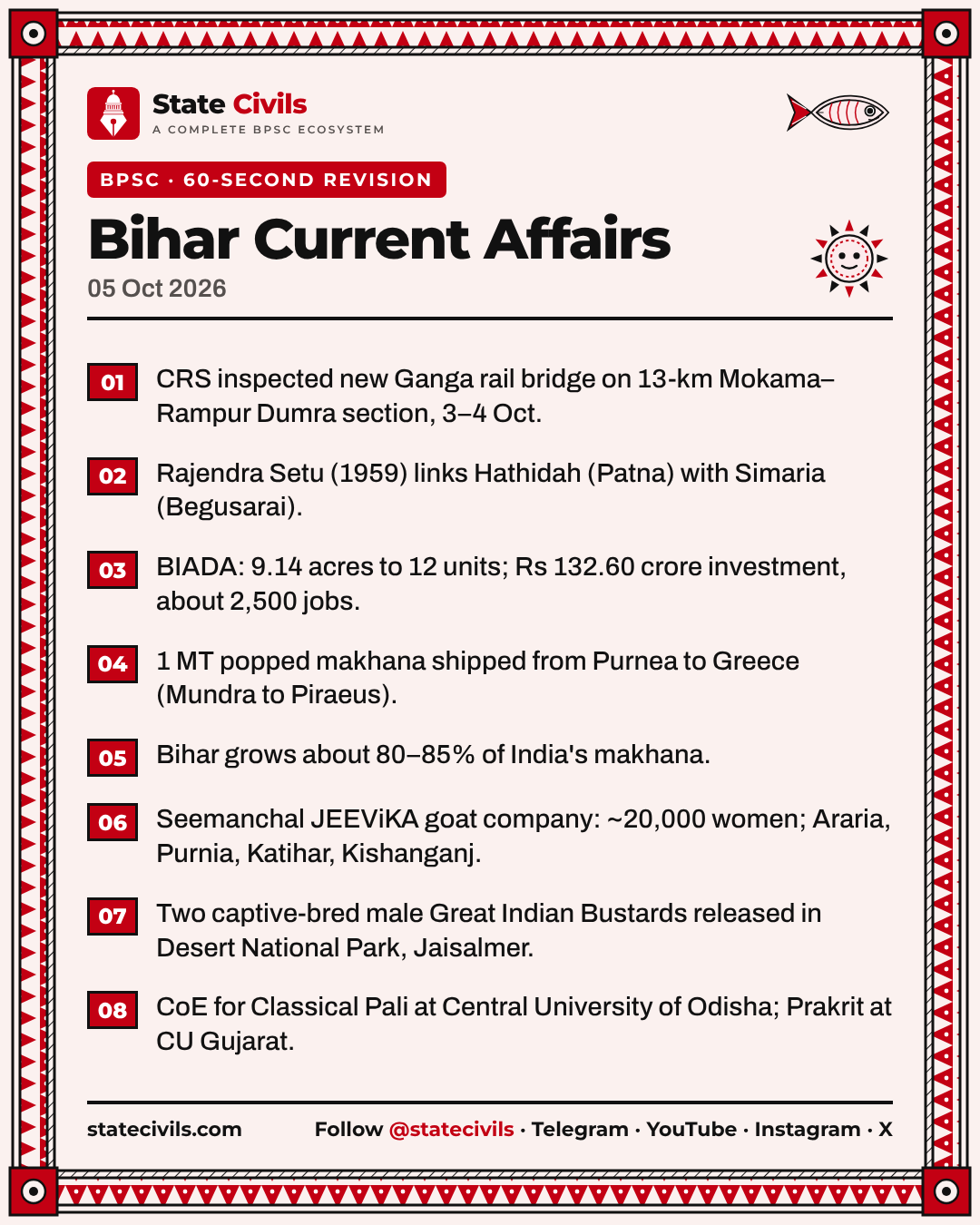
- CRS inspected new Ganga rail bridge on 13-km Mokama–Rampur Dumra section, 3–4 Oct.
- Rajendra Setu (1959) links Hathidah (Patna) with Simaria (Begusarai).
- BIADA: 9.14 acres to 12 units; Rs 132.60 crore investment, about 2,500 jobs.
- 1 MT popped makhana shipped from Purnea to Greece (Mundra to Piraeus).
- Bihar grows about 80–85% of India’s makhana.
- Seemanchal JEEViKA goat company: ~20,000 women; Araria, Purnia, Katihar, Kishanganj.
- Two captive-bred male Great Indian Bustards released in Desert National Park, Jaisalmer.
- CoE for Classical Pali at Central University of Odisha; Prakrit at CU Gujarat.
Share today’s revision card with your study group
One image, eight facts. Forward it to your BPSC group.
WhatsApp Telegram Facebook X Download card
Get this every morning: join @statecivils on Telegram. Also on YouTube, Instagram and X.
Today’s Mains question
Examine how better transport connectivity and ready industrial land can help Bihar create jobs at home and reduce out-migration, with reference to recent developments such as the new Mokama rail bridge and BIADA land allotments. (250 words)
Write your answer in 12 minutes, then open the model answer below and compare. Share this post with a study partner too.
Show the topper-style model answer
Decode the question
Directive: Examine
- Examine how transport connectivity creates local jobs, using the Mokama bridge as an example.
- Examine how ready industrial land does the same, using BIADA allotments as an example.
- Link both to reducing out-migration, and note the limits.
Keywords to use
Push–pull factorsDistress migrationLogistics costNorth–south bottleneckLand bankPlug-and-playLabour-intensive manufacturingEconomic corridorAgri value chainEase of doing business
Introduction
Out-migration from Bihar is driven by push factors (small farms, a thin industrial base) and pull factors (jobs elsewhere). Better transport and ready industrial land tackle two of the biggest gaps that keep investment, and therefore jobs, away from the state.
Body
Connectivity: lower costs, wider markets
- The new double-line Ganga bridge at Mokama runs beside the single-track 1959 Rajendra Setu and eases the main north–south rail bottleneck.
- Corridors such as the Patna–Purnia and Gorakhpur–Siliguri expressways open up Seemanchal, and the Eastern Dedicated Freight Corridor starts at Sonnagar.
- Agri value chains reach new markets: Purnea makhana went to Greece with APEDA’s help.
Ready land: from intent to factories
- BIADA allotted 9.14 acres to 12 units, worth ₹132.60 crore and about 2,500 jobs, showing that small plots can host labour-intensive units.
- In a dense state (1,106 people per sq km, Census 2011), land banks and plug-and-play sheds avoid acquisition delays.
- Power capacity rising from about 500 MW (2005) to over 10,000 MW, and 25% state procurement of local products, add to the pull.
Limits
- Roads also make it easier to leave, so jobs must follow connectivity.
- Skills mismatch, credit gaps and a small manufacturing base (ASI) remain.
Diagram (draw this in your answer)
Add a side box ‘Skills + credit’ feeding into ‘Local jobs’. It shows the examiner you know infrastructure alone is not enough.
Value addition
- Everett Lee’s push–pull theory of migration (1966).
- Rajendra Setu (1959) was the first bridge to join north and south Bihar.
- Bihar grows about 80–85% of India’s makhana, a ready base for food processing.
Conclusion
Connectivity and land are necessary but not sufficient. Paired with skills, credit and stable industrial policy along these new corridors, they can make migration from Bihar a choice rather than a compulsion.
About 227 words without the diagram. Toppers usually score on three things: answering every part the directive asks for, adding Bihar-specific examples and data, and drawing one clean diagram.
Answer to today’s question
(a) Desert National Park, Rajasthan. The two male GIBs were released at Sam in Desert National Park, Jaisalmer, on 4 October 2026 by Union Environment Minister Bhupender Yadav.