Can you answer this?
Tigress T138, moved this week from Bihar’s only tiger reserve, was released in which tiger reserve?
- Palamau (Jharkhand)
- Simlipal (Odisha)
- Buxa (West Bengal)
- Sundarbans (West Bengal)
Answer at the end of the post. Send it to a friend and see who gets it right.
Today’s picks: a big women’s livelihood target, a highway push, fisheries skilling, flood relief, Nalanda’s global ties, a Valmiki tiger in Bengal and a historic hockey gold.
In this post: 7 updates
- Bihar
- 1. “Samriddh Mahila–Samriddh Bihar” (समृद्ध महिला–समृद्ध बिहार): target of 1 crore Lakhpati Didis
- 2. CM and Union Road Minister review Bihar’s highway pipeline
- 3. Free modern training for 9,685 fish farmers in 2026-27
- 4. Gandak floods: ₹7,000 relief per family to be sent by DBT on 9 October
- 5. Nalanda University signs three MoUs with partners in India, Hungary and Mexico
- National
- 6. Indian women’s hockey team wins Asian Games gold, qualifies for LA 2028
- Environment / Science
- 7. Tigress from Bihar’s Valmiki reserve released in Bengal’s Buxa Tiger Reserve
- Revise
- Quick revision
- Today’s Mains question
Bihar
1. “Samriddh Mahila–Samriddh Bihar” (समृद्ध महिला–समृद्ध बिहार): target of 1 crore Lakhpati Didis
The state government’s next big target is to bring 1 crore JEEViKA (जीविका) women into the Lakhpati Didi category, that is, earning at least ₹1 lakh a year; about 50 lakh have already reached it. Under the “Samriddh Mahila–Samriddh Bihar” campaign, the Rural Development Department plans to do this within five years through bank-linked support of up to ₹5 lakh for 10 lakh women entrepreneurs, livestock livelihoods for 60 lakh women, 25 lakh women-led micro-enterprises and 15 lakh new service and skill-sector jobs. JEEViKA, which turns 20 this month, links about 1.81 crore families through 73,517 village organisations. See more scheme updates for BPSC.
Why it matters for BPSC: Prelims: JEEViKA (Bihar Rural Livelihoods Promotion Society) and the Lakhpati Didi (लखपति दीदी) idea under DAY-NRLM (Ministry of Rural Development). Mains GS Paper II (Indian and Bihar economy): SHG federations as a tool for women’s empowerment, rural credit and non-farm diversification.
Prelims fact: JEEViKA was launched in Bihar on 2 October 2006.
Source: ETV Bharat; The CSR Journal
2. CM and Union Road Minister review Bihar’s highway pipeline
Chief Minister Samrat Choudhary and Union Road Transport Minister Nitin Gadkari reviewed around 15 major road projects in Patna, including the Patna–Purnia greenfield expressway, Gorakhpur–Siliguri expressway, Patna Ring Road, Muzaffarpur–Barauni four-laning and the six-lane Varanasi–Ranchi–Kolkata corridor. Detailed Project Reports were ordered for four-laning of NH-139, the Bariarpur–Gangta–Jamui stretch of NH-333 and an Aurangabad–Amba bypass. AI-based monitoring of construction quality was also announced.
Why it matters for BPSC: Bihar infrastructure and connectivity (Mains GS Paper II: economy and geography of India and Bihar). Know the expressway names and the regions they link (Patna–Purnia connects the capital with the Kosi–Seemanchal belt). Static link: national highways are a Union List subject (Entry 23), built through NHAI/MoRTH.
Prelims fact: National highways are a Union List subject (Entry 23, Seventh Schedule), developed through MoRTH/NHAI.
Source: Indian Masterminds
3. Free modern training for 9,685 fish farmers in 2026-27
Under the Fisheries Training and Extension Scheme, the Animal and Fisheries Resources Department will train 9,685 fish farmers this year in 332 batches at fisheries institutes inside and outside Bihar, with only a nominal registration fee. So far 70,221 farmers have been trained (52,485 in-state, 17,726 outside) and over 47,409 have gone on exposure visits to wetland and biofloc units. The department reports fish output rising from 9.69 lakh tonnes in 2024-25 to 10.28 lakh tonnes in 2025-26.
Why it matters for BPSC: Bihar’s rural economy and the “Blue Revolution”. Link with PM Matsya Sampada Yojana (Ministry of Fisheries, Animal Husbandry & Dairying), Bihar’s chaur/wetland resources and biofloc technology, which is often asked as a Prelims concept.
Prelims fact: Fisheries Training and Extension Scheme 2026-27: 9,685 farmers in 332 batches.
Source: Indian Masterminds
4. Gandak floods: ₹7,000 relief per family to be sent by DBT on 9 October
Following up yesterday’s Gandak record-level update: the Gandak has breached its embankment at seven major points, hitting about six lakh people in 30 blocks of West Champaran, East Champaran, Gopalganj, Saran, Darbhanga and Muzaffarpur; at least 12 deaths were reported and over 92,000 people displaced. Twelve NDRF and eight SDRF teams are deployed and 232 community kitchens are running. The Chief Minister has said ₹7,000 gratuitous relief per affected family will be credited to bank accounts on 9 October. Discharge at Valmikinagar barrage has fallen sharply from its 28 September peak.
Why it matters for BPSC: Disaster management (Mains GS Paper I current events; GS Paper II geography): Disaster Management Act, 2005, NDRF/SDRF roles, SDRF norms for gratuitous relief, and the embankment debate on north Bihar rivers. Geography: the Gandak rises in Nepal and meets the Ganga at Sonpur.
Prelims fact: The Gandak meets the Ganga at Sonpur; the Valmikinagar barrage across it was built in 1968–69.
Source: ETV Bharat; First Bihar
5. Nalanda University signs three MoUs with partners in India, Hungary and Mexico
Nalanda University (Rajgir) has signed agreements with the CSIR–Traditional Knowledge Digital Library unit, Dharma Gate Buddhist College in Budapest and Universidad Autónoma de Guerrero in Mexico. They cover joint research supervision, teaching, postdoctoral work, conferences and student–faculty exchange; the TKDL tie-up focuses on documenting traditional knowledge and protecting it from misappropriation. The university is also hosting an ICCR workshop on sustainable crafts using bamboo, mud, straw and jute on 3–4 October.
Why it matters for BPSC: Static link: ancient Nalanda Mahavihara (UNESCO World Heritage Site, 2016) and the revived university set up under the Nalanda University Act, 2010. Prelims: TKDL is a CSIR database used to block wrongful patents on Indian traditional knowledge.
Prelims fact: Nalanda Mahavihara (Bihar) was inscribed as a UNESCO World Heritage Site in 2016.
Source: Patna Press
National
6. Indian women’s hockey team wins Asian Games gold, qualifies for LA 2028
India beat China 1-0 in the final at the Aichi-Nagoya Asian Games, with Lalremsiami scoring in the 10th minute. The win ends a 44-year wait for women’s hockey gold at the Asian Games and gives India a direct berth at the Los Angeles 2028 Olympics. Deepika Sehrawat finished as the team’s top scorer with 21 goals.
Why it matters for BPSC: Sports facts are a regular Prelims item: host city (Aichi-Nagoya, Japan), opponent, result and Olympic qualification. Static link: India’s last women’s hockey gold at the Asian Games came at the 1982 New Delhi Games.
Prelims fact: India’s previous Asian Games women’s hockey gold came in 1982 (New Delhi).
Source: The Tribune; The News Mill
Environment / Science
7. Tigress from Bihar’s Valmiki reserve released in Bengal’s Buxa Tiger Reserve
Tigress T138, about three years old, was captured in Valmiki Tiger Reserve on 29 September, moved by road and then by air, and reached Buxa on 30 September before release during Wildlife Week. Buxa, declared a tiger reserve in 1983 and spread over roughly 760 sq km, has had no confirmed resident tigers for years, only occasional transient males. She carries a satellite collar, and more tigers are planned for translocation. NTCA and the Wildlife Institute of India are among the agencies involved.
Why it matters for BPSC: Valmiki (West Champaran) is Bihar’s only tiger reserve and national park, adjoining Nepal’s Chitwan National Park. Prelims: inter-state tiger translocation, NTCA (statutory body under the Wildlife Protection Act, 1972, via the 2006 amendment) and Project Tiger (1973).
Prelims fact: Valmiki Tiger Reserve (West Champaran) adjoins Nepal’s Chitwan National Park.
Source: The Week
Quick revision
- Target: 1 crore Lakhpati Didis in five years (about 50 lakh already); JEEViKA covers 1.81 crore families via 73,517 village organisations.
- Patna–Purnia greenfield expressway links Patna with the Kosi–Seemanchal belt.
- DPRs ordered: NH-139 four-laning, Bariarpur–Gangta–Jamui (NH-333), Aurangabad–Amba bypass.
- 9,685 fish farmers to be trained in 332 batches in 2026-27; fish output 10.28 lakh tonnes in 2025-26.
- Gandak floods: about 6 lakh people in 30 blocks, seven breaches; ₹7,000 per family by DBT on 9 October.
- Nalanda University MoUs: CSIR-TKDL, Dharma Gate Buddhist College (Budapest), Universidad Autónoma de Guerrero (Mexico).
- Asian Games women’s hockey gold: India 1–0 China (Lalremsiami); first since 1982; direct LA 2028 berth.
- Tigress T138 moved from Valmiki Tiger Reserve to Buxa Tiger Reserve, West Bengal.
Share today’s revision card with your study group
One image, eight facts. Forward it to your BPSC group.
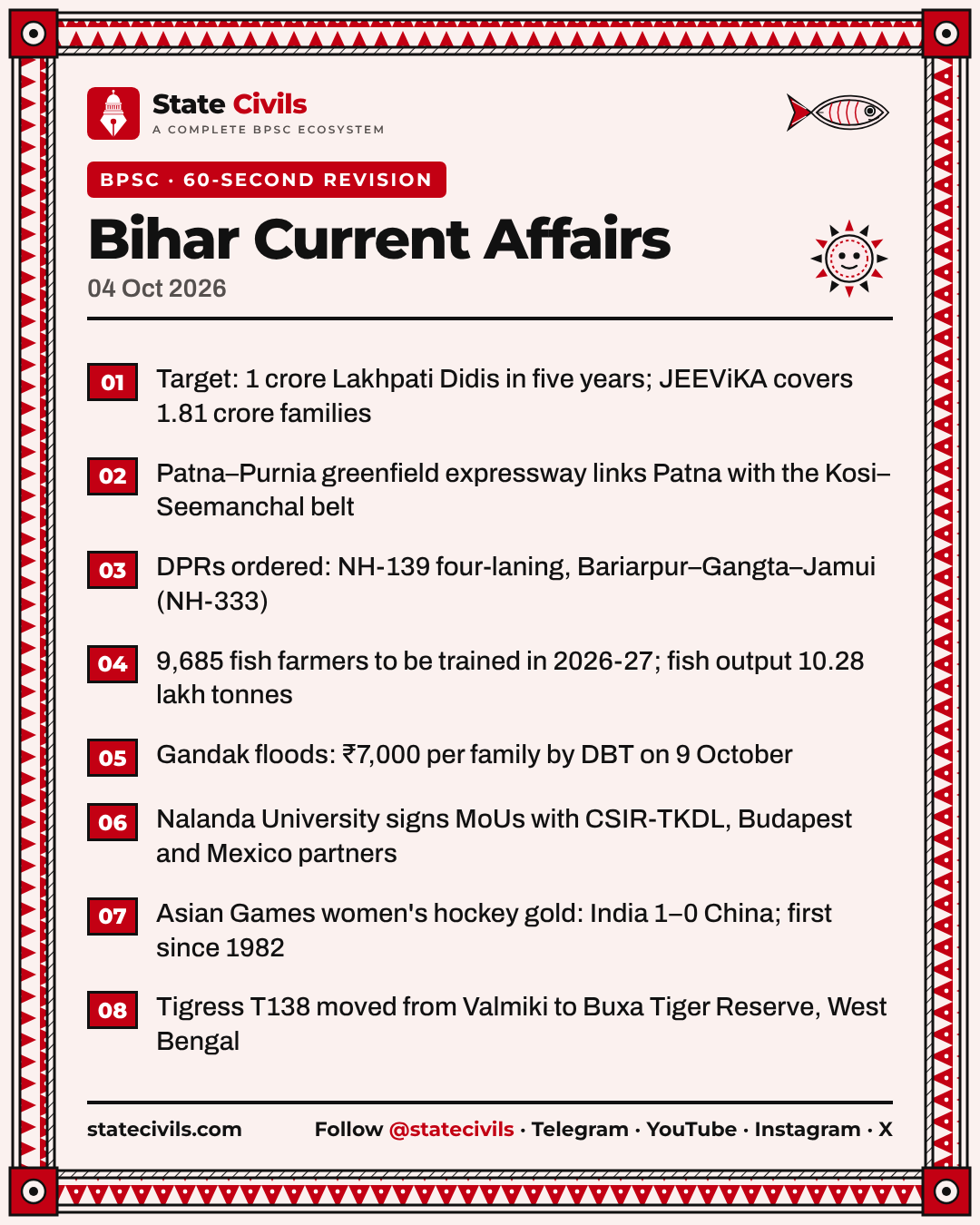
WhatsApp Telegram Facebook X Download card
Get this every morning: join @statecivils on Telegram. Also on YouTube, Instagram and X.
Today’s Mains question
SHG federations such as JEEViKA have reshaped rural Bihar. Examine their role in women’s economic empowerment and the challenges in reaching the target of 1 crore Lakhpati Didis. (250 words)
Write your answer in 12 minutes, then open the model answer below and compare. Share this post with a study partner too.
Show the topper-style model answer
Decode the question
Directive: Examine
- Examine the role of SHG federations such as JEEViKA in women’s economic empowerment (economic, social and institutional).
- Examine the challenges in reaching 1 crore Lakhpati Didis, and briefly suggest a way forward.
Keywords to use
SHG–VO–CLF federationBank linkageLivelihood diversificationProducer companyAgency and voiceDAY-NRLMLakhpati DidiMarket linkageSustained incomeWomen-led development
Introduction
Launched on 2 October 2006 with World Bank support, JEEViKA (Bihar Rural Livelihoods Promotion Society) now links about 1.81 crore families through 73,517 village organisations. About 50 lakh members are already Lakhpati Didis, and the state now aims for 1 crore within five years under ‘Samriddh Mahila–Samriddh Bihar’.
Body
Role in women’s economic empowerment
- Finance: regular savings and bank-linked credit cut dependence on moneylenders.
- Diversification: livestock, micro-enterprises and services. For example, the Seemanchal JEEViKA Goat Producer Company has 20,000 women and a turnover above ₹15 crore.
- Voice: women gain a say at home and in the village. JEEViKA groups were prominent in the campaign that led to prohibition in 2016.
- Convergence: Didi ki Rasoi canteens and the Satat Jeevikoparjan Yojana for ultra-poor households.
Challenges to 1 crore Lakhpati Didis
- Scale: doubling from 50 lakh in five years needs incomes of ₹1 lakh+ every year, not one-off loans.
- Markets: small, low-margin activities with weak value chains and branding.
- Credit: limited enterprise-size finance and a risk of over-indebtedness.
- Constraints: skills, digital literacy, mobility and the unpaid care burden.
- Shocks: floods in north Bihar wipe out livestock and assets.
Way forward
- More producer companies, e-commerce and GeM linkage, credit guarantees, livestock insurance, and income tracking with verified data.
Diagram (draw this in your answer)
Draw it as a pyramid with SHGs at the base, or as two arrows like these.
Value addition
- National Lakhpati Didi target raised from 2 crore to 3 crore (Interim Budget 2024).
- DAY-NRLM is run by the Union Ministry of Rural Development.
- Plans for women under the 5-year target: up to ₹5 lakh support for 10 lakh entrepreneurs, livestock livelihoods for 60 lakh, 25 lakh micro-enterprises.
Conclusion
JEEViKA has already turned women from beneficiaries into economic actors. Reaching 1 crore Lakhpati Didis now depends on moving from thrift to enterprise, with markets, credit and insurance doing for incomes what the SHG movement did for savings. That is the real meaning of Samriddh Mahila–Samriddh Bihar.
About 251 words without the diagram. Toppers usually score on three things: answering every part the directive asks for, adding Bihar-specific examples and data, and drawing one clean diagram.
Answer to today’s question
(c) Buxa Tiger Reserve, West Bengal. T138 came from Valmiki Tiger Reserve in West Champaran.