Can you answer this?
Self-enumeration for Phase 2 (population enumeration) of Census 2027 began on 16 November 2026 in which group of states?
- Bihar, Jharkhand, Odisha and West Bengal
- Goa, Punjab, Uttar Pradesh and Uttarakhand
- Kerala, Tamil Nadu, Karnataka and Telangana
- Assam, Manipur, Meghalaya and Tripura
Answer at the end of the post. Send it to a friend and see who gets it right.
Here are the Bihar current affairs for 18 Nov 2026, picked for BPSC Prelims and Mains: a draft law to regulate groundwater, Bihar startups at the Bengaluru Tech Summit, a new expressway corridor and fresh national data on jobs and the Census.
In this post: 7 updates
- Bihar
- 1. Bihar drafts Groundwater (Management and Regulation) Bill-2026: registration for commercial borewells, fines up to ₹10 lakh
- 2. Bihar Pavilion at Bengaluru Tech Summit 2026 showcases six state startups in AI, robotics and drones
- 3. Gorakhpur–Siliguri greenfield expressway: about ₹73,000 crore project to pass through 8 north Bihar districts
- 4. GIS mapping of every property in Bihar’s 246 urban local bodies to overhaul property tax
- 5. Upvan Township at Bahadurpur, Kankarbagh: Bihar State Housing Board and NBCC plan 888 flats in 11 towers
- National
- 6. Census 2027 Phase 2: self-enumeration begins in Goa, Punjab, Uttar Pradesh and Uttarakhand
- Economy
- 7. PLFS monthly bulletin: India’s unemployment rate falls to 4.9% in October 2026
- Revise
- Quick revision
- Today’s Mains question
Bihar
1. Bihar drafts Groundwater (Management and Regulation) Bill-2026: registration for commercial borewells, fines up to ₹10 lakh
The Minor Water Resources Department (लघु जल संसाधन विभाग) has prepared a draft of the Bihar Groundwater (Management and Regulation) Bill-2026 (बिहार भू-गर्भ जल (प्रबंधन एवं विनियमन) विधेयक-2026) and invited public suggestions. Packaged drinking water plants, bottled water firms, tanker suppliers, heavy institutional users and drilling agencies would have to register with a District Groundwater Authority. A first violation by a commercial, industrial or bulk user could attract a fine of ₹2–5 lakh, and a repeat ₹5–10 lakh, with seizure of equipment. The draft also proposes metering of extraction, bans on new borings in notified areas and a push for rainwater harvesting and recharge.
Why it matters for BPSC: Prelims: water is a State subject, so states legislate on groundwater. Mains GS Paper II: Bihar economy and resource management, and Mains GS Paper I for falling water tables and arsenic-affected belts. See more on our environment updates.
Prelims fact: The draft proposes a three-tier structure: a state authority chaired by the department’s ACS/Principal Secretary, a district authority under the DM and a block authority under the BDO.
Source: News4Nation
2. Bihar Pavilion at Bengaluru Tech Summit 2026 showcases six state startups in AI, robotics and drones
The state Industries Department (उद्योग विभाग) has set up a Bihar Pavilion at the Bengaluru Tech Summit 2026, held from 17 to 19 November at the International Exhibition Centre with the theme “AI and Beyond”. Industries Secretary Kundan Kumar opened the pavilion on 17 November. Six Bihar startups are on show, including Robomanthan (humanoid robots, AI, IoT), Atrobot Drones (drone surveys and LiDAR mapping) and Airspace Globe (crop-spraying drones and UAVs). The effort runs under Startup Bihar (स्टार्टअप बिहार), which links state startups with investors.
Why it matters for BPSC: Mains GS Paper II: industrial policy and science & technology in Bihar’s economy. Links to the Bihar Startup Policy 2022 (बिहार स्टार्टअप नीति 2022), which offers financial aid and incubation support, and to drones in agriculture.
Prelims fact: Theme of Bengaluru Tech Summit 2026: “AI and Beyond” (17–19 November 2026).
Source: Amar Ujala
3. Gorakhpur–Siliguri greenfield expressway: about ₹73,000 crore project to pass through 8 north Bihar districts
Land acquisition is moving ahead in stages for the Gorakhpur–Siliguri greenfield expressway, whose cost is now put at about ₹73,000 crore. In Bihar, the alignment runs through West Champaran, East Champaran, Sheohar, Sitamarhi, Madhubani, Supaul, Araria and Kishanganj. The corridor is planned as four-lane with room to widen later, and is expected to cut Gorakhpur–Siliguri travel time sharply.
Why it matters for BPSC: Mains GS Paper II: infrastructure and connectivity in Bihar’s economy. Prelims: the route crosses the Kosi–Seemanchal belt and links eastern Uttar Pradesh with the Siliguri Corridor (“Chicken’s Neck”) leading to the North-East.
Prelims fact: Bihar districts on the route: West Champaran, East Champaran, Sheohar, Sitamarhi, Madhubani, Supaul, Araria and Kishanganj (8).
Source: Deshaj Times
4. GIS mapping of every property in Bihar’s 246 urban local bodies to overhaul property tax
The Urban Development and Housing Department is getting GIS base maps prepared for all 246 urban local bodies (ULBs) through six consultancy agencies. The first two phases, including preliminary reports and fixing number plates on houses and shops, are complete. A review chaired by the Principal Secretary checked satellite-image quality. The maps will help assess property tax, trace unrecorded properties and support urban planning, building on the push for stronger municipal finances seen in the Patna municipal bond listing on NSE.
Why it matters for BPSC: Mains GS Paper II: urban local governance and own-source revenue of municipalities (74th Amendment, Part IXA). Prelims: GIS and remote sensing applications in governance.
Prelims fact: Number of urban local bodies being GIS-mapped in Bihar: 246.
Source: Patna Press
5. Upvan Township at Bahadurpur, Kankarbagh: Bihar State Housing Board and NBCC plan 888 flats in 11 towers
A master plan has been prepared to redevelop the Bihar State Housing Board colony at Bahadurpur (Sector 5, Kankarbagh, Patna) as “Upvan Township” with NBCC on a self-financing model. The 8.5-acre site will have 11 earthquake-resistant towers of up to 18 floors: 504 HIG 3BHK flats in seven towers and 384 MIG 2BHK flats in four. Only 25% of the land will be built on, leaving 75% open and green. Existing allottees will get transit rent and new flats.
Why it matters for BPSC: Mains GS Paper II: urbanisation and housing in Bihar; redevelopment of old public housing through central PSUs. Useful example for answers on planned urban growth in Patna.
Prelims fact: Built-up share of Upvan Township land: 25%; 75% kept open and green.
Source: Patna Press
National
6. Census 2027 Phase 2: self-enumeration begins in Goa, Punjab, Uttar Pradesh and Uttarakhand
Self-enumeration for the second phase of Census 2027, which counts the population, opened on 16 November 2026 in Goa, Punjab, Uttar Pradesh and the non-snow-bound areas of Uttarakhand, and runs till 30 November. House-to-house enumeration in these states follows from 1 December 2026 to 4 January 2027. Other states and UTs, including Bihar, will have self-enumeration from 10 to 24 January 2027 and enumeration from 25 January to 28 February 2027. Phase 1 (houselisting) is complete in 35 states and UTs, Manipur being the exception.
Why it matters for BPSC: Prelims: Census is a Union subject (Seventh Schedule, Union List) conducted under the Census Act, 1948. Mains GS Paper I: population and data-driven planning, as Census figures feed delimitation and welfare targeting in Bihar.
Prelims fact: Population enumeration in Bihar and most other states: 25 January to 28 February 2027.
Source: News On AIR
Economy
7. PLFS monthly bulletin: India’s unemployment rate falls to 4.9% in October 2026
The Ministry of Statistics and Programme Implementation’s Periodic Labour Force Survey (PLFS) monthly bulletin for October puts the overall unemployment rate (age 15+) at 4.9%, down 0.3 points from a year earlier. Rural unemployment was 4.2% and urban 6.7%. The Labour Force Participation Rate rose 0.3 points to 55.7%, and the Worker Population Ratio was 53%, with 73.7% for men and 33.3% for women.
Why it matters for BPSC: Prelims: labour-market indicators (LFPR, WPR, unemployment rate) and the agency releasing them. Mains GS Paper II: employment and the gender gap in work participation, a key issue for Bihar’s migration-dependent economy.
Prelims fact: PLFS is released by MoSPI; October 2026 urban unemployment rate: 6.7%.
Source: News On AIR
Quick revision
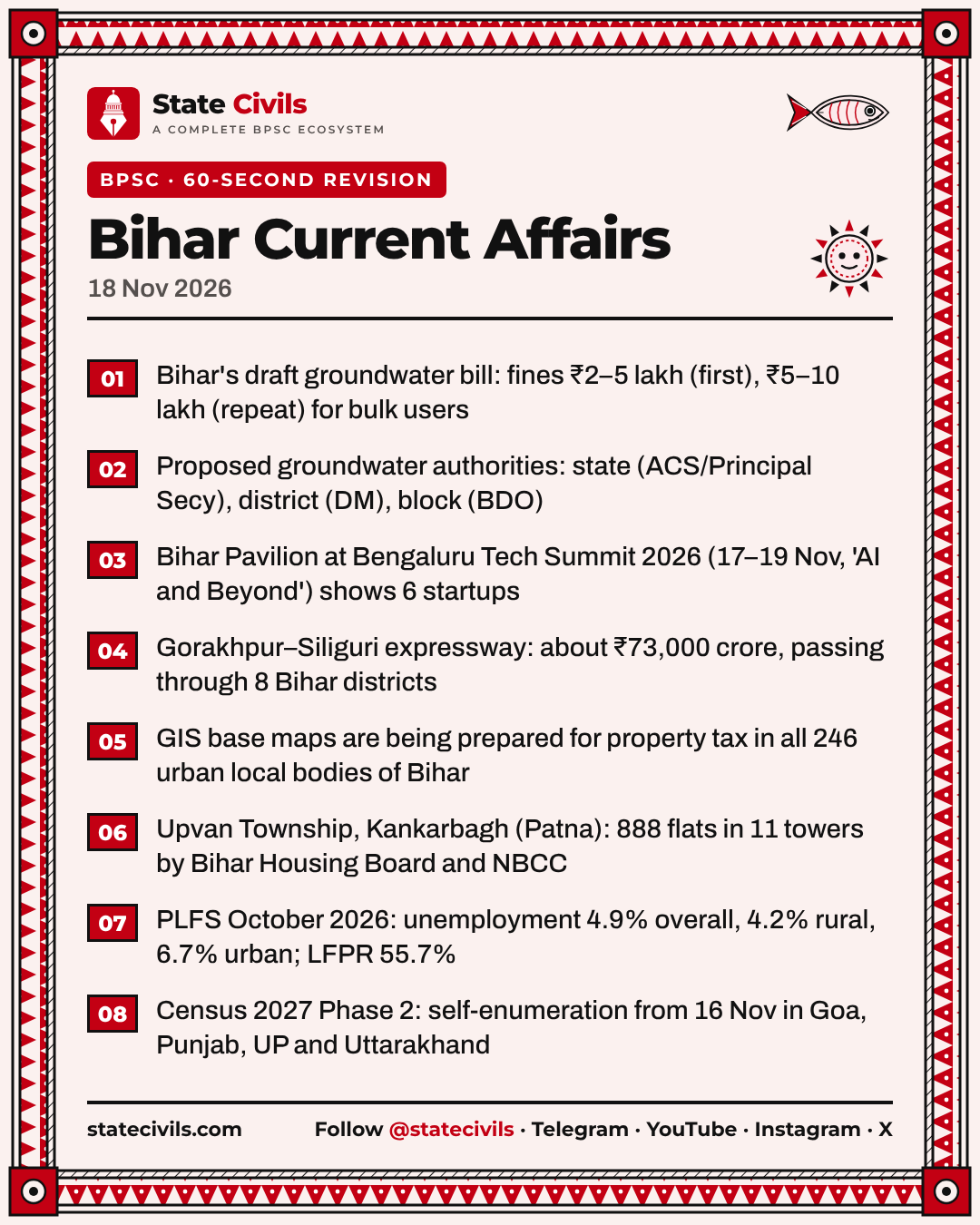
- Bihar’s draft groundwater bill: fines of ₹2–5 lakh (first) and ₹5–10 lakh (repeat) for bulk users
- Proposed groundwater authorities: state (ACS/Principal Secy), district (DM), block (BDO)
- Bihar Pavilion at Bengaluru Tech Summit 2026 (17–19 Nov, theme ‘AI and Beyond’) shows 6 startups
- Gorakhpur–Siliguri expressway: about ₹73,000 crore, passing through 8 Bihar districts
- GIS base maps are being prepared for property tax in all 246 urban local bodies of Bihar
- Upvan Township, Kankarbagh (Patna): 888 flats in 11 towers by Bihar State Housing Board and NBCC
- PLFS October 2026: unemployment 4.9% overall, 4.2% rural, 6.7% urban; LFPR 55.7%
- Census 2027 Phase 2: self-enumeration from 16 Nov in Goa, Punjab, UP and Uttarakhand
Share today’s revision card with your study group
One image, eight facts. Forward it to your BPSC group.
WhatsApp Telegram Facebook X Download card
Get this every morning: join @statecivils on Telegram. Also on YouTube, Instagram and X.
Today’s Mains question
Examine the need for regulating groundwater extraction in Bihar. How does the draft Bihar Groundwater (Management and Regulation) Bill-2026 seek to address it? Suggest measures for its effective implementation. (250 words)
Write your answer in 12 minutes, then open the model answer below and compare. Share this post with a study partner too.
Show the topper-style model answer
Decode the question
Directive: Examine + Explain + Suggest
- Why Bihar needs to regulate groundwater extraction
- How the draft Bill-2026 addresses the problem
- Measures for effective implementation
Keywords to use
Groundwater governanceState List subjectCommercial extractionThree-tier authorityMeteringNotified areasRainwater harvestingRechargeArsenic contaminationJal-Jeevan-Hariyali
Introduction
Groundwater is the main source of drinking water and irrigation in Bihar, yet commercial extraction by bottling plants and tanker suppliers has grown largely unchecked. To fill this gap, the Minor Water Resources Department has released the draft Bihar Groundwater (Management and Regulation) Bill-2026 for public comment.
Body
Why regulation is needed
- Rising urban demand in Patna and other towns pushes private borewells and tanker trade.
- Seasonal fall in water tables in south Bihar districts during summer.
- Arsenic and fluoride contamination along the Ganga belt makes over-pumping a health risk.
- Existing 2006 law lacks strong penalties and field-level enforcement.
How the draft Bill responds
- Mandatory registration of bottling plants, tanker suppliers, bulk users and drilling agencies.
- Graded fines of ₹2–5 lakh for a first offence and ₹5–10 lakh for repeat offences, plus seizure.
- Three-tier authorities at state, district (DM) and block (BDO) levels bring enforcement closer to users.
- Metering of extraction, bans on new borings in notified areas, and promotion of recharge.
Way forward
- Digital registration portal and GIS mapping of wells, as is being done for property in 246 ULBs.
- Protect small farmers and households through exemptions and awareness.
- Link with Jal-Jeevan-Hariyali recharge works and panchayat-level water budgets.
- Publish block-wise water-level data to guide notified areas.
Diagram (draw this in your answer)
Draw two rows of boxes with arrows; label the authorities State, DM, BDO beside row two.
Value addition
- Water is a State subject (Entry 17, State List), so Bihar can legislate on groundwater.
- Bihar already has a 2006 law on groundwater; the 2026 draft seeks to tighten it.
- Draft fines: ₹2–5 lakh (first violation) and ₹5–10 lakh (repeat) for commercial and bulk users.
- Proposed authorities: state level under the department ACS/Principal Secretary, district under the DM, block under the BDO.
Conclusion
A well-implemented groundwater law can turn an open-access resource into a governed commons without burdening small users. Paired with recharge and data transparency, it would advance SDG 6 on clean water and secure Bihar’s water future.
About 242 words without the diagram. Toppers usually score on three things: answering every part the directive asks for, adding Bihar-specific examples and data, and drawing one clean diagram.
Answer to today’s question
(b) Goa, Punjab, Uttar Pradesh and Uttarakhand. Self-enumeration for Phase 2 of Census 2027 opened there on 16 November 2026; other states, including Bihar, follow from 10 January 2027.