Can you answer this?
The report “State of the Cryosphere 2026: The Cost of Overshoot” was released ahead of COP31. Where will COP31 be held?
- Belém, Brazil
- Antalya, Turkey
- Baku, Azerbaijan
- Bonn, Germany
Answer at the end of the post. Send it to a friend and see who gets it right.
Here are today’s Bihar current affairs for BPSC Prelims and Mains, 4 November 2026: river silt for Bihar’s highways, a world ranking for Bihar Museum, Bharat Taxi’s launch dates and longer library hours, plus maize and cryosphere updates.
In this post: 6 updates
- Bihar
- 1. Nadi Sanjeevani: Bihar and MoRTH sign MoU to use river silt in national highway projects
- 2. Bihar Museum, Patna ranked 9th in the world and 1st in Asia in Worth a Journey’s 100 best museums
- 3. Bharat Taxi to start on 21 November in Patna, Gaya, Vaishali and Muzaffarpur
- 4. Governor Hasnain: Bihar university libraries may stay open till 11 PM
- Economy
- 5. 1st International Maize Conference in Hyderabad sets a 75 million tonne goal
- Environment / Science
- 6. State of the Cryosphere 2026: frozen regions warming faster than the global average
- Revise
- Quick revision
- Today’s Mains question
Bihar
1. Nadi Sanjeevani: Bihar and MoRTH sign MoU to use river silt in national highway projects
Bihar and the Union Ministry of Road Transport and Highways signed an MoU in New Delhi on 3 November under the Nadi Sanjeevani (नदी संजीवनी) initiative, in the presence of Union minister Nitin Gadkari and CM Samrat Choudhary. NHAI will desilt rivers and water bodies and use the suitable material in road building. About 243 lakh cubic metres of silt will be given free for 16 ongoing highway projects, and another 835 lakh cubic metres is proposed for 27 upcoming projects. The state’s new Water Source Restoration and Silt Management Policy 2026 frames the effort.
Why it matters for BPSC: Mains GS Paper II (Bihar geography, flood management, infrastructure) and Prelims. Heavy silt from Himalayan rivers such as the Kosi and Gandak raises river beds and worsens floods in north Bihar; turning that silt into road fill links disaster management with infrastructure. Revise it with the 28 Oct flood silt survey update.
Prelims fact: Total silt under the MoU: about 1,078 lakh cubic metres (243 lakh for 16 ongoing + 835 lakh for 27 upcoming NH projects).
Source: ETV Bharat
2. Bihar Museum, Patna ranked 9th in the world and 1st in Asia in Worth a Journey’s 100 best museums
Bihar Museum in Patna has been placed ninth in the world and first in Asia in the travel guide Worth a Journey’s list of the world’s 100 best museums, released in late October. Governor Syed Ata Hasnain congratulated Art and Culture Minister Pramod Kumar Chandravanshi and museum director Anjani Kumar on 3 November, calling it a remarkable achievement for Bihar. The museum showcases the region’s ancient history, art and heritage.
Why it matters for BPSC: Prelims (art and culture, places in Bihar) and Mains GS Paper I (Bihar’s culture and heritage). Heritage tourism is a growth lever for the state economy.
Prelims fact: Bihar Museum stands on Bailey Road (Jawaharlal Nehru Marg), Patna; it opened partially in August 2015 and fully in October 2017.
Source: ThePrint (PTI)
3. Bharat Taxi to start on 21 November in Patna, Gaya, Vaishali and Muzaffarpur
The cooperative cab service Bharat Taxi (भारत टैक्सी) will begin in four Bihar districts — Patna, Gaya, Vaishali and Muzaffarpur — from 21 November, after the customer app trial was completed. Fares are expected to be 10–15% lower than private aggregators, with no surge pricing in rain, festivals or peak hours. Drivers are members and shareholders and keep 80–100% of their earnings; about 2,005 drivers have joined so far. A “Bike Didi” (बाइक दीदी) option will support women’s self-employment.
Why it matters for BPSC: Mains GS Paper II (cooperatives, urban transport, gig-worker welfare) and Prelims. A driver-owned cooperative model is a useful example of the cooperative movement in the services sector.
Prelims fact: Bharat Taxi follows a cooperative “driver-owner” model; the Bihar launch is being steered by the state Transport Department.
Source: Lalluram
4. Governor Hasnain: Bihar university libraries may stay open till 11 PM
Speaking in Muzaffarpur on 3 November, Governor and Chancellor Syed Ata Hasnain said university libraries may soon remain open until 11 pm so that students, researchers and competitive-exam aspirants can study in the evenings; Lok Bhavan has started the process of appointing librarians. Higher Education Minister Sanjay Singh Tiger said new degree colleges are planned in every block. The Chief Minister’s PhD Fellowship Scheme supports 1,000 women students a year with up to Rs 10,000 a month, and the Bihar Ki Beti Innovation Challenge covers 2,100 women students a year with Rs 50,000 to Rs 2 lakh.
Why it matters for BPSC: Mains GS Paper II (education, women’s empowerment) and Prelims (schemes). The Governor acts as Chancellor of state universities — a recurring polity question.
Prelims fact: CM’s PhD Fellowship Scheme: 1,000 women students every year, up to Rs 10,000 per month.
Source: Patna Press
Economy
5. 1st International Maize Conference in Hyderabad sets a 75 million tonne goal
The 1st International Maize Conference is being held in Hyderabad from 2 to 4 November on the theme “Maize Revolution for Food, Feed, Fodder, Fuel and Sustainability”. DARE Secretary and ICAR Director General Dr M.L. Jat said India’s maize output of about 55 million tonnes should rise to 75 million tonnes over the next decade, with a further 1.5-fold rise in productivity. ICAR noted that 329 maize hybrids were developed in the last five years, and that maize is a key ethanol feedstock.
Why it matters for BPSC: Prelims (agriculture, ICAR) and Mains GS Paper II (Bihar economy). Maize matters for the Kosi–Purnia belt and links to ethanol blending, poultry feed and crop diversification.
Prelims fact: Current Indian maize production: about 55 million tonnes; target 75 million tonnes in a decade.
Source: DD News
Environment / Science
6. State of the Cryosphere 2026: frozen regions warming faster than the global average
Two reports released on 2 November by the International Cryosphere Climate Initiative (ICCI) and UNEP — including “State of the Cryosphere 2026: The Cost of Overshoot” — warn that the Arctic warmed up to four times faster than the global average over the past decade. Greenland and Antarctic ice sheets are losing ice about six times faster than in the 1990s, and permafrost over about 14 million sq km stores at least 1,700 billion tonnes of carbon. In the Hindu Kush Himalaya, 1.5°C of global warming could mean 1.8–2.2°C regionally. The reports came about a week before COP31 in Antalya, Turkey.
Why it matters for BPSC: Prelims (environment, international reports) and Mains GS Paper II (climate change). Himalayan glacier melt affects Ganga-system rivers that feed Bihar. See more on our environment current affairs page.
Prelims fact: A separate UN-led study counts 62 glacial lake outburst floods (GLOFs) and 6,119 deaths in India between 1835 and 2025.
Source: Down To Earth
Quick revision
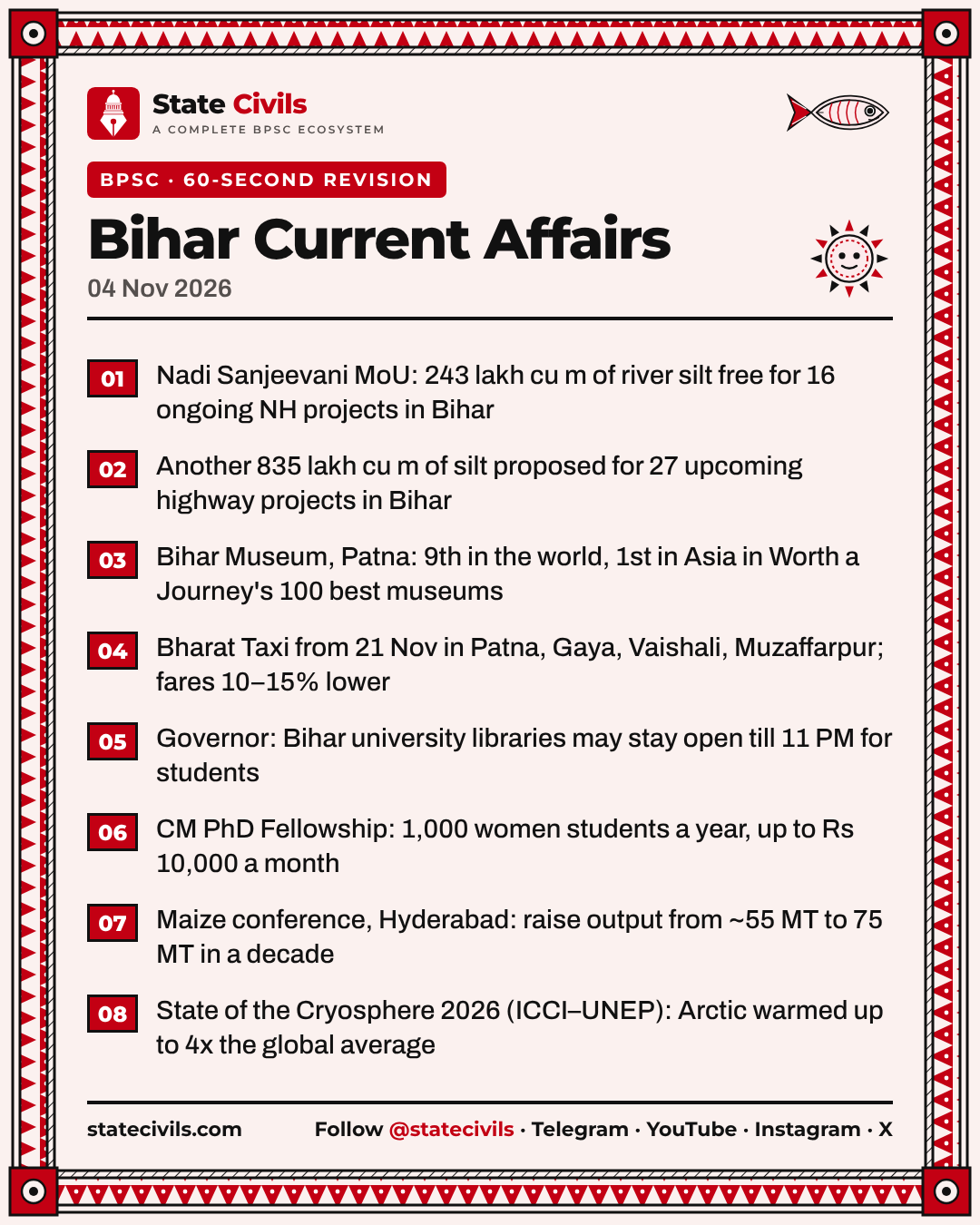
- Nadi Sanjeevani MoU (3 Nov): 243 lakh cu m of silt free for 16 ongoing NH projects in Bihar.
- Another 835 lakh cu m of silt proposed for 27 upcoming highway projects; NHAI to desilt rivers.
- Bihar Museum, Patna: 9th in the world and 1st in Asia in Worth a Journey’s 100 best museums.
- Bharat Taxi starts 21 Nov in Patna, Gaya, Vaishali and Muzaffarpur; fares 10–15% lower.
- Governor Syed Ata Hasnain: university libraries may stay open till 11 PM.
- CM’s PhD Fellowship: 1,000 women students a year, up to Rs 10,000 a month.
- 1st International Maize Conference, Hyderabad (2–4 Nov): output target 75 MT from about 55 MT.
- State of the Cryosphere 2026 (ICCI–UNEP): Arctic warmed up to 4x the global average; COP31 in Antalya.
Share today’s revision card with your study group
One image, eight facts. Forward it to your BPSC group.
WhatsApp Telegram Facebook X Download card
Get this every morning: join @statecivils on Telegram. Also on YouTube, Instagram and X.
Today’s Mains question
Examine how scientific silt management can turn the flood problem of north Bihar into an opportunity for infrastructure development. Suggest measures, with reference to Bihar. (250 words)
Write your answer in 12 minutes, then open the model answer below and compare. Share this post with a study partner too.
Show the topper-style model answer
Decode the question
Directive: Examine + Suggest
- Explain how silt drives floods in north Bihar
- Examine how desilted material can serve infrastructure (opportunities and challenges)
- Suggest measures for a sustainable silt policy
Keywords to use
SiltationAggradationKosi avulsionNadi SanjeevaniNHAICircular economySediment budgetIndo-Nepal river cooperationEnvironmental flowDisaster risk reduction
Introduction
North Bihar’s rivers descend from the young Himalaya carrying huge sediment loads, raising beds and spilling over embankments. On 3 November 2026 Bihar and MoRTH signed the Nadi Sanjeevani MoU, under which about 1,078 lakh cubic metres of river silt will feed national highway projects.
Body
Silt as a cause of floods
- Seven major rivers enter Bihar from Nepal; Kosi and Gandak bring heavy sediment from fragile Himalayan slopes.
- Silt deposits of 10 m or more raise river beds, reduce channel capacity and make embankments less effective.
- Kosi’s shifting course and waterlogging hit Saharsa, Supaul and Madhepura, damaging farms and homes.
- Silt-choked channels also cut irrigation and navigation potential.
Silt as an infrastructure resource
- Opportunity: 243 lakh cubic metres free for 16 ongoing NH projects and 835 lakh for 27 upcoming ones lowers fill costs and saves topsoil.
- Opportunity: desilting restores channel capacity, aiding flood control and inland waterways.
- Challenge: silt quality varies; material must meet MoRTH and IRC specifications.
- Challenge: unscientific dredging can disturb aquatic ecology, banks and dolphin habitat in the Ganga.
- Challenge: sediment comes from Nepal, so in-state dredging alone treats symptoms.
Way forward
- Prepare river-wise sediment budgets and dredge only scientifically identified reaches.
- Apply the Bihar silt management policy 2026 through a single-window permit and testing system.
- Pair desilting with catchment treatment and afforestation in cooperation with Nepal.
- Use silt also for brick, embankment and land-reclamation uses, with community monitoring.
Diagram (draw this in your answer)
Draw two horizontal rows of boxes; link the third box of each row with a dotted arrow.
Value addition
- Nadi Sanjeevani MoU, 3 November 2026: 16 ongoing + 27 upcoming NH projects in Bihar.
- Bihar Water Source Restoration and Silt Management Policy 2026 frames the state’s approach.
- NHAI has 39 projects of about 1,561 km under construction in Bihar (ETV Bharat, 3 Nov 2026).
- Sendai Framework for Disaster Risk Reduction 2015–2030 stresses reducing hazard exposure, not just relief.
Conclusion
Silt management can convert a recurring hazard into a resource if dredging is scientific, tested and ecologically careful. Combined with Indo-Nepal catchment cooperation, it can advance a flood-resilient Bihar and SDG 9 and SDG 13.
About 268 words without the diagram. Toppers usually score on three things: answering every part the directive asks for, adding Bihar-specific examples and data, and drawing one clean diagram.
Answer to today’s question
(b) Antalya, Turkey. The ICCI–UNEP cryosphere reports were released on 2 November 2026, about a week before COP31 begins in Antalya.