Can you answer this?
From 1 November 2026, the CISF moved to functional sector-based commands. Where is the headquarters of its new Coal sector?
- Dhanbad
- Ranchi
- Asansol
- Bilaspur
Answer at the end of the post. Send it to a friend and see who gets it right.
Here are the Bihar current affairs for 3 November 2026 for BPSC Prelims and Mains: four Bihar updates on highways, power subsidy, liver screening and paperless land registry, plus two national stories.
In this post: 6 updates
- Bihar
- 1. Patna–Purnia Expressway and three more highway projects: Bihar seeks quick Centre nod for ₹49,751 crore
- 2. Bihar CM asks income-tax payers to give up 125 units of free electricity
- 3. ‘Healthy Liver, Healthy Bihar’ campaign to screen 26 lakh people for fatty liver
- 4. Nalanda’s paperless land registry: 110 deeds a day with QR-code copies
- National
- 5. CISF replaces territorial commands with functional sectors for power, coal, ports and metro
- Environment / Science
- 6. Bharat Renewable Energy Summit 2026: PM says over half of India’s power capacity is now non-fossil
- Revise
- Quick revision
- Today’s Mains question
Bihar
1. Patna–Purnia Expressway and three more highway projects: Bihar seeks quick Centre nod for ₹49,751 crore
Chief Minister Samrat Choudhary met Union Road Transport Minister Nitin Gadkari in Delhi on 2 November and asked for early approval of four national highway and expressway projects worth ₹49,751 crore, covering about 330 km. The projects have already been cleared by the Public Private Partnership Appraisal Committee (PPPAC) and now wait for the Cabinet Committee on Economic Affairs (CCEA). The biggest is the four-lane greenfield Patna–Purnia expressway (₹31,987.11 crore); the others are a six-lane greenfield stretch of the Varanasi–Ranchi–Kolkata highway (₹7,331.40 crore), a six-lane elevated road on the Saristabad/Aniesabad–Didarganj sections in Patna (₹8,455.86 crore) and a two-lane Gandak bridge on NH-727AA linking Manuapul (Bettiah) with Tiwaripatti in Uttar Pradesh (₹1,976.77 crore). Bihar also asked for notification of the Raxaul–Haldia expressway and the Bihar stretch of the Gorakhpur–Siliguri expressway.
Why it matters for BPSC: Mains GS Paper II (Bihar economy, infrastructure) and Prelims (rivers, places, PPP bodies). The Patna–Purnia corridor links the capital with the Kosi–Seemanchal region; read it with yesterday’s update on two new greenfield airports for Bihar’s connectivity push.
Prelims fact: The Patna–Purnia expressway is a four-lane greenfield project costing ₹31,987.11 crore; it awaits CCEA approval.
Source: IBC24 (PTI-Bhasha)
2. Bihar CM asks income-tax payers to give up 125 units of free electricity
Speaking at the Pataliputra National Youth Parliament 2.0 in Patna on 1 November, Chief Minister Samrat Choudhary appealed to income-tax payers and well-off families to voluntarily give up the free electricity they receive. Bihar gives 125 units of free power a month to all domestic consumers, a scheme started before the November 2025 Assembly elections. The state spends about ₹23,000 crore a year on power subsidy, which works out to roughly ₹8,000–10,000 per household a year.
Why it matters for BPSC: Mains GS Paper II (Bihar economy, state finances) and Essay (freebies versus welfare). The appeal mirrors the national ‘Give It Up’ idea for LPG and raises the question of targeting subsidies. Read it with our 30 October update on Bihar’s power upgrade.
Prelims fact: Bihar provides 125 units of free electricity a month; the yearly subsidy bill is about ₹23,000 crore.
Source: ETV Bharat
3. ‘Healthy Liver, Healthy Bihar’ campaign to screen 26 lakh people for fatty liver
Bihar’s Health Department will screen about 26 lakh people aged above 30 for fatty liver disease over 18 months in all 38 districts. The Institute of Liver and Biliary Sciences (ILBS), New Delhi, is the technical partner. Around 25,000 health workers, including 150 master trainers, will be trained, and ASHAs, ANMs, Community Health Officers and Jeevika didis will do the field work. The drive is linked to the non-communicable disease (NCD) programme and Ayushman Arogya Mandirs, and was reviewed at the Health Department headquarters on 2 November.
Why it matters for BPSC: Mains GS Paper I (current events, social sector) and GS Paper II (health governance). Non-alcoholic fatty liver disease is a rising lifestyle disease; the drive shows how NCD screening is moving to primary health centres.
Prelims fact: The campaign covers all 38 districts of Bihar with technical support from ILBS, New Delhi.
Source: Patna Press
4. Nalanda’s paperless land registry: 110 deeds a day with QR-code copies
Paperless land registration is picking up in Nalanda district. The registry offices at Biharsharif, Hilsa and Rajgir together register about 110 documents digitally every day. After registration the buyer gets the original deed and a secure PDF copy by SMS and WhatsApp, and a QR code on the document lets anyone download or print it later.
Why it matters for BPSC: Mains GS Paper II (e-governance, land reforms in Bihar). Digital registration cuts middlemen and fake deeds and supports land-record digitisation; useful as a Bihar example in answers on e-governance.
Prelims fact: Biharsharif, Hilsa and Rajgir are the three registry offices of Nalanda district running paperless registration.
Source: Amar Ujala
National
5. CISF replaces territorial commands with functional sectors for power, coal, ports and metro
From 1 November 2026, with Ministry of Home Affairs approval, the Central Industrial Security Force reorganised its field commands by function instead of geography. The new sectors include Power-I (New Delhi), Power-II (Kolkata), Coal (Ranchi), Steel (Bhilai), Petroleum and Natural Gas (Guwahati), West Coast Ports (Mumbai), East Coast Ports (Chennai) and a sector for government buildings, museums, monuments and metro systems (New Delhi). Earlier, one territorial headquarters could oversee more than 50 very different units. The aviation sector has worked this way since 2001.
Why it matters for BPSC: Prelims (security forces, their ministries) and Mains GS Paper II (internal security of critical infrastructure). Note the Coal sector HQ in Ranchi, next door to Bihar.
Prelims fact: The CISF’s new Coal sector is headquartered in Ranchi; the change came into force on 1 November 2026.
Source: India TV
Environment / Science
6. Bharat Renewable Energy Summit 2026: PM says over half of India’s power capacity is now non-fossil
Prime Minister Narendra Modi opened the Bharat Renewable Energy Summit and Expo (BRESE) 2026 at Bharat Mandapam, New Delhi, on 2 November; it runs till 5 November with the 9th International Solar Alliance (ISA) Assembly and the 4th International Conference on Green Hydrogen. He said more than 50% of India’s installed power capacity is now non-fossil, about five years ahead of the 2030 goal, and India is on track for 500 GW of non-fossil capacity. More than 65 lakh households have joined the PM Surya Ghar rooftop solar scheme. The green hydrogen target is 5 million tonnes a year by 2030.
Why it matters for BPSC: Prelims (ISA, Panchamrit targets) and Mains GS Paper II (energy, science and technology). For Bihar, rooftop solar under PM Surya Ghar can ease the state’s own power-subsidy burden.
Prelims fact: India now has over 50% non-fossil installed power capacity; the national green hydrogen target is 5 MMT a year by 2030.
Source: Business Today
Quick revision
- Bihar has sought CCEA approval for four highway projects worth ₹49,751 crore (about 330 km).
- Patna–Purnia expressway: four-lane, greenfield, ₹31,987.11 crore.
- Gandak bridge on NH-727AA will link Manuapul (Bettiah) with Tiwaripatti (UP).
- Bihar gives 125 units of free power a month; subsidy about ₹23,000 crore a year.
- Healthy Liver, Healthy Bihar: about 26 lakh people over 30, 18 months, all 38 districts, ILBS support.
- Nalanda’s Biharsharif, Hilsa and Rajgir offices: about 110 paperless registries a day.
- CISF functional sectors from 1 Nov 2026; Coal sector HQ Ranchi, Steel sector HQ Bhilai.
- BRESE 2026 (2–5 Nov) runs alongside the 9th ISA Assembly; over 50% of capacity now non-fossil.
Share today’s revision card with your study group
One image, eight facts. Forward it to your BPSC group.
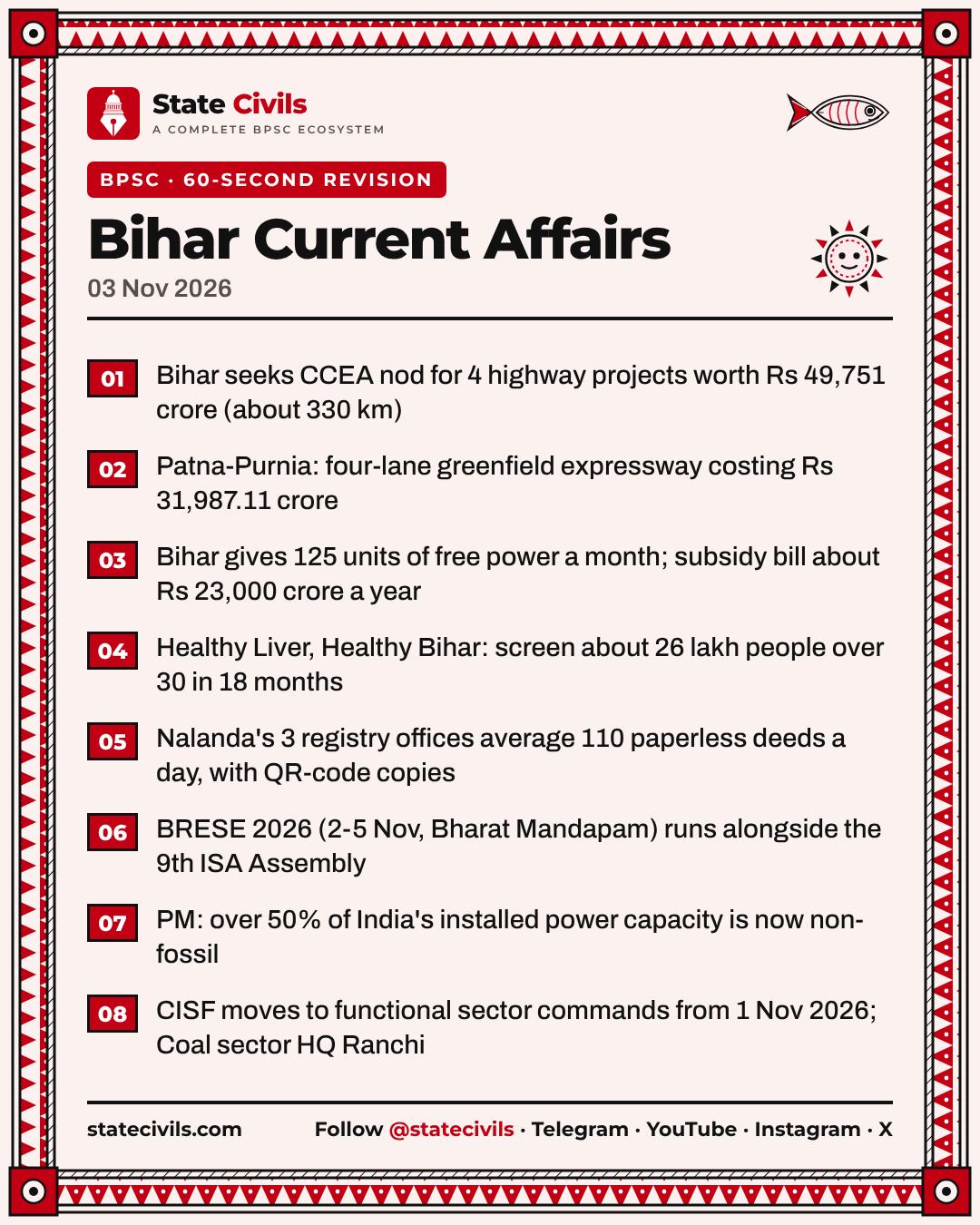
WhatsApp Telegram Facebook X Download card
Get this every morning: join @statecivils on Telegram. Also on YouTube, Instagram and X.
Today’s Mains question
Universal free electricity and large highway projects compete for Bihar’s limited fiscal space. Examine the fiscal and social implications of universal power subsidies in Bihar and suggest measures to balance welfare with capital investment. (250 words)
Write your answer in 12 minutes, then open the model answer below and compare. Share this post with a study partner too.
Show the topper-style model answer
Decode the question
Directive: Examine + Suggest
- Fiscal implications of universal power subsidy in Bihar
- Social implications (benefits and equity concerns)
- Measures to balance welfare with capital investment
Keywords to use
Fiscal spaceMerit vs non-merit subsidyTargetingCapital expenditureDISCOM viabilityRooftop solarVoluntary give-upInclusion errorPPPEnergy justice
Introduction
Bihar gives 125 units of free electricity a month to every household and spends about ₹23,000 crore a year on power subsidy. At the same time it is seeking central approval for highway projects worth ₹49,751 crore. How the state shares its money between subsidy and capital spending will shape its growth.
Body
Fiscal implications
- A large, recurring subsidy bill crowds out capital spending on roads, power grids and irrigation.
- Universal coverage pays the same benefit to rich and poor households, raising inclusion errors.
- Delayed subsidy payments can weaken DISCOM finances and the quality of supply.
- Bihar’s own CM appealed to income-tax payers to give up the benefit, which shows the strain.
Social implications
- Relief for poor and rural households, more use of lighting, fans and study hours.
- Helps small home-based work such as tailoring and food processing in Bihar villages.
- Risk of wasteful use and weak conservation incentives when power is free.
- Spending on subsidy may come at the cost of schools, health and jobs that also help the poor.
Way forward
- Target the subsidy: voluntary give-up first, then exclude income-tax payers.
- Push PM Surya Ghar rooftop solar so households cut bills without state subsidy.
- Protect capital spending through PPP and central schemes, as with the Patna–Purnia expressway.
- Pay DISCOMs on time through direct benefit transfer and smart meters.
Diagram (draw this in your answer)
Draw two parallel arrows and circle the ‘Savings for capex’ box.
Value addition
- PM Surya Ghar: over 65 lakh households have joined the rooftop solar scheme (PM, 2 Nov 2026).
- India’s installed power capacity is now over 50% non-fossil, ahead of the 2030 goal.
- Bihar’s four highway projects worth ₹49,751 crore have PPPAC clearance and await CCEA approval.
- Bihar’s power subsidy averages about ₹8,000–10,000 per household a year.
Conclusion
Welfare and growth need not be rivals if subsidies reach those who need them most. A targeted, solar-backed power policy can free money for the roads, grids and jobs that a Viksit Bihar needs.
About 253 words without the diagram. Toppers usually score on three things: answering every part the directive asks for, adding Bihar-specific examples and data, and drawing one clean diagram.
Answer to today’s question
(b) Ranchi. From 1 November 2026 the CISF’s new Coal sector is headquartered in Ranchi, while the Steel sector sits in Bhilai and the Power-II sector in Kolkata.