Can you answer this?
Cyclone Arnab, which is set to cross the Andhra Pradesh coast this week, gets its name from the list submitted by which member of the WMO/ESCAP Panel on Tropical Cyclones?
- India
- Bangladesh
- Myanmar
- Thailand
Answer at the end of the post. Send it to a friend and see who gets it right.
Here are today’s Bihar current affairs for BPSC Prelims and Mains, 28 Oct 2026: four Bihar updates and three national and international stories, each with its exam angle.
In this post: 7 updates
- Bihar
- 1. Bihar orders a survey of sand and silt on flood-hit farmland and fish ponds in 22 districts
- 2. Cyclone Arnab: IMD Patna issues an orange alert for Bihar on 29 October
- 3. BPSC TRE-4 draws about 9.5 lakh applications for 33,320 school teacher posts
- 4. Bihar Gramin Bank: two wage disputes settled, about 10,900 employees to gain about ₹77.69 crore
- National
- 5. PM opens ESTIC 2026: ₹24,000 crore committed for market-ready R&D in a year
- Economy
- 6. India–China trade rises about 29% to $91.76 billion in April–September
- International
- 7. India and Liechtenstein discuss a Double Taxation Avoidance Agreement
- Revise
- Quick revision
- Today’s Mains question
Bihar
1. Bihar orders a survey of sand and silt on flood-hit farmland and fish ponds in 22 districts
On the Chief Minister’s direction, the Disaster Management Department has asked district magistrates of 22 districts, including Patna, Bhagalpur, Purnia, Supaul and Saharsa, to inspect farmland and fisheries where floods have left sand and silt behind. After on-site checks, the state will seek funds to clear the deposits under prescribed relief norms. Officials say this year’s floods in the Ganga, Son, Gandak and Kosi basins affected about 50 lakh people.
Why it matters for BPSC: Prelims and Mains GS Paper II (Bihar geography and economy, disaster management). Sand casting is a long-term loss: it can keep land out of cultivation for seasons. Link it to the Disaster Management Act, 2005, the SDRF/NDRF relief norms, and north Bihar’s Nepal-fed rivers.
Prelims fact: Relief for this damage will be sought under the norms of the State Disaster Response Fund (SDRF) and National Disaster Response Fund (NDRF).
Source: ThePrint (PTI)
2. Cyclone Arnab: IMD Patna issues an orange alert for Bihar on 29 October
Cyclone Arnab, which we first tracked as a Bay of Bengal system in our 25 Oct current affairs, has grown into a very severe cyclonic storm and is expected to cross the Andhra Pradesh coast near Yanam. As it moves north and weakens over land, the IMD’s Patna centre expects rain across Bihar from 28 October to 1 November, with a statewide orange alert on 29 October, the heaviest rain in north Bihar and winds of 40–50 km/h. Farmers have been told to protect standing crops.
Why it matters for BPSC: Prelims (cyclone naming, IMD alert colours) and Mains GS Paper I/II (geography, disaster management). Shows how a Bay of Bengal cyclone affects a landlocked state through remnant rain, which matters for the paddy harvest now under way.
Prelims fact: Cyclone names for the north Indian Ocean come from a list adopted by the 13-member WMO/ESCAP Panel on Tropical Cyclones; ‘Arnab’ was proposed by Bangladesh.
Source: ETV Bharat Bihar
3. BPSC TRE-4 draws about 9.5 lakh applications for 33,320 school teacher posts
The Bihar Public Service Commission had received about 9.5 lakh applications for the fourth Teacher Recruitment Exam (TRE-4) by Monday night, more than 28 candidates for every post. The 33,320 posts include 932 added this month for Classes 9 to 12. The last date to apply is 3 November.
Why it matters for BPSC: Prelims and Mains GS Paper II (Bihar governance, education). Useful for answers on the pupil–teacher ratio, quality of school education and recruitment through the BPSC, a constitutional body under Article 315.
Prelims fact: BPSC is a State Public Service Commission set up under Article 315 of the Constitution.
Source: Amar Ujala
4. Bihar Gramin Bank: two wage disputes settled, about 10,900 employees to gain about ₹77.69 crore
Two industrial disputes between Bihar Gramin Bank and its employees’ organisations have been settled through conciliation by the Assistant Labour Commissioner (Central), Patna, under the Union Labour Ministry. About 10,900 employees will receive financial benefits of about ₹77.69 crore; the officers’ union settlement alone covers about 8,400 staff.
Why it matters for BPSC: Prelims (RRBs, banking structure) and Mains GS Paper II (Bihar economy, rural credit). Bihar Gramin Bank is the state’s single regional rural bank after the ‘One State, One RRB’ merger, so it carries much of Bihar’s farm and self-help-group credit.
Prelims fact: Bihar Gramin Bank began work on 1 May 2025 by merging Dakshin Bihar Gramin Bank and Uttar Bihar Gramin Bank; its sponsor bank is Punjab National Bank.
Source: UNI
National
5. PM opens ESTIC 2026: ₹24,000 crore committed for market-ready R&D in a year
Following up on yesterday’s preview of ESTIC 2026, the Prime Minister inaugurated the Emerging Science, Technology and Innovation Conclave at Bharat Mandapam, New Delhi. He said the government committed ₹12,000 crore over the past year to take lab technologies to market and private investors matched it, for ₹24,000 crore in all. Patent filings rose from under 50,000 a year a decade ago to nearly 1.5 lakh last year. He asked scientists to set three-year targets for a technology, prototype or product.
Why it matters for BPSC: Prelims and Mains GS Paper II (science and technology, Indian economy). Quote the R&D numbers and the Anusandhan National Research Foundation in answers on innovation, self-reliance and startups.
Prelims fact: India’s annual patent filings rose to nearly 1.5 lakh last year, from under 50,000 a decade ago.
Source: PM India
Economy
6. India–China trade rises about 29% to $91.76 billion in April–September
Speaking in The Hague during a visit to the Netherlands, Commerce and Industry Minister Piyush Goyal said India is open to Chinese suppliers for its import needs but will use legal remedies against unfair pricing. India–China trade rose about 29% to $91.76 billion in April–September of 2026-27, making China India’s largest trading partner in the first half of the year. India hopes to become a major exporter to China and ASEAN.
Why it matters for BPSC: Prelims and Mains GS Paper II (Indian economy, external sector). Useful for answers on trade deficits, anti-dumping duties and supply-chain dependence, including China’s export curbs on machinery such as tunnel boring machines.
Prelims fact: China was India’s largest trading partner in the first half (April–September) of 2026-27.
Source: All India Radio News
International
7. India and Liechtenstein discuss a Double Taxation Avoidance Agreement
During talks in New Delhi briefed by MEA Secretary (West) Sibi George, India and Liechtenstein discussed a proposed Double Taxation Avoidance Agreement (DTAA), which Liechtenstein sees as giving investors predictability and legal certainty. The sides also focused on trade, technology and talent, and on skill development and vocational education. Cumulative FDI from Liechtenstein into India stands at $110 million.
Why it matters for BPSC: Prelims and Mains GS Paper II (international relations, economy). A DTAA lets a taxpayer avoid paying tax on the same income in two countries; link it to FDI flows and India’s ties with European partners.
Prelims fact: Cumulative FDI inflows from Liechtenstein into India total $110 million.
Source: All India Radio News
Quick revision
- Bihar’s Disaster Management Department asked DMs of 22 districts to assess sand and silt deposits on flood-hit farmland and fisheries.
- This year’s floods affected about 50 lakh people in Bihar; relief is sought under SDRF/NDRF norms.
- Cyclone Arnab (name proposed by Bangladesh) is a very severe cyclonic storm; IMD Patna has an orange alert for all of Bihar on 29 October.
- BPSC TRE-4: about 9.5 lakh applications for 33,320 teacher posts; last date 3 November.
- Bihar Gramin Bank settlements: about 10,900 employees, benefits of about ₹77.69 crore; the bank was formed on 1 May 2025, sponsor bank PNB.
- ESTIC 2026 (Bharat Mandapam): ₹12,000 crore government plus ₹12,000 crore private = ₹24,000 crore R&D commitments.
- India–China trade rose about 29% to $91.76 billion in April–September 2026-27.
- India and Liechtenstein discussed a DTAA; cumulative FDI from Liechtenstein is $110 million.
Share today’s revision card with your study group
One image, eight facts. Forward it to your BPSC group.
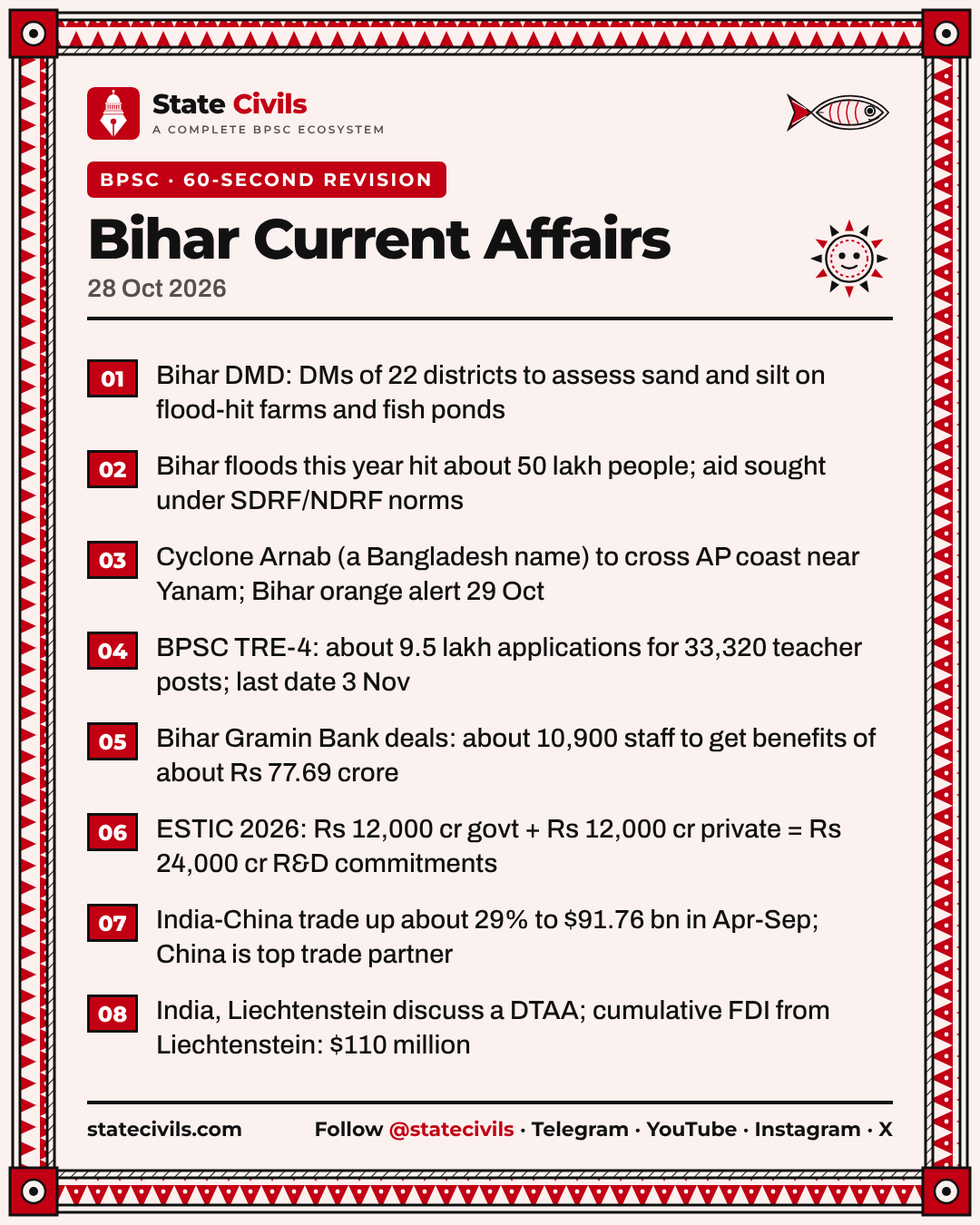
WhatsApp Telegram Facebook X Download card
Get this every morning: join @statecivils on Telegram. Also on YouTube, Instagram and X.
Today’s Mains question
Floods in Bihar cause losses that last long after the water recedes. Examine the challenges of post-flood recovery for farmers and fish farmers in Bihar, and suggest measures to make them more flood-resilient. (250 words)
Write your answer in 12 minutes, then open the model answer below and compare. Share this post with a study partner too.
Show the topper-style model answer
Decode the question
Directive: Examine + Suggest
- Why post-flood losses persist in Bihar (nature of the damage)
- Challenges in recovery for farmers and fish farmers (economic, institutional, social)
- Concrete measures to build flood resilience
Keywords to use
Sand castingSDRF/NDRF normsDisaster Management Act, 2005Kosi–Gandak basinLivelihood resilienceCrop insuranceBuild back betterEarly warningFlood-tolerant paddyGram panchayat planning
Introduction
About 73% of Bihar’s area is flood-prone, and this year’s floods affected about 50 lakh people. The state’s order to survey sand and silt deposits in 22 districts shows that the real cost of a flood is the farm and fishery loss that continues long after the water recedes.
Body
Why losses persist
- Sand casting buries fertile topsoil, so fields can stay out of cultivation for one or more seasons.
- Silt chokes fish ponds and drains, cutting fish output and incomes.
- North Bihar’s Nepal-fed rivers (Kosi, Gandak, Bagmati) carry heavy sediment loads.
Challenges in recovery
- Relief norms pay a fixed amount per hectare, which rarely covers the full cost of desilting.
- Tenant and sharecropper farmers often lack land records, so they miss compensation.
- Damage assessment by district officials is slow, and late rain such as Cyclone Arnab’s remnants on 29 October can hit crops again.
- Small fish farmers in Purnia, Supaul and Saharsa have little access to credit for restocking.
- Repeated floods push households into debt and distress migration.
Way forward
- Time-bound, satellite-assisted damage surveys with payment straight into bank accounts.
- Use Bihar Gramin Bank and JEEViKA groups for quick restructured loans and restocking credit.
- Promote flood-tolerant paddy, raised nurseries and community fish ponds with embankments.
- Village-level early warning and gram panchayat disaster plans under the DDMA.
- Basin-level cooperation with Nepal on sediment and flood forecasting.
Diagram (draw this in your answer)
Draw two rows of four boxes; write the flood-prone rivers (Kosi, Gandak) beside the first box.
Value addition
- Disaster Management Act, 2005: NDMA is chaired by the Prime Minister, SDMA by the Chief Minister and DDMA by the District Magistrate.
- Bihar has about 16.5% of India’s flood-affected area and 22.1% of its flood-affected population.
- About 73.06% of Bihar’s geographical area is flood-prone; north Bihar is the worst hit.
- Relief for sand-casting damage is sought under SDRF/NDRF norms, as in today’s 22-district survey order.
Conclusion
Bihar must move from relief after each flood to resilience before the next one. Faster surveys, credit through local institutions and basin-level planning can protect rural livelihoods and advance SDG 1 and SDG 13.
About 259 words without the diagram. Toppers usually score on three things: answering every part the directive asks for, adding Bihar-specific examples and data, and drawing one clean diagram.
Answer to today’s question
(b) Bangladesh. ‘Arnab’ is one of the 13 names Bangladesh submitted to the list adopted by the WMO/ESCAP Panel on Tropical Cyclones, whose names are used in turn for storms in the north Indian Ocean.