Can you answer this?
The 2026 Nobel Prize in Physiology or Medicine was awarded for discoveries concerning:
- CRISPR-based gene editing of human cells
- Light-gated ion channels and optogenetics
- MicroRNA and gene regulation
- Nucleoside modifications enabling mRNA vaccines
Answer at the end of the post. Send it to a friend and see who gets it right.
Here is your Bihar current affairs for BPSC on 7 October 2026: eight exam-ready updates, from the CM’s Rohtas projects and new PhD rules in state universities to the first indigenous Fleet Support Ship and the 2026 Nobel Prizes.
In this post: 8 updates
- Bihar
- 1. Sasaram bypass opened; CM Samrat Choudhary unveils ₹412.9 crore of projects in Rohtas
- 2. Raj Bhavan orders PhD monitoring cells in 14 Bihar state universities
- 3. NHRC holds open hearing and camp sitting in Patna on 7–8 October
- 4. 871 Digital Mitra centres for Kushal Yuva Programme operators under Saat Nischay-3
- 5. Patna’s overhead power lines to go underground in a ₹515 crore, two-phase project
- National
- 6. Rajnath Singh launches FSS-1, India’s first indigenous Fleet Support Ship, at HSL Visakhapatnam
- Economy
- 7. HSBC India Services PMI rises to 55.2 in September 2026, a three-month high
- Environment / Science
- 8. Nobel Prizes 2026: optogenetics wins Medicine, IceCube’s Francis Halzen wins Physics
- Revise
- Quick revision
- Today’s Mains question
Bihar
1. Sasaram bypass opened; CM Samrat Choudhary unveils ₹412.9 crore of projects in Rohtas
On his first visit to Rohtas as Chief Minister on 6 October, Samrat Choudhary opened the two-lane Sasaram bypass, which runs 9.2 km from Beda bus stand to Mokar and cost ₹122.39 crore. At a Sahyog camp in the district he inaugurated 125 completed projects and laid foundation stones for 52 more, together worth ₹412.9 crore. He also spoke of plans for an airport and a tourism hub in Rohtas, and set a goal of 1 crore jobs in five years so that people do not have to migrate out of poverty by 2030. A district water-conservation drive, Rohtas Jal Sanjeevani (रोहतास जल संजीवनी), was launched to clean and maintain ponds and reservoirs and free them of encroachment.
Why it matters for BPSC: Prelims can ask about bypasses, road length and district geography. For Mains GS Paper II (Bihar economy), it links road connectivity, tourism (Rohtasgarh, Sher Shah’s tomb at Sasaram) and distress migration, a recurring Bihar theme. Water-body revival fits environment and drought-proofing of the Kaimur plateau districts.
Prelims fact: The Sasaram bypass is 9.2 km long and cost ₹122.39 crore; Sasaram is the headquarters of Rohtas district.
Source: Amar Ujala
2. Raj Bhavan orders PhD monitoring cells in 14 Bihar state universities
The Governor’s Secretariat, acting on the direction of Governor and Chancellor Syed Ata Hasnain, has told 14 state universities to set up cells that will watch over PhD admissions and the quality of research. The step follows complaints of irregularities in admissions. The cells will enforce the new PhD Regulation-2026 (पीएचडी रेगुलेशन-2026), under which a NET-qualified candidate can get PhD admission only in the year of passing the exam. Universities covered include Patna, Magadh, Patliputra, LNMU, BRA Bihar, TMBU and Purnea.
Why it matters for BPSC: Prelims and Mains GS Paper II (polity): the Governor acts as Chancellor of state universities under state university Acts, not under the Constitution. It is a good example for questions on quality of higher education in Bihar. Compare with the move to take revenue courts fully online, covered yesterday, as a governance-reform example.
Prelims fact: Patna University, set up on 1 October 1917, is the first university of Bihar.
Source: Amar Ujala
3. NHRC holds open hearing and camp sitting in Patna on 7–8 October
The full National Human Rights Commission, led by Chairperson Justice V. Ramasubramanian with members Justice (Dr.) Bidyut Ranjan Sarangi and Vijaya Bharathi Sayani, sits at Gyan Bhawan, Patna. On 7 October it hears cases of alleged rights violations from Bihar with complainants and state officials present. On 8 October the Chairperson takes up bonded-labour cases while a Division Bench hears other matters, followed by meetings with civil society groups and senior state officers.
Why it matters for BPSC: Mains GS Paper II (polity): statutory bodies, human rights protection and bonded labour (Article 23). Prelims often asks about the NHRC’s composition and the Protection of Human Rights Act, 1993.
Prelims fact: NHRC was set up on 12 October 1993 under the Protection of Human Rights Act, 1993; its Chairperson can be a former Chief Justice of India or a former Supreme Court judge.
Source: NHRC (press release)
4. 871 Digital Mitra centres for Kushal Yuva Programme operators under Saat Nischay-3
Bihar is allotting 871 Digital Mitra centres in the first phase, one to each of the 871 existing Kushal Yuva Programme (KYP) operators who ran centres under Saat Nischay-2. Applications opened on 6 October on the Bihar Skill Development Mission portal. The state cabinet cleared the plan on 12 August 2026 and the order followed on 19 August. A second phase will cover operators who ran two or more centres earlier. The scheme comes under the first resolution of Saat Nischay-3, “Double Employment, Double Income”.
Why it matters for BPSC: Prelims: Bihar’s flagship Saat Nischay programmes, KYP and the Bihar Skill Development Mission are frequent questions. Mains GS Paper II: skilling and digital service delivery as tools against unemployment and migration.
Prelims fact: Phase 1 allots 871 Digital Mitra centres; applications are made on the Bihar Skill Development Mission portal.
Source: Indian Masterminds
5. Patna’s overhead power lines to go underground in a ₹515 crore, two-phase project
The Patna Electric Supply Undertaking (PESU) plans to shift about 774 km of distribution lines underground at a cost of ₹515 crore, with completion due by March 2028. Zone 1 (Dakbungalow and Bankipore divisions) is worth ₹179.57 crore and Zone 2 (New Capital, Kankarbagh, Kadamkuan and Pataliputra) ₹335.40 crore. All 33 kV lines and most 11 kV lines will go underground, with Ring Main Units to restore supply quickly during faults. It follows other power reforms such as solar power for farm feeders noted on 3 October.
Why it matters for BPSC: Mains GS Paper II (Bihar economy, infrastructure): urban power reliability, safety in storms and floods, and smart-city planning. Useful as a Bihar example in answers on urbanisation.
Prelims fact: Patna’s underground cabling project: about 774 km of lines, ₹515 crore, target March 2028.
Source: Patna Press
National
6. Rajnath Singh launches FSS-1, India’s first indigenous Fleet Support Ship, at HSL Visakhapatnam
On 6 October, Defence Minister Rajnath Singh launched the first Fleet Support Ship (FSS-1) at Hindustan Shipyard Limited, Visakhapatnam, and laid the keel of the fifth ship of the series (FSS-5). He also opened an upgraded Slipway-4 and a 300-tonne Goliath crane, which let the yard build larger vessels. Fleet support ships refuel and resupply warships at sea, so the Navy’s ships can stay deployed for longer without returning to port.
Why it matters for BPSC: Prelims: defence shipbuilding, defence PSUs and Atmanirbhar Bharat in defence. Mains GS Paper II (science & technology): indigenisation and blue-water naval capability in the Indian Ocean.
Prelims fact: The Fleet Support Ship series has 5 ships, built by Hindustan Shipyard Limited, Visakhapatnam, a defence PSU.
Source: UNI
Economy
7. HSBC India Services PMI rises to 55.2 in September 2026, a three-month high
The HSBC India Services PMI climbed to 55.2 in September from 54.1 in August, helped by stronger domestic demand and the fastest rise in new orders in three months. The composite PMI rose to 55.9 from 54.3, and manufacturing PMI touched a seven-month high of 55.1. Input-cost inflation eased to a 10-month low, while export growth slowed.
Why it matters for BPSC: Prelims: what PMI measures and what the 50 mark means. Mains GS Paper II (economy): services drive most of India’s growth and Bihar’s state economy too.
Prelims fact: A PMI reading above 50 signals expansion; below 50 signals contraction.
Source: Business Standard
Environment / Science
8. Nobel Prizes 2026: optogenetics wins Medicine, IceCube’s Francis Halzen wins Physics
The 2026 Nobel Prize in Physiology or Medicine went to Karl Deisseroth (Stanford University), Peter Hegemann (Humboldt University Berlin) and Georg Nagel (University of Würzburg) for discoveries concerning light-gated ion channels and optogenetics, a method that uses light to switch chosen nerve cells on or off. The Physics prize went to Francis Halzen of the University of Wisconsin–Madison for his decisive contributions to the IceCube Neutrino Observatory at the South Pole and the discovery of high-energy neutrinos of astrophysical origin.
Why it matters for BPSC: Prelims: Nobel winners and their fields are asked almost every year. Mains GS Paper II (science & technology): neuroscience tools and neutrino astronomy; link to India’s own neutrino project (INO) debate.
Prelims fact: IceCube Neutrino Observatory, linked to Physics Nobel 2026 winner Francis Halzen, is located at the South Pole in Antarctica.
Source: Britannica
Quick revision
- Sasaram bypass (Beda bus stand to Mokar, Rohtas): 9.2 km, two-lane, ₹122.39 crore.
- CM’s Rohtas visit: 125 projects inaugurated, 52 foundation stones, total ₹412.9 crore.
- Raj Bhavan: PhD monitoring cells in 14 state universities under PhD Regulation-2026.
- NHRC open hearing and camp sitting at Gyan Bhawan, Patna on 7–8 Oct 2026.
- 871 Digital Mitra centres for Kushal Yuva Programme operators; applications from 6 Oct.
- PESU: about 774 km of Patna power lines to go underground for ₹515 crore by March 2028.
- FSS-1, India’s first indigenous Fleet Support Ship, launched at HSL Visakhapatnam on 6 Oct.
- Nobel Medicine 2026: Deisseroth, Hegemann, Nagel (optogenetics); Physics: Francis Halzen (IceCube).
Share today’s revision card with your study group
One image, eight facts. Forward it to your BPSC group.
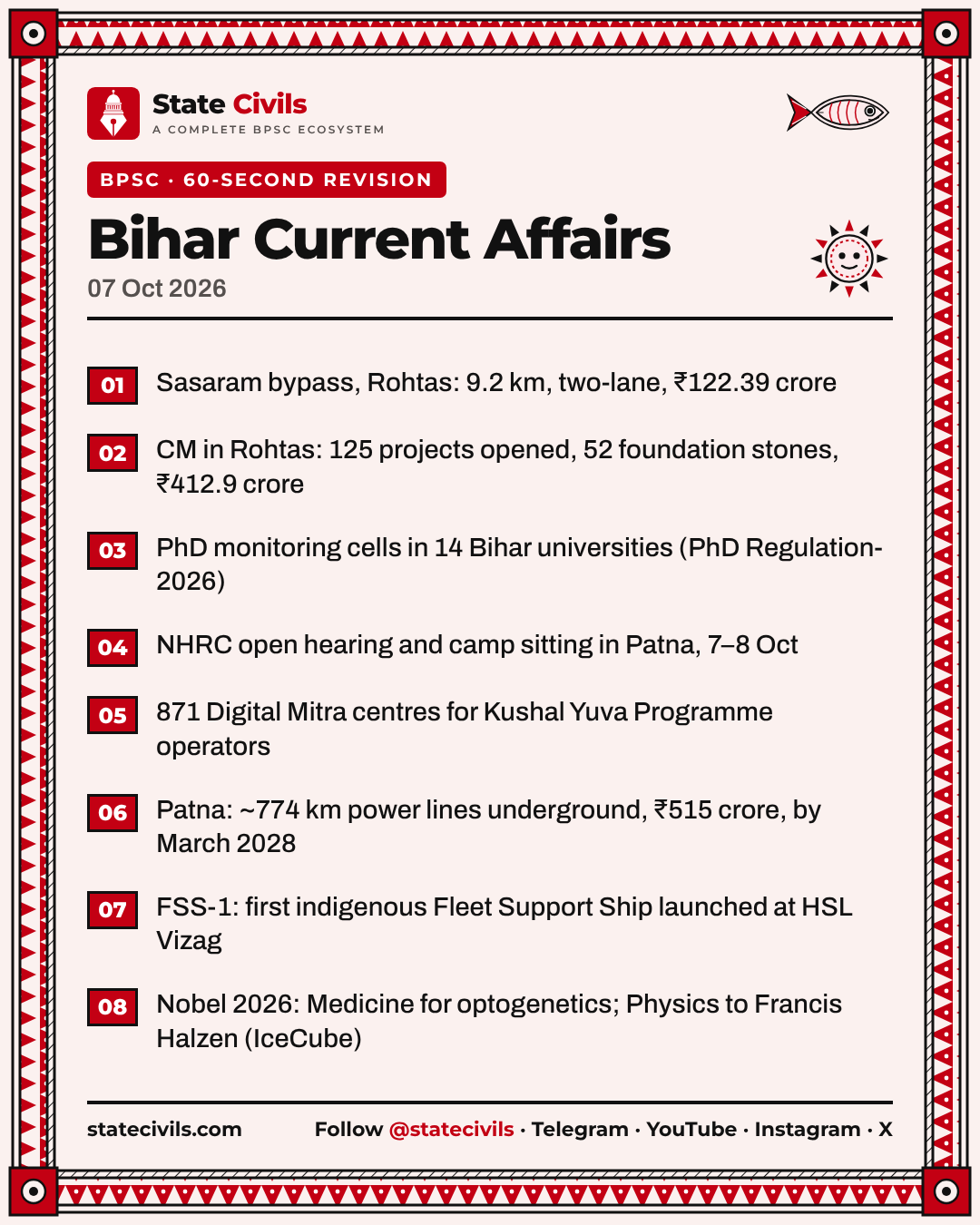
WhatsApp Telegram Facebook X Download card
Get this every morning: join @statecivils on Telegram. Also on YouTube, Instagram and X.
Today’s Mains question
Examine how investment in physical infrastructure and local skill-delivery networks can reduce distress migration from Bihar. Suggest measures to make such efforts effective, with reference to recent initiatives in the state. (250 words)
Write your answer in 12 minutes, then open the model answer below and compare. Share this post with a study partner too.
Show the topper-style model answer
Decode the question
Directive: Examine + Suggest
- How roads, power and other physical infrastructure can reduce distress migration
- How local skill-delivery networks help, and their limits
- Measures to make these efforts effective in Bihar
Keywords to use
Distress migrationPush and pull factorsSaat Nischay-3Kushal Yuva ProgrammeRural non-farm employmentLast-mile connectivityReliable power supplyArticle 19(1)(e)Remittance economySkill mismatch
Introduction
Bihar is one of India’s largest sources of out-migrant workers, driven by low farm incomes, floods and weak industry. On 6 October 2026 the Chief Minister set a goal of 1 crore jobs in five years so that no one has to migrate out of poverty by 2030, which puts infrastructure and skilling at the centre of state policy.
Body
Physical infrastructure as a pull for local jobs
- Roads cut travel time to markets: the 9.2 km Sasaram bypass and the ₹412.9 crore Rohtas projects improve access for traders and farmers.
- Reliable power attracts small industry and cold storage; Patna’s ₹515 crore underground cabling plan reduces outages.
- Tourism circuits (Rohtasgarh, Sher Shah’s tomb) and an airport plan can create service jobs.
- Water-body revival such as Rohtas Jal Sanjeevani supports irrigation, fisheries and farm incomes.
Skill networks: role and limits
- 871 Digital Mitra centres under the Kushal Yuva Programme bring digital and soft skills to the block level.
- Saat Nischay-3’s first resolution, Double Employment, Double Income, links skilling with jobs.
- Limits: skill mismatch with industry demand, low private investment and few local factories.
Way forward
- Link skilling with industrial clusters and BIADA land allotments.
- Track outcomes: placements and wages, not only enrolments.
- Support migrants who still move: portable welfare and safe migration desks.
- Use Sahyog camps for quick grievance redress and scheme access.
Diagram (draw this in your answer)
Draw two rows of boxes with arrows; label the second row ‘Saat Nischay-3’.
Value addition
- Article 19(1)(e) guarantees every citizen the right to reside and settle in any part of India, so the aim is to end distress migration, not mobility.
- Saat Nischay-3’s first resolution is ‘Double Employment, Double Income’; 871 Digital Mitra centres are being allotted under it.
- CM’s target (6 Oct 2026): 1 crore jobs in five years and no migration out of poverty by 2030.
- SDG 8 (decent work and economic growth) and SDG 9 (industry, innovation and infrastructure).
Conclusion
Infrastructure and skills reduce distress migration only when they lead to real local jobs and better wages. If Bihar links roads, power and skilling with industry and tracks outcomes, it can move closer to its 2030 goal and to SDG 8.
About 262 words without the diagram. Toppers usually score on three things: answering every part the directive asks for, adding Bihar-specific examples and data, and drawing one clean diagram.
Answer to today’s question
(b) Light-gated ion channels and optogenetics. Karl Deisseroth, Peter Hegemann and Georg Nagel shared the 2026 Medicine prize for this tool, which uses light to control chosen nerve cells.