Can you answer this?
Bihar’s Renewable Energy Policy 2025 sets which target to be achieved by FY2030?
- 10 GW renewable capacity and 2 GWh energy storage
- 24 GW renewable capacity and 6 GWh energy storage
- 25 GW renewable capacity and 10 GWh energy storage
- 18 GW renewable capacity and 4 GWh energy storage
Answer at the end of the post. Send it to a friend and see who gets it right.
Here are today’s Bihar current affairs for BPSC Prelims and Mains (6 November 2026): a big push for the new rural jobs mission, Bihar’s green-energy investment roadmap, a health recruitment drive and two national updates.
In this post: 6 updates
- Bihar
- 1. CM Samrat Choudhary reviews VB-G RAM G; ₹22,000 crore of rural schemes to join the mission
- 2. Bihar unveils ₹2.57 lakh crore power and renewable energy roadmap at India Renewable Energy Summit
- 3. Bihar Health Department to recruit for over 11,000 posts through the State Health Society
- 4. Kalyanpur in Munger to light over 11 lakh diyas at Deepotsav on 7 November
- Economy
- 5. Cabinet approves ₹2,814 crore capex support scheme for lithium and nickel processing
- Environment / Science
- 6. NASA’s Neil Gehrels Swift Observatory re-enters the atmosphere over North Sumatra
- Revise
- Quick revision
- Today’s Mains question
Bihar
1. CM Samrat Choudhary reviews VB-G RAM G; ₹22,000 crore of rural schemes to join the mission
Chief Minister Samrat Choudhary reviewed the Viksit Bharat–Guarantee for Rozgar and Ajeevika Mission (Gramin), or VB-G RAM G (विकसित भारत-रोजगार एवं आजीविका गारंटी मिशन (ग्रामीण)), at the Sankalp hall of Lok Sevak Awas, Patna, on 5 November. He directed that schemes worth about ₹22,000 crore be brought under the mission. Rural households are entitled to 125 days of work a year, wages must be paid within 15 days, and the cost is shared 60:40 between the Centre and the State. About 1.5 lakh works have been taken up so far, and the target is to double this to 3 lakh, across water security, rural infrastructure, livelihood enhancement and disaster management. Anganwadi centres, extra classrooms and rural haats are among the assets planned. See more on our schemes page.
Why it matters for BPSC: Prelims (scheme features, funding ratio) and Mains GS Paper II (Bihar economy, rural employment, migration). Static link: Article 41 (Directive Principle on the right to work) and the Ministry of Rural Development’s wage-employment programmes.
Prelims fact: VB-G RAM G guarantees 125 days of wage employment a year to rural households, funded 60:40 by the Centre and the State.
Source: Amar Ujala
2. Bihar unveils ₹2.57 lakh crore power and renewable energy roadmap at India Renewable Energy Summit
At the Bihar session of the India Renewable Energy Summit & Expo 2026 at Bharat Mandapam, New Delhi, Energy Minister Shailesh Kumar alias Bulo Mandal presented a roadmap worth ₹2,57,316 crore for generation, transmission and distribution. Bihar’s power demand has grown from about 700 MW in 2005 to around 10,000 MW and is expected to reach about 25,000 MW in the next decade. Projects worth about ₹78,400 crore are under way, including the 301 MW Kajra solar project with a 523 MWh battery storage system. Near-term plans include about 2,700 MW of solar under PM-KUSUM, rooftop solar for about 15 lakh homes under PM Surya Ghar, and a proposed 150 MW solar park in Aurangabad. This builds on the power-sector moves in our 3 November update on free electricity.
Why it matters for BPSC: Mains GS Paper II (Bihar economy, infrastructure, energy security) and Prelims (policy targets, flagship projects). Links to India’s net-zero 2070 goal and the Ministry of New and Renewable Energy’s PM-KUSUM and PM Surya Ghar schemes.
Prelims fact: Bihar Renewable Energy Policy 2025 targets 24 GW of renewable capacity and 6 GWh of energy storage by FY2030.
Source: Oneindia
3. Bihar Health Department to recruit for over 11,000 posts through the State Health Society
Bihar’s Health Department is preparing to fill more than 11,000 posts under the National Health Programme through the State Health Society, Bihar, Health Minister Nishant Kumar announced. The official advertisement is expected in the last week of November, followed by a detailed recruitment calendar. Posts include staff nurse, lab technician, block health manager and clerical and managerial cadres. Vacancy data is being collected from health institutions in all 38 districts, with a second phase planned for remaining vacancies.
Why it matters for BPSC: Mains GS Paper II (health infrastructure and human resources in Bihar) and Essay (public health). Static link: health is a State List subject (Entry 6, List II, Seventh Schedule); the National Health Mission is run with the Union Ministry of Health and Family Welfare.
Prelims fact: The new health recruitment covers health institutions in all 38 districts of Bihar and is routed through the State Health Society, Bihar.
Source: Amar Ujala
4. Kalyanpur in Munger to light over 11 lakh diyas at Deepotsav on 7 November
Kalyanpur village in Munger district will hold a grand Deepotsav on the evening of 7 November, with an organising committee target of more than 11 lakh earthen lamps. Chief Minister Samrat Choudhary is to inaugurate the event, which is held in devotion to Maa Badi Durga Maharani. The organisers describe it as the largest deepotsav in Bihar. District officials are reviewing security, traffic and crowd management.
Why it matters for BPSC: Mains GS Paper I (culture and festivals of Bihar) and Prelims (places in Bihar). Munger lies on the south bank of the Ganga and is known for the Munger Fort and the Bihar School of Yoga.
Prelims fact: Kalyanpur, the venue of the 7 November 2026 Deepotsav, is in Munger district.
Source: News4Nation
Economy
5. Cabinet approves ₹2,814 crore capex support scheme for lithium and nickel processing
The Union Cabinet chaired by PM Narendra Modi approved the Capex Support Scheme to Promote Critical Mineral Processing with an outlay of ₹2,814 crore for FY 2026-27 to 2030-31. It gives a 30% capital subsidy to four plants: two lithium processing plants (minimum 30 kt each) and two nickel processing plants (minimum 50 kt each). Support is capped at ₹500 crore per lithium beneficiary and ₹900 crore per nickel beneficiary, with cobalt expected as a by-product of nickel processing. Beneficiaries are chosen in a two-stage process (technical, then financial bidding) and paid in three milestone-linked tranches.
Why it matters for BPSC: Mains GS Paper II (industrial policy, energy transition, science and technology) and Prelims (scheme numbers). Critical minerals feed electric vehicles, battery energy storage, electronics and defence, linking to Bihar’s own storage targets.
Prelims fact: The scheme offers a 30% capital subsidy, capped at ₹900 crore for each nickel plant and ₹500 crore for each lithium plant.
Source: PM India
Environment / Science
6. NASA’s Neil Gehrels Swift Observatory re-enters the atmosphere over North Sumatra
NASA confirmed that the Neil Gehrels Swift Observatory re-entered Earth’s atmosphere on 4 November over the North Sumatra region of Indonesia, almost 22 years after its 2004 launch. Built for a two-year prime mission, the multiwavelength observatory carried three telescopes and worked for more than two decades. It was best known for catching gamma-ray bursts, the most powerful explosions in the universe, and also studied supernovae, active galaxies, comets and asteroids.
Why it matters for BPSC: Prelims (space science, telescopes) and Mains GS Paper II (science and technology). Note the issue of orbital decay and space debris as low-Earth-orbit satellites age.
Prelims fact: Swift, launched in 2004 to study gamma-ray bursts, re-entered over North Sumatra, Indonesia, on 4 November 2026.
Source: NASA
Quick revision
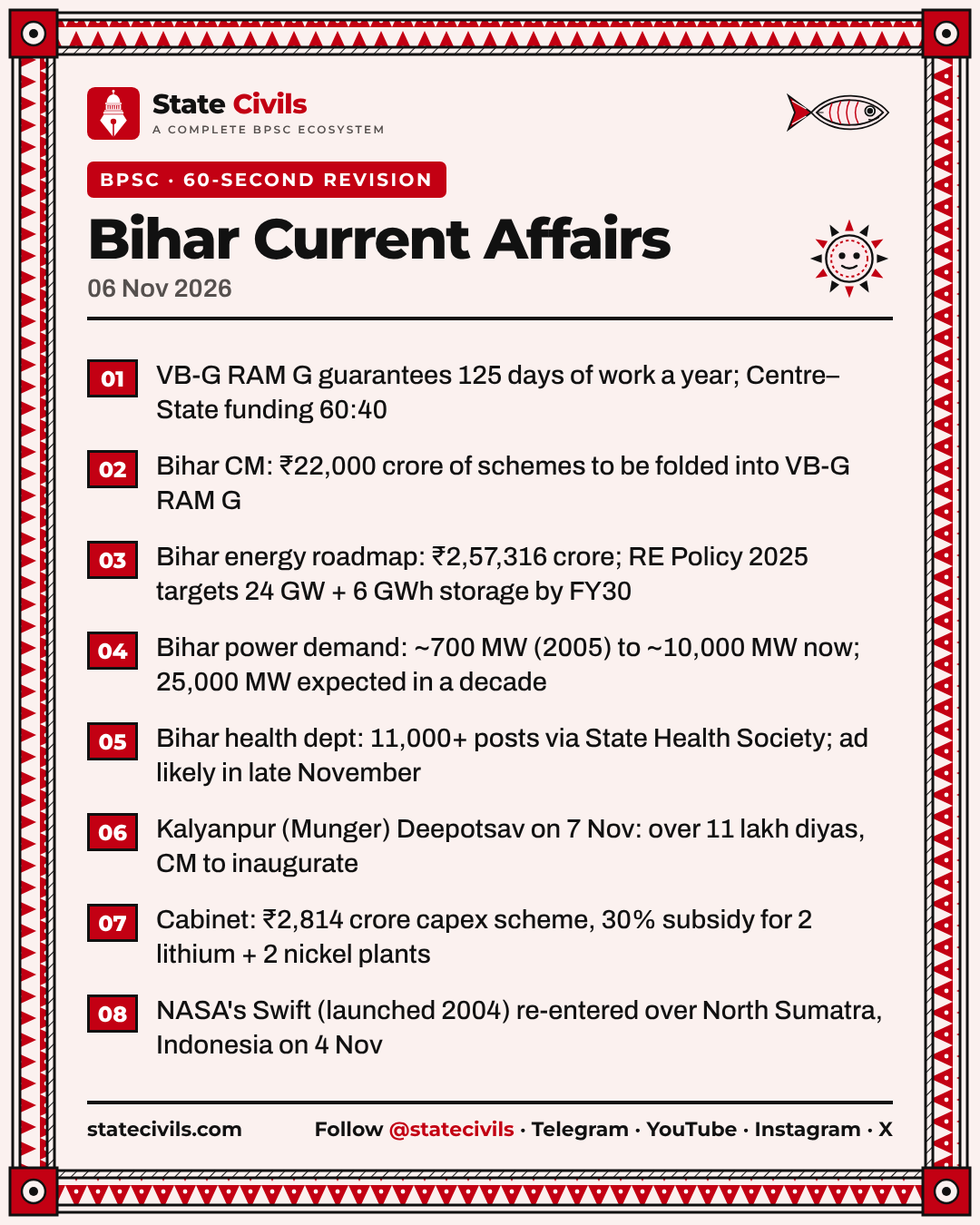
- VB-G RAM G guarantees 125 days of work a year; Centre–State funding 60:40
- Bihar CM: ₹22,000 crore of schemes to be folded into VB-G RAM G
- Bihar energy roadmap: ₹2,57,316 crore; RE Policy 2025 targets 24 GW + 6 GWh storage by FY30
- Bihar power demand: ~700 MW (2005) to ~10,000 MW now; 25,000 MW expected in a decade
- Bihar health dept: 11,000+ posts via State Health Society; ad likely in late November
- Kalyanpur (Munger) Deepotsav on 7 Nov: over 11 lakh diyas, CM to inaugurate
- Cabinet: ₹2,814 crore capex scheme, 30% subsidy for 2 lithium + 2 nickel plants
- NASA’s Swift (launched 2004) re-entered over North Sumatra, Indonesia on 4 Nov
Share today’s revision card with your study group
One image, eight facts. Forward it to your BPSC group.
WhatsApp Telegram Facebook X Download card
Get this every morning: join @statecivils on Telegram. Also on YouTube, Instagram and X.
Today’s Mains question
Examine how the Viksit Bharat–Guarantee for Rozgar and Ajeevika Mission (Gramin) can strengthen rural livelihoods in Bihar. What challenges must be addressed for it to succeed? (250 words)
Write your answer in 12 minutes, then open the model answer below and compare. Share this post with a study partner too.
Show the topper-style model answer
Decode the question
Directive: Examine + Suggest
- How VB-G RAM G can strengthen rural livelihoods in Bihar
- Challenges in implementation
- Measures to make it succeed
Keywords to use
Right to work (Article 41)Demand-driven employment60:40 cost sharingTimely wage paymentDurable rural assetsConvergenceDistress migrationSocial auditGram Sabha planningClimate-resilient works
Introduction
VB-G RAM G guarantees 125 days of wage work a year to rural households, with wages due within 15 days and costs shared 60:40 by the Centre and the State. On 5 November 2026, Bihar decided to fold schemes worth about ₹22,000 crore into the mission, making it the State’s main tool for rural jobs and assets.
Body
Livelihood potential in Bihar
- Extra workdays offer income security to landless and marginal farm households in the lean season.
- Four work streams, water security, rural infrastructure, livelihoods and disaster management, suit flood-prone north Bihar.
- Assets such as Anganwadi centres, classrooms and rural haats improve human capital and local markets.
- Plan to raise works from 1.5 lakh to 3 lakh can absorb labour and curb distress migration.
- Convergence with JEEViKA groups and PM-KUSUM solar can create farm and non-farm income.
Implementation challenges
- The State’s 40% share strains Bihar’s limited fiscal space.
- Delays in wage payment or work allocation weaken trust in the guarantee.
- Weak panchayat capacity and technical staff affect planning and quality of assets.
- Leakages, fake job cards and poor maintenance of assets.
Way forward
- Gram Sabha-led annual plans and regular social audits.
- Direct benefit transfer with real-time monitoring of the 15-day wage rule.
- Climate-resilient works: ponds, embankment repair, desilting and plantation.
- Skilling of workers to move them into better jobs over time.
Diagram (draw this in your answer)
Draw two rows of boxes with arrows; label the 60:40 box clearly.
Value addition
- Article 41 of the Constitution directs the State to secure the right to work within its economic capacity.
- Bihar CM’s review on 5 Nov 2026: ₹22,000 crore of schemes to be brought under VB-G RAM G.
- Wages under the mission are to be paid within 15 days; works fall under four categories.
- Bihar’s energy roadmap plans about 2,700 MW of PM-KUSUM solar, a natural convergence area for rural assets.
Conclusion
If funded on time and planned by Gram Sabhas, VB-G RAM G can turn Bihar’s surplus rural labour into durable, climate-resilient assets. Steady delivery will advance SDG 1 and SDG 8 and the goal of a self-reliant rural Bihar.
About 259 words without the diagram. Toppers usually score on three things: answering every part the directive asks for, adding Bihar-specific examples and data, and drawing one clean diagram.
Answer to today’s question
(b) 24 GW renewable capacity and 6 GWh energy storage. The Bihar Renewable Energy Policy 2025 sets these targets for FY2030, as officials told the India Renewable Energy Summit 2026.