Can you answer this?
The Fund for Responding to Loss and Damage, which has just approved its first allocation for a sudden-onset climate disaster (in Nepal), was established at which UNFCCC Conference of the Parties?
- COP26, Glasgow
- COP27, Sharm el-Sheikh
- COP28, Dubai
- COP29, Baku
Answer at the end of the post. Send it to a friend and see who gets it right.
Here are the Bihar current affairs for 25 October 2026 that matter for BPSC Prelims and Mains: a 20,000 MW power plan for industry, a new bank ranking index, compulsory computer classes, and three national and global stories.
In this post: 7 updates
- Bihar
- 1. Bihar targets 20,000 MW for industry and 12 townships between Gaya and Bodh Gaya ahead of Business Connect 2027
- 2. Bihar launches a 100-point index to rank banks; IDFC FIRST Bank tops, SBI in the red zone
- 3. Computer education to be compulsory for Class 6 and above in Bihar from the next academic session
- 4. Bihar food safety drive: 531 establishments inspected, Patna leads with 87
- Environment / Science
- 5. Bay of Bengal system may become Cyclone Arnab; IMD warns of extremely heavy rain in Andhra Pradesh and Odisha
- 6. Physicist Ashoke Sen becomes the first Indian to win the Oskar Klein Medal
- International
- 7. Loss and Damage Fund approves $21.6 million for Nepal after the Bhotekoshi floods
- Revise
- Quick revision
- Today’s Mains question
Bihar
1. Bihar targets 20,000 MW for industry and 12 townships between Gaya and Bodh Gaya ahead of Business Connect 2027
At a curtain-raiser in Bodh Gaya for Bihar Business Connect 2027 and the Bihar Integrated Manufacturing City Gaya Limited (BIMCGL), Chief Minister Samrat Choudhary said the state wants about 20,000 MW of power for industry over the next five years, with green sources such as solar, wind and hydrogen getting priority. About 20,000 acres of land is to be ready for industry by February 2027, and acquisition of nearly 13,000 acres along national highways has begun. A deemed-approval system is proposed so that clearances not processed within 30 days are treated as granted, subject to rules. Twelve townships are planned between Gaya and Bodh Gaya under a common Magadh identity. The plan builds on the 1,091 investment proposals reported in yesterday’s update.
Why it matters for BPSC: Mains GS Paper II (Bihar economy: industrialisation, land, power, ease of doing business). The Gaya manufacturing city lies on the Amritsar–Kolkata Industrial Corridor; link it to Bihar’s low share of manufacturing and the need for land banks and reliable power. Prelims can ask about the venue, the corridor or the targets.
Prelims fact: Bihar Business Connect 2027 is due in February 2027; the curtain-raiser was held in Bodh Gaya (Gaya district).
Source: The Hans India (IANS)
2. Bihar launches a 100-point index to rank banks; IDFC FIRST Bank tops, SBI in the red zone
At a high-level review meeting in Patna, Development Commissioner Mihir Kumar Singh announced a 100-point performance index that ranks banks working in Bihar. Banks scoring 50 or more are in the green zone (11 banks), followed by yellow and red zones. IDFC FIRST Bank leads with 74 points, while several big public sector lenders, including SBI, fall in the red zone. Against the 2026-27 Annual Credit Plan target of ₹4.95 lakh crore, banks had lent about ₹1.89 lakh crore (38.25%) by 30 September. MSME lending reached 52.68% of its target, but farm lending was only 28%.
Why it matters for BPSC: Mains GS Paper II (Bihar economy: banking, credit flow, financial inclusion). Bihar’s low credit-deposit (CD) ratio is a standard Mains theme; this index is a new tool to push lenders. Link it to priority-sector lending rules and the role of the State Level Bankers’ Committee. See more on the Economy topic page.
Prelims fact: IDFC FIRST Bank topped Bihar’s first bank performance index with 74 of 100 points; green zone = 50+ points.
Source: ThePrint Hindi (PTI-Bhasha)
3. Computer education to be compulsory for Class 6 and above in Bihar from the next academic session
Education Minister Mithilesh Tiwari directed at a review meeting at Vikas Bhawan in Patna that computer education be made compulsory for students of Class 6 and above from the next academic session. Teachers will first be trained at the State Council of Educational Research and Training (SCERT). Officials were also told to set up smart classrooms in all 700 Saraswati Vidya Niketans designated as model schools by 31 March. A Gurukulam Vidyapeeth is planned in every division, the first in Buxar at an estimated ₹70 crore.
Why it matters for BPSC: Mains GS Paper II (social sector: education and digital skills in Bihar). Useful for answers on human capital and the digital divide; link to the National Education Policy 2020 push for coding and digital literacy from the middle stage.
Prelims fact: Teacher training for the computer course will be done through SCERT, Bihar; the first divisional Gurukulam Vidyapeeth is planned in Buxar.
Source: Punjab Kesari (IANS)
4. Bihar food safety drive: 531 establishments inspected, Patna leads with 87
The Bihar Food Safety Department has inspected 531 food businesses across the state in a festive-season drive launched on the direction of Health Minister Nishant. Patna saw the most checks, with 87 establishments. Two licences have been suspended and prosecution has been started against violators. The drive covers hotels, restaurants, sweet shops, dairy units, food manufacturers, packaged drinking water plants and online food sellers.
Why it matters for BPSC: Mains GS Paper II (governance and public health). Food safety is enforced under the Food Safety and Standards Act, 2006, with FSSAI at the centre and state Commissioners of Food Safety implementing it; a good example for answers on regulatory capacity in Bihar.
Prelims fact: Food safety in India is regulated under the Food Safety and Standards Act, 2006.
Source: UNI
Environment / Science
5. Bay of Bengal system may become Cyclone Arnab; IMD warns of extremely heavy rain in Andhra Pradesh and Odisha
A low-pressure area over the east-central Bay of Bengal was forecast by the India Meteorological Department (IMD) to become a depression on 24 October, a deep depression on 25 October and a cyclonic storm over the west-central Bay by the morning of 26 October. It is likely to move west-northwest towards north Andhra Pradesh and south Odisha. If it becomes a cyclone it will be named Arnab, a name suggested by Bangladesh. IMD has warned of extremely heavy rain in coastal Andhra Pradesh on 27–28 October and in Odisha on 28 October.
Why it matters for BPSC: Prelims (geography: tropical cyclones, the North Indian Ocean naming system run by IMD/WMO) and Mains GS Paper II (disaster management). Remnants of Bay of Bengal cyclones often bring late-season rain to south Bihar, so track the system’s path.
Prelims fact: The name Arnab was contributed by Bangladesh; it means “ocean” in Bengali.
Source: The Daily Jagran
6. Physicist Ashoke Sen becomes the first Indian to win the Oskar Klein Medal
String theorist Ashoke Sen, ICTS-Infosys Madhava Chair Professor at the International Centre for Theoretical Sciences (ICTS), Bengaluru, is the first Indian to receive the Oskar Klein Medal. He delivered the 2026 Oskar Klein Memorial Lecture on 22 October at Stockholm University’s AlbaNova Centre. His work on S-duality, the exact counting of black hole entropy and string field theory was cited. Earlier honours include the Breakthrough Prize in Fundamental Physics (2012), the Dirac Medal (2014) and the Padma Bhushan (2013).
Why it matters for BPSC: Prelims (awards, science and technology personalities) and Mains GS Paper II (science and technology: India’s achievements in basic research).
Prelims fact: The Oskar Klein Medal (since 1988) is given by Stockholm University and the Nobel Committee for Physics of the Royal Swedish Academy of Sciences.
Source: National Herald
International
7. Loss and Damage Fund approves $21.6 million for Nepal after the Bhotekoshi floods
The Board of the Fund for Responding to Loss and Damage (FRLD), at a virtual extraordinary meeting on 22 October, provisionally approved $21.6 million for Nepal: $20 million for relief, rehabilitation and reconstruction after the 26 August Bhotekoshi floods, and $1.6 million as oversight fees. It is the first time the Fund has allocated money for a sudden-onset climate disaster. Under the Fund’s start-up phase, the Barbados Implementation Modalities, 119 countries had sent 176 requests worth about $2.8 billion.
Why it matters for BPSC: Prelims (environment: UNFCCC, climate finance) and Mains GS Paper I (current events) and GS Paper II (disaster management). Nepal’s Himalayan rivers feed the Kosi and Gandak systems, so climate-driven floods upstream are directly relevant to north Bihar.
Prelims fact: The Fund was set up at COP27 (2022) and operationalised at COP28 (2023).
Source: The Wire
Quick revision
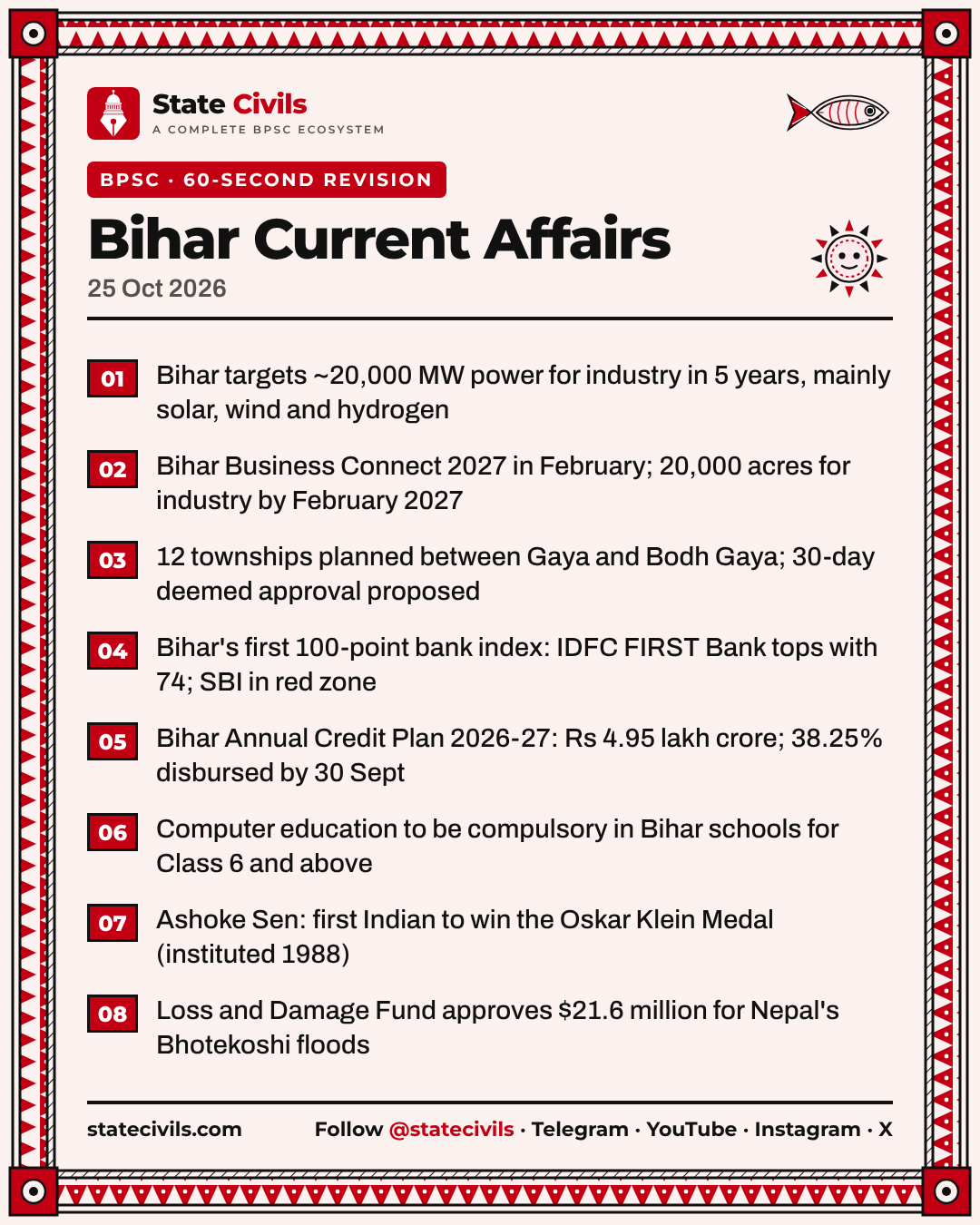
- Bihar targets ~20,000 MW power for industry in 5 years, mainly solar, wind and hydrogen
- Bihar Business Connect 2027 in February; 20,000 acres for industry by February 2027
- 12 townships planned between Gaya and Bodh Gaya; 30-day deemed approval proposed
- Bihar’s first 100-point bank index: IDFC FIRST Bank tops with 74; SBI in red zone
- Bihar Annual Credit Plan 2026-27: Rs 4.95 lakh crore; 38.25% disbursed by 30 Sept
- Computer education to be compulsory in Bihar schools for Class 6 and above
- Ashoke Sen: first Indian to win the Oskar Klein Medal (instituted 1988)
- Loss and Damage Fund approves $21.6 million for Nepal’s Bhotekoshi floods
Share today’s revision card with your study group
One image, eight facts. Forward it to your BPSC group.
WhatsApp Telegram Facebook X Download card
Get this every morning: join @statecivils on Telegram. Also on YouTube, Instagram and X.
Today’s Mains question
Low bank credit has long held back Bihar’s economy. Examine the reasons for weak credit flow in Bihar and suggest measures to channel more credit into agriculture and MSMEs, with reference to recent state initiatives. (250 words)
Write your answer in 12 minutes, then open the model answer below and compare. Share this post with a study partner too.
Show the topper-style model answer
Decode the question
Directive: Examine + Suggest
- Examine why credit flow in Bihar is weak (supply and demand side).
- Suggest measures to raise credit for agriculture and MSMEs.
- Use recent Bihar initiatives as examples.
Keywords to use
Credit-deposit ratioAnnual Credit PlanPriority-sector lendingState Level Bankers’ CommitteeKisan Credit CardCollateral gapDeemed approvalIndustrial land bankFinancial inclusion
Introduction
Bihar’s banks collect far more deposits than they lend locally: the credit-deposit (CD) ratio stood at about 60% on 30 September 2026. By then only 38.25% of the ₹4.95 lakh crore Annual Credit Plan for 2026-27 had been disbursed, with farm lending at just 28% of target.
Body
Reasons for weak credit flow
- Supply side: large lenders are cautious; the new state index placed SBI and other major banks in the red zone.
- Small, fragmented landholdings and unclear land records limit collateral for farm loans.
- Few large industrial units, so demand for big-ticket credit is low.
- Flood-prone north Bihar raises perceived risk and loan defaults.
- Thin branch and business-correspondent reach in rural areas.
Measures for agriculture and MSMEs
- Use the 100-point bank index to reward green-zone banks and press laggards in SLBC reviews.
- Expand Kisan Credit Card renewals into fresh lending; over 7.37 lakh KCC accounts were served this year.
- Credit guarantees and cluster lending for MSMEs, which already reached 52.68% of target.
- Faster land records and digital land survey to create bankable collateral.
- Crop insurance and flood-risk pooling to lower lending risk.
Linking credit to industrial growth
- Land banks of 20,000 acres and a 30-day deemed approval make projects bankable.
- Reliable power (20,000 MW target) improves MSME viability.
- Industrial corridor projects such as the Gaya manufacturing city create credit demand.
Diagram (draw this in your answer)
Draw two parallel rows of boxes with arrows; label the top row “problem” and the bottom “solution”.
Value addition
- Bihar Annual Credit Plan 2026-27: ₹4.95 lakh crore; 38.25% disbursed by 30 September (PTI).
- CD ratio 60.17% on 30 September 2026; the Development Commissioner called below 50% unacceptable for major banks (IANS).
- PM SVANidhi: 2,17,731 applications approved in Bihar so far this year (IANS).
- Bihar Business Connect 2027 (February) targets 20,000 acres of industrial land by February 2027.
Conclusion
Raising Bihar’s CD ratio needs both willing lenders and bankable borrowers. Combining bank accountability with land, power and risk reforms can turn local deposits into local growth and advance SDG 8 on decent work and economic growth.
About 257 words without the diagram. Toppers usually score on three things: answering every part the directive asks for, adding Bihar-specific examples and data, and drawing one clean diagram.
Answer to today’s question
(b) COP27, Sharm el-Sheikh. The Fund for Responding to Loss and Damage was agreed at COP27 in 2022 and operationalised at COP28 in Dubai in 2023.