Can you answer this?
Bihar’s Legislative Council polls on 23 October 2026 cover graduates’ and teachers’ constituencies. Under Article 171 of the Constitution, what fraction of a state Legislative Council is elected by teachers?
- One-third
- One-sixth
- One-twelfth
- One-fourth
Answer at the end of the post. Send it to a friend and see who gets it right.
Here are today’s Bihar current affairs for 23 Oct 2026, picked for BPSC Prelims and Mains: Bihar’s draft AI policy, the Legislative Council polls, teacher transfers and urban housing, plus the RBI’s policy minutes and India–Poland ties.
In this post: 6 updates
- Bihar
- 1. Draft Bihar AI Policy 2026 aims to train 5 lakh youths in five years
- 2. Bihar Legislative Council polls today in 4 graduates’ and 4 teachers’ seats
- 3. Bihar teacher transfer portal to reopen in the second week of November
- 4. Bihar to set up state and city technical teams for PMAY-Urban
- Economy
- 5. RBI MPC minutes: rate cuts off the table after hike to 5.50%
- International
- 6. India and Poland aim to double bilateral trade by 2030
- Revise
- Quick revision
- Today’s Mains question
Bihar
1. Draft Bihar AI Policy 2026 aims to train 5 lakh youths in five years
Chief Minister Samrat Choudhary reviewed the draft Bihar Artificial Intelligence Policy 2026 (बिहार एआई नीति 2026) in Patna on 22 October. The draft sets a target of AI training for five lakh youths over five years and plans a large AI event every year. The state is working with IIT Patna on an advanced IT and AI research centre and a deeptech startup lab, and has signed non-financial MoUs with Google, Microsoft, CoRover’s BharatGPT and Sarvam AI for skilling officials, teachers and young people. The CM asked the IT Department to form a special team to meet the targets on time. This builds on the push seen in the 14 October update on Patna’s data centre and first tech park.
Why it matters for BPSC: Mains GS Paper II (science & technology, Bihar economy): AI for jobs, governance and services. The draft plans AI use in education, health, agriculture, land reforms and disaster management – useful examples for answers on e-governance and skilling. Static link: Bihar’s demographic dividend and the IT Department’s role in state digital policy.
Prelims fact: The draft Bihar AI Policy 2026 targets AI training for 5 lakh youths in 5 years, with IIT Patna as a research partner.
Source: ETV Bharat
2. Bihar Legislative Council polls today in 4 graduates’ and 4 teachers’ seats
Voting for eight seats of the Bihar Legislative Council takes place on 23 October, from 8 am to 4 pm. The graduates’ constituencies are Patna, Darbhanga, Tirhut and Kosi; the teachers’ constituencies are Patna, Darbhanga, Tirhut and Saran. In all, 150 candidates are in the fray and 5,32,847 voters are on the rolls, including 1,46,611 women. Counting is on 27 October. More on the Council in our polity and governance updates.
Why it matters for BPSC: Prelims and Mains GS Paper II (polity): Bihar is one of the few states with a bicameral legislature. Article 171 fixes the Council’s make-up – one-twelfth elected by graduates of three years’ standing and one-twelfth by teachers with three years’ teaching at secondary level or above – while Article 169 covers creation and abolition.
Prelims fact: Under Article 171, one-twelfth of a Legislative Council is elected by graduates and one-twelfth by teachers.
Source: ThePrint (PTI)
3. Bihar teacher transfer portal to reopen in the second week of November
Education Minister Mithilesh Tiwari said on 21 October in Gopalganj that the online portal for general teacher transfers will open again in the second week of November, after the model code of conduct for the Council polls ends. So far 21,940 teachers have been transferred. The first phase under the Bihar State Teacher Transfer Rules, 2026 drew 81,790 applications: 61,123 from surplus teachers, 9,244 for mutual transfers and 11,423 for inter-district moves. The minister also said ₹195 crore has been released through DBT for about 25,000 staff of unaided institutions.
Why it matters for BPSC: Mains GS Paper II (governance) and Essay: rationalising teacher deployment is key to better pupil-teacher ratios in Bihar’s schools. Link it to the Right to Education (Article 21A) and to the use of online, rule-based systems to cut discretion in transfers.
Prelims fact: 21,940 teachers have been transferred so far under the Bihar State Teacher Transfer Rules, 2026.
Source: LiveCities
4. Bihar to set up state and city technical teams for PMAY-Urban
The Urban Development and Housing Department will form technical teams at the state level and in cities to speed up the Pradhan Mantri Awas Yojana – Urban (प्रधानमंत्री आवास योजना (शहरी)). The state team will handle broader technical work on the scheme, while city teams will help individual urban local bodies solve problems on the ground. More than ₹4.72 crore has been sanctioned for 2026-27 to set up and run the teams, of which the Centre has released ₹2.44 crore.
Why it matters for BPSC: Prelims and Mains GS Paper II (Bihar economy, urbanisation): Bihar is among India’s least urbanised states, so delivery capacity in urban local bodies matters. PMAY-U is a central scheme of the Ministry of Housing and Urban Affairs; link it to the 74th Amendment and the role of urban local bodies.
Prelims fact: Bihar sanctioned over ₹4.72 crore for 2026-27 for PMAY-Urban technical teams; the Centre’s share released is ₹2.44 crore.
Source: Subkuz
Economy
5. RBI MPC minutes: rate cuts off the table after hike to 5.50%
Minutes of the Monetary Policy Committee meeting of 5–7 October, released on 21 October, show all six members backed the 25 basis point hike in the repo rate to 5.50%. The change of stance from neutral to calibrated tightening passed 4–2, with external members Nagesh Kumar and Ram Singh dissenting. Governor Sanjay Malhotra said the stance signals that rate cuts are off the table in the near term. The MPC projects CPI inflation at 5.2% for 2026-27 and expects it to touch 6% in the third quarter. The next meeting is on 2–4 December.
Why it matters for BPSC: Prelims and Mains GS Paper II (economy): know the MPC structure (six members, three from the RBI and three nominated by the Centre, Governor’s casting vote) and the flexible inflation target of 4% with a 2–6% band. Higher rates affect credit costs for Bihar’s MSMEs and farm borrowers.
Prelims fact: The MPC has six members; the RBI Governor has the casting vote in case of a tie.
Source: Business Standard
International
6. India and Poland aim to double bilateral trade by 2030
Polish Prime Minister Donald Tusk is on an official visit to India from 21 to 23 October. After talks with PM Narendra Modi on 22 October, the two sides set a goal of doubling bilateral trade by 2030 and endorsed the mid-term review of the India–Poland Action Plan 2024–2028. Poland announced it is joining the Coalition for Disaster Resilient Infrastructure (CDRI), and India invited it to join the International Solar Alliance, the Global Biofuels Alliance and the Indo-Pacific Oceans Initiative. An MoU on geology, mining and critical minerals is under negotiation.
Why it matters for BPSC: Prelims and Mains GS Paper I (current events of international importance): India’s Central Europe outreach, critical minerals and India-led platforms such as CDRI and ISA. Static link: Operation Ganga, when Poland helped over 2,000 stranded Indian students leave Ukraine.
Prelims fact: India and Poland follow a Joint Action Plan for 2024–2028; Poland has announced accession to CDRI.
Source: PM India
Quick revision
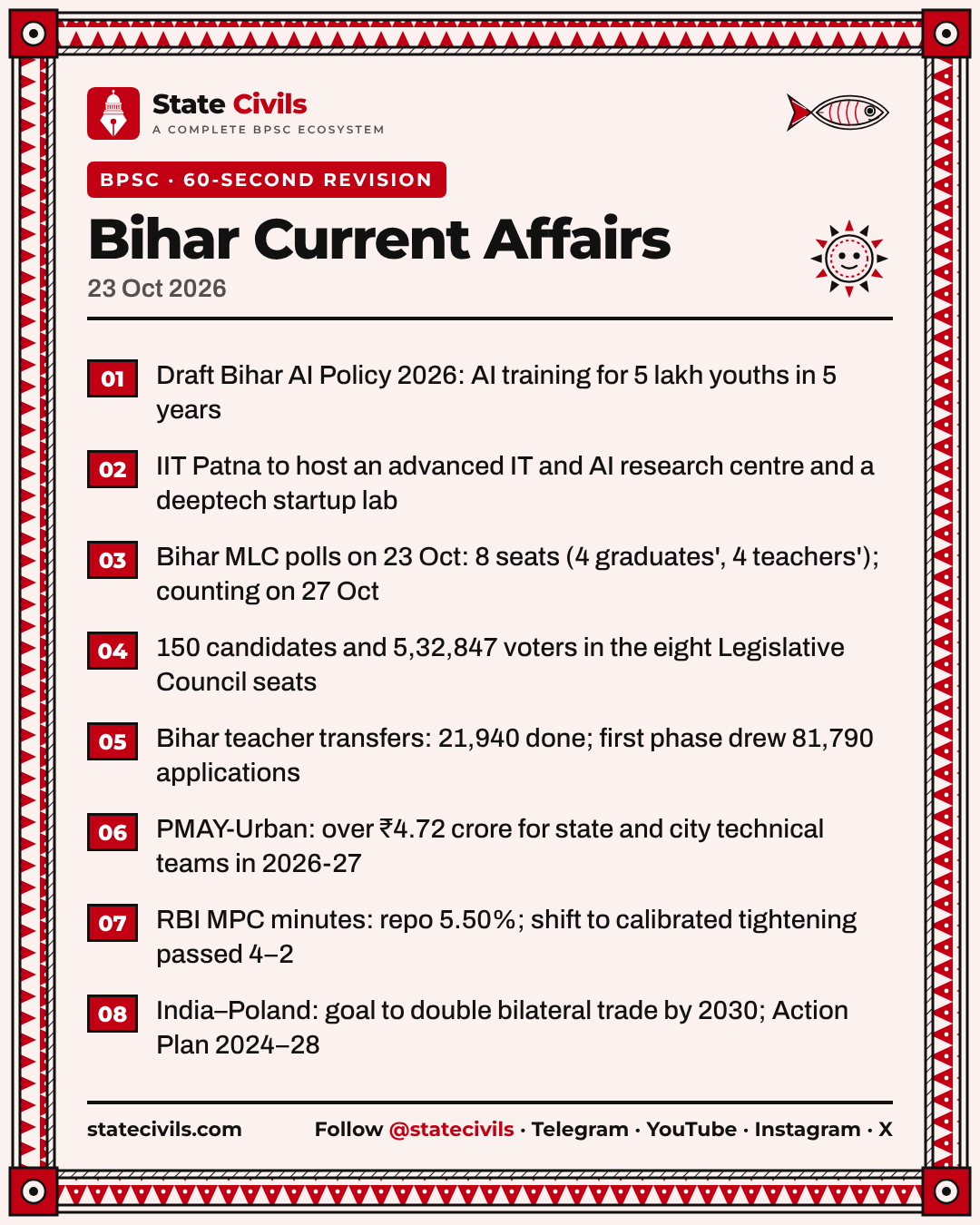
- Draft Bihar AI Policy 2026 targets AI training for 5 lakh youths in 5 years.
- IIT Patna will host an advanced IT and AI research centre and a deeptech startup lab under the AI push.
- Bihar MLC polls on 23 Oct: 8 seats – graduates (Patna, Darbhanga, Tirhut, Kosi), teachers (Patna, Darbhanga, Tirhut, Saran); counting 27 Oct.
- 150 candidates and 5,32,847 voters in the eight Council seats.
- Bihar teacher transfers: 21,940 done; first phase drew 81,790 applications.
- PMAY-Urban technical teams: over ₹4.72 crore sanctioned for 2026-27; Centre released ₹2.44 crore.
- RBI MPC: repo 5.50%; shift to calibrated tightening passed 4–2 (Nagesh Kumar, Ram Singh dissented).
- India–Poland: double bilateral trade by 2030; Action Plan 2024–2028; Poland joins CDRI.
Share today’s revision card with your study group
One image, eight facts. Forward it to your BPSC group.
WhatsApp Telegram Facebook X Download card
Get this every morning: join @statecivils on Telegram. Also on YouTube, Instagram and X.
Today’s Mains question
Examine how the draft Bihar AI Policy 2026 can generate skills and employment for Bihar’s youth. What challenges must the state address for it to succeed? (250 words)
Write your answer in 12 minutes, then open the model answer below and compare. Share this post with a study partner too.
Show the topper-style model answer
Decode the question
Directive: Examine
- How the draft Bihar AI Policy 2026 can create jobs and skills for Bihar’s youth
- The challenges Bihar must address for the policy to succeed
Keywords to use
Demographic dividendSkillingDeeptech startupsDigital public infrastructureIndustry–academia linkageDigital divideE-governanceData centresEase of doing business
Introduction
The draft Bihar AI Policy 2026, reviewed by the Chief Minister on 22 October, aims to train five lakh youths in artificial intelligence within five years. For a young, migration-prone state, it is an attempt to turn the demographic dividend into skilled, local employment.
Body
Employment and skilling potential
- Direct skilling: the target of five lakh trained youths creates a pool for IT, data and AI-enabled service jobs.
- Research base: the planned IT and AI research centre and deeptech startup lab with IIT Patna can incubate local startups.
- Industry links: non-financial MoUs with Google, Microsoft, BharatGPT and Sarvam AI bring training for officials, teachers and youths.
- Sector jobs: AI in agriculture, health and land reforms needs local technicians.
- Investment: fast-track approvals and support for data centres can draw firms, as seen with Patna’s planned tech park.
Challenges
- Digital divide: weak rural connectivity and low device access limit reach.
- Foundation skills: gaps in school mathematics and English slow advanced AI learning.
- Few anchor employers: without companies in Bihar, trained youth may still migrate.
- Implementation: MoUs are non-financial; budgets and outcome tracking are needed.
- Ethics and data: AI in land records or welfare needs privacy safeguards and grievance redress.
Way forward
- Tie training to placement with industry partners and track outcomes district-wise.
- Start AI labs in polytechnics and ITIs, not only in Patna.
Diagram (draw this in your answer)
Draw three rows of boxes with arrows; label the last row in red as risks.
Value addition
- Draft policy target: AI training for 5 lakh youths in 5 years (state review, 22 Oct 2026).
- IIT Patna partnership for an advanced IT and AI research centre and deeptech startup lab.
- Non-financial MoUs with Google, Microsoft, CoRover’s BharatGPT and Sarvam AI for capacity building.
- Planned AI use in education, healthcare, agriculture, land reforms and disaster management.
Conclusion
The policy can make Bihar a producer, not only a consumer, of digital talent if training is linked to real jobs across districts. Pairing it with connectivity, school learning and investment would move the state closer to inclusive growth and SDG 8 on decent work.
About 265 words without the diagram. Toppers usually score on three things: answering every part the directive asks for, adding Bihar-specific examples and data, and drawing one clean diagram.
Answer to today’s question
(c) One-twelfth. Article 171 provides that one-twelfth of a state Legislative Council is elected by teachers with at least three years’ teaching at secondary school level or above, and another one-twelfth by graduates of three years’ standing. (One-third is elected by local bodies and one-third by the Assembly; one-sixth is nominated by the Governor.)