Can you answer this?
Vikramshila Setu, which is to get a digital Bridge Health Monitoring System, links Bhagalpur with which place across the Ganga?
- Munger
- Naugachhia
- Sultanganj
- Kahalgaon
Answer at the end of the post. Send it to a friend and see who gets it right.
Here are today’s Bihar current affairs for BPSC, 20 Oct 2026: four Bihar updates on climate-smart farming, vulture conservation, a household debt survey and bridge safety, plus two national stories.
In this post: 6 updates
- Bihar
- 1. Bihar rolls out ₹14.05 crore climate-resilient farming plan in 1,200 villages of 24 districts
- 2. Valmiki Tiger Reserve planned as India’s ninth vulture conservation centre
- 3. NSS 81st round: Bihar begins household survey on farm income, assets and debt
- 4. Vikramshila Setu in Bhagalpur to get a digital Bridge Health Monitoring System
- Schemes
- 5. Shivraj Singh Chouhan launches upgraded Agri Welfare Portal as single window for farmers
- International
- 6. India–New Zealand Free Trade Agreement enters into force on 20 October
- Revise
- Quick revision
- Today’s Mains question
Bihar
1. Bihar rolls out ₹14.05 crore climate-resilient farming plan in 1,200 villages of 24 districts
The state Agriculture Department has started a climate-resilient agriculture programme worth ₹14.05 crore. It covers 120 primary villages (five per district) and 1,080 secondary villages, each primary village being linked to nine secondary ones. Demonstrations will run on 1,150 acres (750 acres in rabi, 400 in the summer season), with a 30-acre seed hub in every district, soil testing, leaf colour charts, custom hiring centres, bee boxes and vermicompost units. Only small farmers holding 0.5–3 acres and registered on the department’s DBT portal are eligible.
Why it matters for BPSC: Prelims (agriculture schemes, Bihar districts) and Mains GS Paper II (Bihar economy, agriculture and climate change). Flood in the north and drought-prone south make Bihar a textbook case for climate adaptation; link it to the Agriculture Road Map and to SDG 13 (Climate Action). More on our environment page.
Prelims fact: The plan uses a cluster model: 5 primary villages per district × 9 linked secondary villages = 1,200 villages in 24 districts.
Source: Patna Press
2. Valmiki Tiger Reserve planned as India’s ninth vulture conservation centre
Valmiki Tiger Reserve (VTR) in West Champaran has begun vulture conservation work in its Gonauli forest range, with the aim of developing it into the country’s ninth vulture conservation centre. Vulture nests are now found mostly in the core area; officials hope birds will spread into the buffer zone within four to five years. The reserve will provide naturally dead wildlife carcasses as safe food and monitor carcasses of animals coming from outside, since residues of banned veterinary drugs in carcasses caused the crash in vulture numbers. The move comes days after VTR reopened for tourists, covered in our 18 Oct update on Valmiki Tiger Reserve safaris.
Why it matters for BPSC: Prelims (protected areas of Bihar, endangered species) and Mains GS Paper II (environment and biodiversity in Bihar). VTR is Bihar’s best-known protected area, bordering Nepal’s Chitwan National Park; vultures are scavengers that keep disease in check.
Prelims fact: India’s first vulture conservation breeding centre is at Pinjore, Haryana; it began in 2001 as a Vulture Care Centre and breeds three critically endangered Gyps species.
Source: First Bihar
3. NSS 81st round: Bihar begins household survey on farm income, assets and debt
The Directorate of Economics and Statistics, Bihar, has started fieldwork for the 81st round of the National Sample Survey (राष्ट्रीय प्रतिदर्श सर्वेक्षण), which will continue until June 2027 across rural and urban areas. It has two parts: the Situation Assessment Survey of Agricultural Households (कृषि परिवार स्थिति आकलन सर्वेक्षण), on income and spending of farming families, and the All-India Debt and Investment Survey (अखिल भारतीय ऋण एवं निवेश सर्वेक्षण), on assets and loans from banks and moneylenders. The Planning and Development Department says individual data will stay confidential and will be used only for statistics.
Why it matters for BPSC: Prelims (NSO surveys, MoSPI) and Mains GS Paper I (statistics) and GS Paper II (rural indebtedness and farm income in Bihar). Survey data shape welfare, credit and farm-support schemes.
Prelims fact: The previous All-India Debt and Investment Survey and Situation Assessment Survey were run in the NSS 77th round (January–December 2019).
Source: Prabhat Khabar
4. Vikramshila Setu in Bhagalpur to get a digital Bridge Health Monitoring System
Engineers will install a Bridge Health Monitoring System (BHMS) on the existing Vikramshila Setu over the Ganga, in addition to a similar system already planned for the new four-lane bridge being built alongside it. Sensors linked through the Internet of Things will track stress, vibration, bending and displacement under traffic and weather, and alert authorities when readings cross safe limits. The system will support, not replace, routine physical inspections, and comes along with restoration work in which damaged sections are being replaced with steel girders.
Why it matters for BPSC: Prelims (bridges and rivers of Bihar) and Mains GS Paper II (infrastructure, science and technology applications). Shows how IoT and data analytics can improve safety of ageing bridges in a river-crossed state.
Prelims fact: Vikramshila Setu, opened in 2001, links Barari Ghat in Bhagalpur with Naugachhia on the north bank of the Ganga.
Source: Patna Press
Schemes
5. Shivraj Singh Chouhan launches upgraded Agri Welfare Portal as single window for farmers
Union Agriculture and Farmers Welfare Minister Shivraj Singh Chouhan launched an upgraded Agri Welfare Portal that lets farmers reach schemes, financial help and farm information on their mobile phones without visiting several offices or websites. It brings Farmer Producer Organisations, Primary Agricultural Credit Societies, scientists and startups onto one platform and works as a gateway to PM-KISAN, AgriStack and the Pradhan Mantri Fasal Bima Yojana. Krishi Vigyan Kendras will run a training campaign to help farmers use it.
Why it matters for BPSC: Prelims (central schemes and ministries) and Mains GS Paper II (e-governance in agriculture). Useful with today’s Bihar climate-farming item as an example of digital delivery cutting out middlemen.
Prelims fact: The portal is run by the Ministry of Agriculture and Farmers Welfare and links PM-KISAN, AgriStack and PMFBY.
Source: News On AIR
International
6. India–New Zealand Free Trade Agreement enters into force on 20 October
The India–New Zealand FTA, signed in April 2026 at Bharat Mandapam, New Delhi, comes into force on Vijayadashami, 20 October 2026. It gives duty-free access to all Indian exports to New Zealand, opens markets for fruits, vegetables and spices, and expands openings in services, investment and student and professional mobility, while keeping dairy protected. Both countries aim to double trade in goods and services by 2030; bilateral merchandise trade was about US$1.1 billion in 2025-26.
Why it matters for BPSC: Prelims (trade agreements) and Mains GS Paper II (India’s economy and external trade). Note the protection of dairy, a sensitive sector for small livestock farmers in states such as Bihar.
Prelims fact: New Zealand has committed to facilitate US$20 billion of investment into India under the agreement.
Source: News On AIR
Quick revision
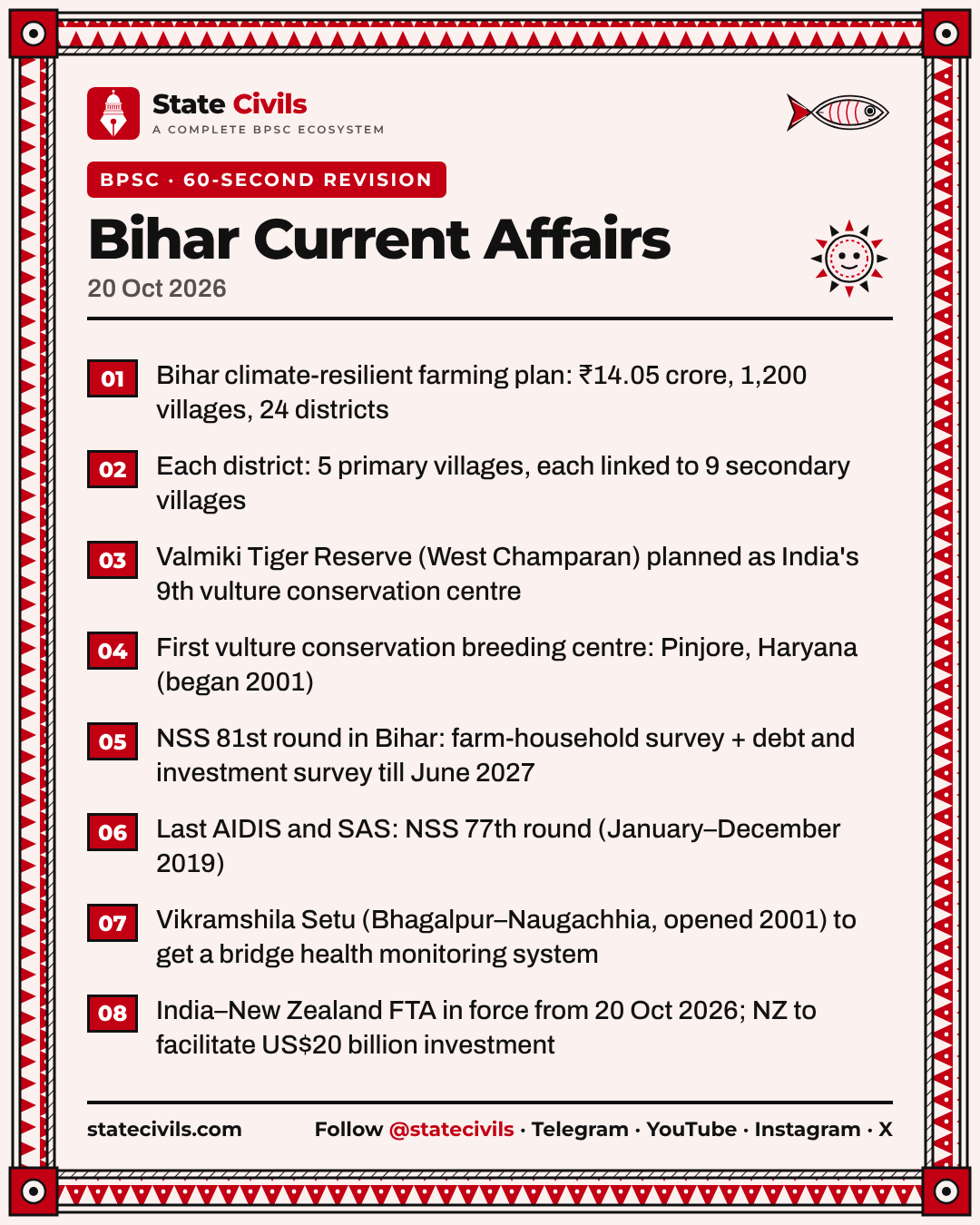
- Bihar climate-resilient farming plan: ₹14.05 crore, 1,200 villages, 24 districts
- Each district: 5 primary villages, each linked to 9 secondary villages
- Valmiki Tiger Reserve (West Champaran) planned as India’s 9th vulture conservation centre
- First vulture conservation breeding centre: Pinjore, Haryana (began 2001)
- NSS 81st round in Bihar: farm-household survey + debt and investment survey till June 2027
- Last AIDIS and SAS: NSS 77th round (January–December 2019)
- Vikramshila Setu (Bhagalpur–Naugachhia, opened 2001) to get a bridge health monitoring system
- India–New Zealand FTA in force from 20 Oct 2026; NZ to facilitate US$20 billion investment
Share today’s revision card with your study group
One image, eight facts. Forward it to your BPSC group.
WhatsApp Telegram Facebook X Download card
Get this every morning: join @statecivils on Telegram. Also on YouTube, Instagram and X.
Today’s Mains question
Examine the significance of climate-resilient agriculture for farm livelihoods in Bihar. Suggest measures to scale it up, with reference to recent state initiatives. (250 words)
Write your answer in 12 minutes, then open the model answer below and compare. Share this post with a study partner too.
Show the topper-style model answer
Decode the question
Directive: Examine + Suggest
- Why climate-resilient agriculture matters for Bihar’s farm livelihoods
- What recent state initiatives do and where they fall short
- Concrete measures to scale it up
Keywords to use
Climate-resilient agricultureFlood–drought dualitySmallholder farmingCrop diversificationSeed hubsCustom hiring centresDBTAgriculture Road MapFarm indebtednessSDG 13
Introduction
Climate-resilient agriculture adapts crops, inputs and practices so that farm incomes survive floods, droughts and heat stress. Bihar has just launched a ₹14.05 crore programme covering 1,200 villages in 24 districts, showing adaptation is now central to farm policy.
Body
Significance for Bihar’s farm livelihoods
- North Bihar faces recurrent floods while south Bihar faces deficient rain; one cropping pattern cannot cope with both.
- Most farmers are smallholders, so a single failed season pushes them into debt; the ongoing NSS 81st round debt survey will measure this.
- Diversifying into millets, pulses, oilseeds and horticulture spreads risk and improves nutrition.
- Balanced fertiliser use and water conservation cut costs.
Recent initiatives and gaps
- State programme: 120 primary villages linked to 1,080 secondary villages, 1,150 acres of demonstrations and a 30-acre seed hub per district.
- Soil testing, leaf colour charts, custom hiring centres, bee boxes and vermicompost units add allied income.
- Centre’s upgraded Agri Welfare Portal links PM-KISAN, AgriStack and PMFBY in one window.
- Gaps: eligibility limited to DBT-registered farmers with 0.5–3 acres, leaving out many tenant farmers; demonstration area is small; only 24 of 38 districts are covered.
Way forward
- Extend the cluster model to all 38 districts, starting with flood-prone Kosi and drought-prone south Bihar blocks.
- Register tenant and sharecropping farmers so they can access benefits.
- Link seed hubs to FPOs and PACS for marketing and credit.
- Use Krishi Vigyan Kendras for training and weather advisories.
Diagram (draw this in your answer)
Draw two rows of three boxes with arrows; label the top row red and the bottom green.
Value addition
- Bihar programme: ₹14.05 crore, 1,200 villages, 24 districts, farmers with 0.5–3 acres (Agriculture Department, Oct 2026).
- NSS 81st round (till June 2027) repeats the Situation Assessment Survey of Agricultural Households last done in the 77th round (2019).
- Agri Welfare Portal integrates PM-KISAN, AgriStack and PMFBY (Ministry of Agriculture and Farmers Welfare).
- SDG 2 (Zero Hunger) and SDG 13 (Climate Action) frame farm adaptation globally.
Conclusion
Climate-resilient farming can turn Bihar’s vulnerability into a chance to raise farm incomes. Scaling the cluster model statewide with tenant farmers included would advance SDG 2 and SDG 13 and the goal of a prosperous rural Bihar.
About 270 words without the diagram. Toppers usually score on three things: answering every part the directive asks for, adding Bihar-specific examples and data, and drawing one clean diagram.
Answer to today’s question
(b) Naugachhia. Vikramshila Setu, opened in 2001, joins Barari Ghat in Bhagalpur on the south bank of the Ganga with Naugachhia on the north bank.