Can you answer this?
Sukhna Wetland and Sauj Jheel, which took India’s Ramsar tally to 103 in October 2026, are located respectively in:
- Punjab and Haryana
- Chandigarh and Uttar Pradesh
- Chandigarh and Rajasthan
- Himachal Pradesh and Uttar Pradesh
Answer at the end of the post. Send it to a friend and see who gets it right.
Here are the Bihar current affairs for 17 October 2026 that matter for BPSC Prelims and Mains: Bihar’s Farakka agenda at the GFCC, a sharp rise in sand revenue, Fresh Catch fish kiosks, AI training for technical colleges, and three national stories.
In this post: 7 updates
- Bihar
- 1. Bihar to raise Farakka Barrage silt and flood concerns at the 19th GFCC meeting on 27 October
- 2. Sand mining resumes at 212 ghats in Bihar; mining revenue up 41.48% to ₹1,220.53 crore
- 3. Bihar to open 100 Fresh Catch fish kiosks on the Sudha milk-booth model; 30 in the first phase
- 4. Google for Education trains principals of 84 Bihar government technical institutions in generative AI
- National
- 5. Global Hunger Index 2026: India ranks 100th of 122 countries with a ‘serious’ score of 24.1
- 6. Vice-President commissions INS Samarthak, the Navy’s first indigenous multi-purpose vessel, at Karwar
- Environment / Science
- 7. India’s Ramsar sites rise to 103 with Sukhna Wetland in Chandigarh and Sauj Jheel in Uttar Pradesh
- Revise
- Quick revision
- Today’s Mains question
Bihar
1. Bihar to raise Farakka Barrage silt and flood concerns at the 19th GFCC meeting on 27 October
Chief Minister Samrat Choudhary will lead Bihar’s team at the 19th meeting of the Ganga Flood Control Commission (GFCC) in New Delhi on 27 October, to be chaired by Union Jal Shakti Minister C.R. Patil. The agenda includes a risk-based national flood control master plan, a national flood-monitoring dashboard, use of AI in preparing detailed project reports, and SOPs for flood management. Bihar plans to argue that silt piling up behind the Farakka Barrage has slowed the Ganga’s flow, made floods worse in the state and left it short of water in the lean months. The issue is sharper because the India–Bangladesh Ganga Water Treaty comes up for renewal in December. Floods remain a yearly cost for the state, as seen in the flood ex gratia transfer covered on 13 October.
Why it matters for BPSC: Prelims can ask about the GFCC, the Farakka Barrage and the 1996 treaty. For Mains GS Paper II (Bihar geography and economy) and Mains GS Paper I (current events), this links river siltation, floods in north and south Bihar, inter-state and international water sharing, and federal consultation on treaties that affect a state.
Prelims fact: The India–Bangladesh Ganga Water Treaty was signed on 12 December 1996 for 30 years; it shares lean-season (1 January–31 May) flows at Farakka in 10-day blocks. The GFCC itself was set up in 1972.
Source: ETV Bharat
2. Sand mining resumes at 212 ghats in Bihar; mining revenue up 41.48% to ₹1,220.53 crore
Sand mining restarted across Bihar on 16 October after the four-month monsoon ban (15 June–15 October) that follows National Green Tribunal (NGT) rules. Mining now runs at 212 ghats: 181 for yellow sand and 31 for white sand. The Mines and Geology Department says sand revenue for April–September 2026-27 reached ₹1,220.53 crore, against ₹862.64 crore in the same period last year, a jump of 41.48%. Tenders for 10 more ghats are done and are expected to add about ₹76 crore. Action against illegal mining so far this year includes 393 arrests, 3,614 seized vehicles and ₹52.71 crore in fines.
Why it matters for BPSC: Sand is one of Bihar’s main non-tax revenue sources, so this fits Mains GS Paper II (Bihar economy, state finances) and environment questions on riverbed mining, the NGT and the monsoon ban that protects river ecology and fish breeding.
Prelims fact: Bihar’s sand mining ban runs from 15 June to 15 October each year under NGT rules; mining restarted at 212 ghats (181 yellow, 31 white sand).
Source: ETV Bharat (Hindi)
3. Bihar to open 100 Fresh Catch fish kiosks on the Sudha milk-booth model; 30 in the first phase
The state plans 100 Fresh Catch (फ्रेश कैच) kiosks to sell clean, fresh fish, modelled on the Sudha milk outlets. Thirty will come up in the first phase, in 13 cities including Patna, Gaya, Muzaffarpur, Bhagalpur, Purnia and Darbhanga, and 70 in the second. The proposal falls under the Saat Nischay-3 programme with an estimated ceiling of ₹10.56 crore; the prescribed unit cost is ₹11 lakh per kiosk and the government will bear up to 80% of it. The Directorate of Fisheries will implement it with the Bihar Aquaculture Infrastructure and Development Corporation. Kiosks will have deep freezers, cold-chain support and digital payments, and will source from fish farmers, FFPOs and cooperatives.
Why it matters for BPSC: Bihar is pushing to cut fish imports from other states and raise farmer income. Useful for Mains GS Paper II (Bihar economy: fisheries, cooperatives, value chains) and for Prelims questions on the Sudha (COMFED) model. See more on our schemes page.
Prelims fact: The kiosks follow the Sudha model; the government share is up to 80% of the ₹11 lakh unit cost, with 30 kiosks in phase one.
Source: Indian Masterminds
4. Google for Education trains principals of 84 Bihar government technical institutions in generative AI
The Department of Science, Technology and Technical Education held a programme titled “Transforming Higher Education in Bihar with Generative AI” with Google for Education at the Planetarium Auditorium, Patna, on 15 October. Principals and master trainers from 38 government engineering colleges and 46 government polytechnics took part. Sessions covered Google Workspace, Gemini and AI-based teaching methods; faculty get free AI training and Workspace access. Department Secretary Himanshu Sharma stressed data privacy, human judgement and accountability in using AI. Master trainers will now train teachers in their own institutions.
Why it matters for BPSC: Fits Mains GS Paper II (science and technology, education in Bihar) and essay themes on AI in governance and learning. It also builds on the state’s earlier AI partnerships with big tech firms.
Prelims fact: Bihar has 38 government engineering colleges and 46 government polytechnics under the Department of Science, Technology and Technical Education (84 institutions in total).
Source: Indian Masterminds
National
5. Global Hunger Index 2026: India ranks 100th of 122 countries with a ‘serious’ score of 24.1
The Global Hunger Index 2026, released on 14 October, places India 100th among 122 countries with a score of 24.1, in the ‘serious’ band (20.0–34.9). Child stunting has fallen from 50% in 2000 to 29.3%, undernourishment to 9.8% and under-five mortality to 2.7%. But child wasting, at 19%, is higher than in 2012 and the worst in South Asia. India’s score is above the South Asian average of 23.5. The index is published by Concern Worldwide and Welthungerhilfe.
Why it matters for BPSC: Reports and indices are a Prelims favourite. For Mains GS Paper II, link this to nutrition schemes, Poshan 2.0 and anganwadis, and to Bihar’s own high child-stunting burden.
Prelims fact: GHI uses four indicators: undernourishment, child stunting, child wasting and child mortality; India’s 2026 score is 24.1.
Source: Global Hunger Index; rank: Free Press Journal
6. Vice-President commissions INS Samarthak, the Navy’s first indigenous multi-purpose vessel, at Karwar
Vice-President C.P. Radhakrishnan commissioned INS Samarthak at Karwar, Karnataka. It is the Indian Navy’s first indigenous multi-purpose vessel, built by Larsen & Toubro at its Kattupalli yard in Tamil Nadu under a 2022 contract. The 107-metre ship will help test new weapons, sensors and unmanned systems, and can handle surveillance, target launch and recovery, torpedo retrieval and humanitarian relief. A second ship of the class, INS Utkarsh, is in sea trials.
Why it matters for BPSC: Useful for Prelims (defence, Make in India, private shipbuilding) and Mains GS Paper II (science and technology, indigenisation in defence).
Prelims fact: INS Samarthak was built by L&T at Kattupalli and commissioned at Karwar.
Source: PIB
Environment / Science
7. India’s Ramsar sites rise to 103 with Sukhna Wetland in Chandigarh and Sauj Jheel in Uttar Pradesh
Union Environment Minister Bhupender Yadav announced that Sukhna Wetland (Chandigarh) and Sauj Jheel (Mainpuri district, Uttar Pradesh) are now Wetlands of International Importance, taking India’s Ramsar count to 103. Sukhna is a man-made lake created in 1958 at the foot of the Shivalik hills; it supports resident and migratory birds and helps recharge groundwater. Urban growth, pollution and fluctuating water levels are its main threats.
Why it matters for BPSC: Ramsar sites are asked almost every year in Prelims. Bihar link: Kanwar Lake (Kabartal) in Begusarai, an oxbow lake of the Burhi Gandak, was Bihar’s first Ramsar site (2020). Useful for Mains GS Paper II (environment and Bihar geography).
Prelims fact: The Ramsar Convention was signed at Ramsar, Iran, in 1971; India became a party in 1982.
Source: Free Press Journal
Quick revision
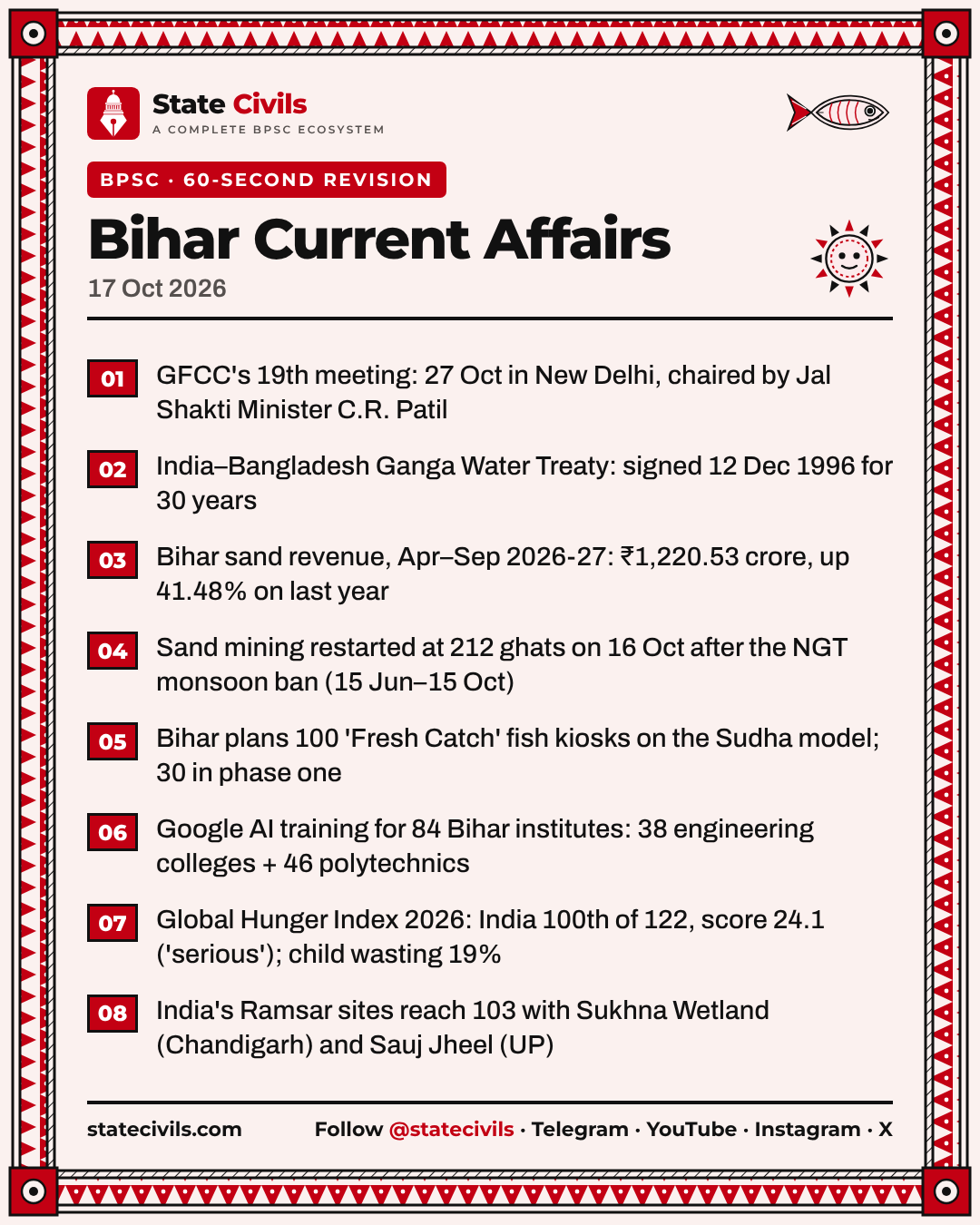
- GFCC’s 19th meeting: 27 Oct in New Delhi, chaired by Jal Shakti Minister C.R. Patil
- India–Bangladesh Ganga Water Treaty: signed 12 Dec 1996 for 30 years
- Bihar sand revenue, Apr–Sep 2026-27: ₹1,220.53 crore, up 41.48% on last year
- Sand mining restarted at 212 ghats on 16 Oct after the NGT monsoon ban (15 Jun–15 Oct)
- Bihar plans 100 ‘Fresh Catch’ fish kiosks on the Sudha model; 30 in phase one
- Google AI training for 84 Bihar institutes: 38 engineering colleges + 46 polytechnics
- Global Hunger Index 2026: India 100th of 122, score 24.1 (‘serious’); child wasting 19%
- India’s Ramsar sites reach 103 with Sukhna Wetland (Chandigarh) and Sauj Jheel (UP)
Share today’s revision card with your study group
One image, eight facts. Forward it to your BPSC group.
WhatsApp Telegram Facebook X Download card
Get this every morning: join @statecivils on Telegram. Also on YouTube, Instagram and X.
Today’s Mains question
Examine how the Farakka Barrage and recurring Ganga floods affect Bihar’s water security. Suggest what Bihar should seek in the renewal of the India–Bangladesh Ganga Water Treaty. (250 words)
Write your answer in 12 minutes, then open the model answer below and compare. Share this post with a study partner too.
Show the topper-style model answer
Decode the question
Directive: Examine + Suggest
- Examine how the Farakka Barrage and recurring Ganga floods affect Bihar’s water security
- Suggest what Bihar should seek in the renewal of the India–Bangladesh Ganga Water Treaty
Keywords to use
Farakka BarrageSiltationGanga Water Treaty 1996Lean-season flowGFCCFlood-prone north BiharIntegrated river basin managementCooperative federalismDesiltationClimate resilience
Introduction
Bihar sits in the middle Ganga plain and receives the flows of the Kosi, Gandak and Burhi Gandak. Ahead of the 19th GFCC meeting on 27 October 2026, Bihar has flagged siltation behind the Farakka Barrage, with the 1996 Ganga Water Treaty due for renewal in December.
Body
Impact on Bihar’s water security
- Siltation: Bihar says silt deposited upstream of Farakka has reduced river depth and slowed drainage of the Ganga.
- Floods: slow drainage worsens floods; the state paid ₹7,000 ex gratia to 1.60 lakh flood-hit families in October 2026.
- Agriculture: crop losses needed ₹112.52 crore in input subsidy for 2.48 lakh farmers this month.
- Lean season: the treaty divides January–May flows in 10-day blocks, while Bihar faces water stress in summer.
- Ecology: riverbed changes affect fisheries and sand ghats, both key to Bihar’s economy.
Way forward for the treaty renewal
- Formal consultation with Bihar, as an upstream riparian state, before the Union signs any new terms.
- A time-bound desiltation and sediment-management plan for the Farakka pond, reviewed by the GFCC.
- Joint flow and silt monitoring stations, with data shared on the proposed national flood dashboard.
- Basin-wide plan that links flood control in north Bihar with lean-season needs to 2050.
- Restore wetlands such as Kanwar Lake to store floodwater and recharge groundwater.
Diagram (draw this in your answer)
Draw two rows of four boxes with arrows; label the Ganga, Farakka and Bihar on a tiny map sketch beside it.
Value addition
- Ganga Water Treaty: signed 12 December 1996 for 30 years, lean season 1 January–31 May.
- Ganga Flood Control Commission: set up in 1972 for floods in the Ganga basin states.
- Ramsar Convention, 1971; Kanwar Lake in Begusarai became Bihar’s first Ramsar site in 2020.
- GFCC agenda now includes a risk-based national flood master plan and AI-based DPRs.
Conclusion
Farakka has served Kolkata port and the bilateral bond, but Bihar bears much of its silt and flood cost. A renewed treaty that brings Bihar to the table and funds sediment management would advance SDG 6 and a flood-resilient Bihar.
About 251 words without the diagram. Toppers usually score on three things: answering every part the directive asks for, adding Bihar-specific examples and data, and drawing one clean diagram.
Answer to today’s question
(b) Chandigarh and Uttar Pradesh. Sukhna Wetland is in Chandigarh and Sauj Jheel is in Mainpuri district of Uttar Pradesh; together they took India’s Ramsar tally to 103.