Can you answer this?
The National Human Rights Commission, which marked its 33rd foundation day on 12 October 2026, was set up under which law?
- Commissions of Inquiry Act, 1952
- Protection of Human Rights Act, 1993
- Protection of Civil Rights Act, 1955
- Constitution (Seventy-third Amendment) Act, 1992
Answer at the end of the post. Send it to a friend and see who gets it right.
Here are the Bihar current affairs for 13 Oct 2026 that matter for BPSC Prelims and Mains: a big Bihar cabinet sitting on airports, power and water, flood ex gratia, Bihar’s inflation data, the NHRC at 33 and this year’s Nobel in economics.
In this post: 6 updates
- Bihar
- 1. Bihar cabinet clears ₹225.91 crore land deal for a logistics park and cargo hub at Darbhanga airport
- 2. Supaul’s Pipra to get a 220/132 kV grid substation; Munger and Vaishali get surface-water supply schemes
- 3. Flood ex gratia: ₹112.14 crore sent by DBT to 1.60 lakh flood-hit families at ₹7,000 each
- 4. Bihar’s retail inflation at 5.48% in September 2026, just below the all-India 5.54%
- National
- 5. NHRC marks 33rd foundation day; CJI Surya Kant says safe drinking water is part of a dignified life
- International
- 6. Nobel economics prize 2026 goes to Robert Hall and Michael Woodford for macroeconomic stabilisation models
- Revise
- Quick revision
- Today’s Mains question
Bihar
1. Bihar cabinet clears ₹225.91 crore land deal for a logistics park and cargo hub at Darbhanga airport
The state cabinet chaired by Chief Minister Samrat Choudhary cleared 23 agenda items on 12 October. The biggest connectivity decision was compensation of about ₹225.91 crore to acquire nearly 50 acres (49.9973 acres) next to Darbhanga International Airport for a logistics park and cargo hub. The cabinet also approved tourism projects under public-private partnership (PPP): a 10-acre resort at Vaishali and three eco-tourism clusters in the Bhimbandh area of Munger, plus an MoU with NBCC (India) Ltd to develop the Gardanibagh Tank Park in Patna.
Why it matters for BPSC: Mains GS Paper II (Bihar economy, infrastructure): an air-cargo hub in Mithila could help perishable farm exports such as makhana and fish reach markets faster. Prelims angle: Darbhanga airport, PPP models and Bhimbandh (known for its hot springs) in Munger district. More on the state’s growth story on our economy current affairs page.
Prelims fact: About 50 acres at Darbhanga International Airport will host a logistics park and cargo hub; compensation sanctioned is ₹225.91 crore.
Source: Patna Press
2. Supaul’s Pipra to get a 220/132 kV grid substation; Munger and Vaishali get surface-water supply schemes
The same cabinet approved a new grid substation with 220 kV and 132 kV lines at Pipra block in Supaul for ₹575.36 crore (₹115.07 crore state equity, the rest as loans backed by a state guarantee), and ₹51.07 crore to give the Tarapur grid substation a second independent power source. For drinking water, a ₹279.51 crore scheme will use surface water from Kharagpur Lake (22 MLD) for 177 wards of Haveli Kharagpur and Tetia-Bambar blocks in Munger, while a ₹506.71 crore multi-village scheme will draw Ganga water (72 MLD) for 493 wards of Mahua and Chehrakalan blocks in Vaishali.
Why it matters for BPSC: Mains GS Paper II (Bihar economy, infrastructure, water resources): shifting from groundwater to surface water reduces exposure to arsenic and fluoride, a long-standing problem in parts of Bihar. Prelims angle: Kharagpur Lake in Munger and the Kosi-region district of Supaul.
Prelims fact: The Munger scheme (₹279.51 crore, 22 MLD) draws surface water from Kharagpur Lake for 177 wards in 14 panchayats.
Source: Patna Press
3. Flood ex gratia: ₹112.14 crore sent by DBT to 1.60 lakh flood-hit families at ₹7,000 each
Chief Minister Samrat Choudhary transferred ₹112.14 crore by Direct Benefit Transfer on 12 October to 1.60 lakh flood-affected families, at ₹7,000 per family. District Magistrates were asked to send details of families still left out, the agricultural input subsidy for crop losses is to be credited on 14 October, and repairs to damaged infrastructure are to be finished before Diwali. Floods in the Ganga, Gandak, Kosi, Bagmati and Kamla Balan affected about 55 lakh people, and Ganga erosion continues in Bhagalpur (including Naugachia), Patna, Munger, Bhojpur and Buxar. See our 11 October update on the ₹10,671 crore flood loss estimate for the damage figures.
Why it matters for BPSC: Mains GS Paper II (disaster management, Bihar geography) and GS Paper I (current events): Bihar is among India’s most flood-prone states, and the shift from cash doles to DBT is a governance theme. Link it to the Disaster Management Act, 2005 and river erosion along the Ganga.
Prelims fact: Ex gratia flood relief in Bihar this year is ₹7,000 per affected family, paid by DBT.
Source: IANS
4. Bihar’s retail inflation at 5.48% in September 2026, just below the all-India 5.54%
The National Statistics Office (NSO), MoSPI, released CPI data for September 2026 on the new base year 2024=100. All-India headline inflation rose to 5.54% from 4.83% in August, with rural inflation (6.08%) well above urban (4.88%). Food inflation (CFPI) jumped to 7.74%, led by onion (108.09%), ginger and garlic, while potato and tomato prices fell year on year. Bihar’s combined inflation was 5.48% (rural 5.58%, urban 4.88%).
Why it matters for BPSC: Mains GS Paper II (Indian and Bihar economy): Bihar’s mostly rural consumption basket makes rural food inflation a direct welfare issue. Prelims angle: CPI is compiled by the NSO under MoSPI and is the measure used in RBI’s inflation-targeting framework.
Prelims fact: The new CPI series uses base year 2024=100; September 2026 all-India CPI inflation was 5.54%.
Source: MoSPI (NSO)
National
5. NHRC marks 33rd foundation day; CJI Surya Kant says safe drinking water is part of a dignified life
The National Human Rights Commission (NHRC) marked its 33rd foundation day on 12 October with a conference on water titled “Water – The Elixir of Life”. Chief Justice of India Surya Kant said water access is not just a tap connection but a safe and reliable supply, and that water contaminated with arsenic or fluoride threatens life and health. He noted that the Supreme Court has read pollution-free water and air into the right to life under Article 21. The NHRC has registered more than 24 lakh cases and disposed of over 23 lakh, and launched a mobile app.
Why it matters for BPSC: Mains GS Paper II (polity, statutory bodies, fundamental rights): links Article 21 jurisprudence with Bihar’s own arsenic and fluoride problem and the drinking-water schemes cleared this week. Prelims angle: NHRC is a statutory, not constitutional, body.
Prelims fact: The NHRC was set up on 12 October 1993 under the Protection of Human Rights Act, 1993; its chairperson is Justice V. Ramasubramanian.
Source: ANI
International
6. Nobel economics prize 2026 goes to Robert Hall and Michael Woodford for macroeconomic stabilisation models
The Royal Swedish Academy of Sciences awarded the 2026 Sveriges Riksbank Prize in Economic Sciences in Memory of Alfred Nobel to US economists Robert Hall and Michael Woodford on 12 October, the last Nobel announcement of the year. Their work built macroeconomic models on microeconomic foundations (how households and firms actually behave), giving central banks and governments a sounder basis for using monetary and fiscal policy to smooth booms and recessions after older Keynesian models broke down in the 1970s oil crises.
Why it matters for BPSC: Prelims (awards) and Mains GS Paper II (economy): the theory behind inflation targeting by central banks such as the RBI, which ties in with this week’s CPI data.
Prelims fact: The 2026 economics Nobel went to Robert Hall and Michael Woodford; the prize is worth about $1.2 million.
Source: Al Jazeera
Quick revision
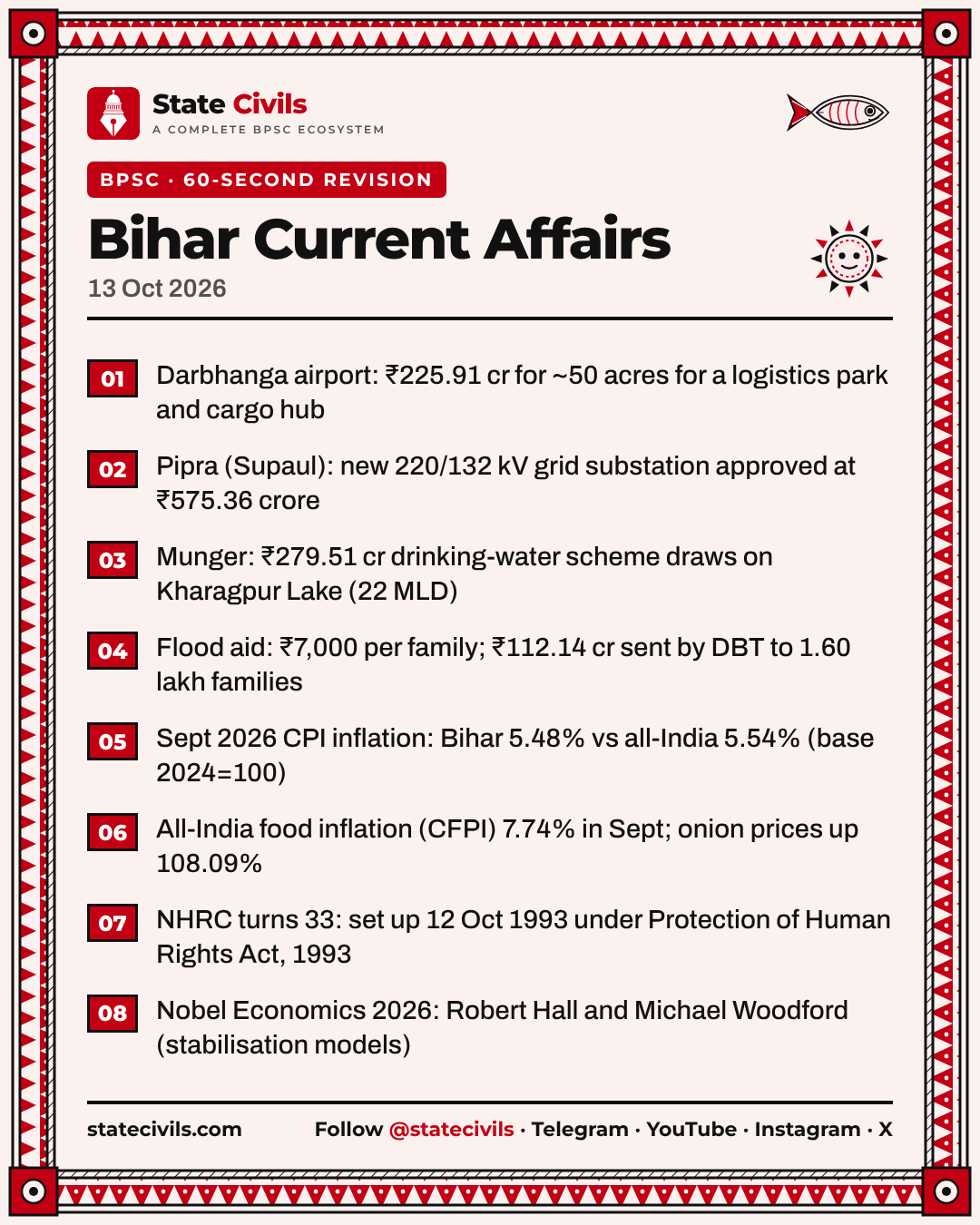
- Darbhanga International Airport: ₹225.91 crore for about 50 acres for a logistics park and cargo hub.
- Pipra (Supaul): new 220/132 kV grid substation at ₹575.36 crore.
- Munger: ₹279.51 crore drinking-water scheme using Kharagpur Lake (22 MLD, 177 wards).
- Flood ex gratia: ₹7,000 per family; ₹112.14 crore sent by DBT to 1.60 lakh families.
- September 2026 CPI inflation: Bihar 5.48%, all-India 5.54% (base 2024=100).
- All-India food inflation (CFPI) 7.74% in September; onion up 108.09%.
- NHRC: set up 12 October 1993 under the Protection of Human Rights Act, 1993; 33rd foundation day.
- Nobel Economics 2026: Robert Hall and Michael Woodford.
Share today’s revision card with your study group
One image, eight facts. Forward it to your BPSC group.
WhatsApp Telegram Facebook X Download card
Get this every morning: join @statecivils on Telegram. Also on YouTube, Instagram and X.
Today’s Mains question
Floods in Bihar are an annual disaster, yet the response remains largely relief-centric. Examine the challenges in Bihar’s flood and erosion management and suggest measures to build long-term resilience, with reference to the 2026 floods. (250 words)
Write your answer in 12 minutes, then open the model answer below and compare. Share this post with a study partner too.
Show the topper-style model answer
Decode the question
Directive: Examine + Suggest
- Show why Bihar’s flood response is still relief-centric, using 2026 data
- Examine the challenges in flood and erosion management (physical, institutional, economic)
- Suggest measures for long-term resilience
Keywords to use
Flood-prone plainsEx gratia via DBTRiver erosionEmbankmentsSediment loadDisaster Management Act, 2005Sendai FrameworkFlood forecastingCrop input subsidyClimate resilience
Introduction
North Bihar sits on the floodplains of the Kosi, Gandak, Bagmati and Kamla Balan, rivers that rise in Nepal and carry heavy silt. In 2026, floods affected about 55 lakh people, and on 12 October the state paid ₹112.14 crore as ₹7,000 ex gratia to 1.60 lakh families by DBT.
Body
Relief-centric response
- Cash doles, dry rations and input subsidies dominate spending every year.
- Losses for 2026 are estimated at ₹10,671 crore, a recurring fiscal drain.
- DBT has improved speed and transparency, but left-out families still depend on district surveys.
Challenges
- Physical: high silt load, shifting channels and Ganga erosion at Naugachia, Bhagalpur, Munger and Buxar.
- Trans-boundary: most catchments lie in Nepal, so rainfall data and dam releases need cooperation.
- Institutional: embankments breach, maintenance is weak and repairs race against the next monsoon.
- Socio-economic: smallholders, sharecroppers and migrants lose crops, homes and land titles to erosion.
Way forward
- Basin-level planning with Nepal and real-time flood forecasting.
- Anti-erosion works plus relocation and land-for-land for families losing homesteads.
- Flood-resilient housing, raised platforms and crop insurance for kharif.
- Restore wetlands and drainage to give rivers room to spread.
Diagram (draw this in your answer)
Draw two rows of boxes with arrows; circle the loop back from ex gratia to the next flood.
Value addition
- Disaster Management Act, 2005 created NDMA and state disaster management authorities.
- Sendai Framework for Disaster Risk Reduction 2015–2030 shifts focus from response to risk reduction.
- 2026 Bihar floods: about 55 lakh people affected; ₹7,000 ex gratia per family paid by DBT.
- SDG 11 and SDG 13 call for resilient settlements and climate adaptation.
Conclusion
Relief by DBT is a welcome governance reform, but it treats symptoms. A basin-wide, forecast-led and erosion-aware strategy aligned with the Sendai Framework and SDG 13 can turn Bihar’s floodplains from a liability into a resilient growth zone.
About 222 words without the diagram. Toppers usually score on three things: answering every part the directive asks for, adding Bihar-specific examples and data, and drawing one clean diagram.
Answer to today’s question
(b) Protection of Human Rights Act, 1993. The NHRC was set up on 12 October 1993 as a statutory body under this Act, which is why its foundation day falls on 12 October.