Quick answer: The 72nd BPSC Prelims is scheduled for 25 October 2026 (tentative, as per the latest BPSC exam calendar). With about three weeks left, stop starting new topics. Spend week 1 revising Bihar-specific topics and static General Studies, week 2 on current affairs of the last 12 months and full mock tests, and week 3 on quick revision, one mock every two days, and rest before the exam.
The last three weeks before the BPSC Prelims decide more than most aspirants realise. This is when you convert months of reading into marks. This 72nd BPSC Prelims strategy gives you a day-by-day revision plan, a subject-wise priority list, the exam-day rules you must know, and an attempt strategy for the paper.
Key facts
- Exam: 72nd BPSC Combined (Preliminary) Competitive Examination 2026.
- Date: 25 October 2026 (tentative). It was first scheduled for 26 July 2026 and was postponed.
- Paper: one General Studies paper, 150 MCQs, 150 marks, 2 hours.
- Negative marking: one-third of a mark for each wrong answer.
- Five options per question: A to D are answers; E means “not attempted”. An unmarked question is also penalised.
- Prelims is a screening test; its marks are not counted in the final merit.
72nd BPSC Prelims 2026: exam date and pattern
The Bihar Public Service Commission (BPSC) released the 72nd Combined Competitive Examination notification in May 2026, with online applications open from 7 to 31 May 2026. The Prelims was originally scheduled for 26 July 2026. It was postponed, and the latest BPSC exam calendar lists 25 October 2026 as the tentative date. Always confirm the final date and your admit card on the official BPSC website.
| Feature | Details |
|---|---|
| Number of papers | 1 (General Studies) |
| Questions | 150 multiple-choice questions |
| Total marks | 150 |
| Duration | 2 hours |
| Options | 5 (A, B, C, D and E = not attempted) |
| Negative marking | 1/3 mark per wrong or unmarked answer |
| Language | Hindi and English |
| Nature | Qualifying (screening for Mains) |
Prelims fact: If you do not want to answer a question, darken option E. Leaving all five options blank attracts the same one-third negative mark as a wrong answer.
72nd BPSC Prelims strategy: what to revise first
In the last three weeks, revise what is most likely to be asked and what you have already studied. Use this priority list, based on the official syllabus and the pattern of recent BPSC papers.
| Priority | Area | What to revise |
|---|---|---|
| Very high | Bihar-specific topics | History of Bihar, Bihar in the freedom struggle, geography and rivers of Bihar, Bihar economy and state schemes |
| Very high | Current affairs | National, international and Bihar events of the last 12 months |
| High | Modern Indian history and national movement | 1857 to 1947, with Bihar’s role |
| High | Indian polity | Constitution basics, Parliament, judiciary, Panchayati Raj |
| High | General science | NCERT-level physics, chemistry and biology; everyday science |
| Medium | Geography of India and the world | Physical features, rivers, climate, maps |
| Medium | Indian economy | Basic concepts, budget, schemes, banking |
| Medium | General mental ability | Arithmetic, reasoning, data interpretation |
For Bihar topics in English, our Bihar Special for Prelims course has detailed PDF notes and practice quizzes made for exactly this kind of quick revision.
Week 1: revise Bihar and static General Studies
The first week is about consolidation. Do not open a new book.
- Mornings (3 hours): Bihar-specific topics. Cover history of Bihar on days 1–2, geography and rivers on days 3–4, economy and schemes on days 5–6, and Bihar’s role in the national movement on day 7.
- Afternoons (3 hours): static General Studies from your own notes: polity, modern history, science.
- Evenings (1 hour): 30–40 MCQs on the day’s topics, and the daily current affairs quiz.
Keep a “mistakes sheet”. Every time you get a question wrong, write the correct fact in one line. This sheet becomes your final revision material.
Week 2: current affairs and full mock tests
In the second week, shift to current affairs and exam practice.
- Current affairs: revise 12 months of events, one month per half-day. Focus on Bihar schemes, appointments, awards, sports, reports and indices. Our monthly Bihar current affairs compilations are designed for this.
- Mock tests: take three full-length mock tests this week, in exam conditions: 2 hours, OMR sheet, no breaks.
- Analysis: spend as long analysing each mock as you spent writing it. Note your accuracy in each subject and the questions you guessed.
Week 3: final revision and rest
The last week is for sharpening, not learning.
- Revise your mistakes sheet and short notes twice.
- Take a mock test every second day, at the same time as the real exam (12 noon to 2 pm), so your mind is alert at that hour.
- Revise maps of Bihar: districts, rivers, national parks and wildlife sanctuaries.
- Sleep 7–8 hours every night. Tiredness costs more marks than one more chapter can add.
- Take the last two days lightly: quick revision only, and prepare your documents.
How many questions to attempt in the 72nd BPSC Prelims
There is no fixed safe number. It depends on the difficulty of the paper and your accuracy. Use your mock tests to find your own number with this rule of thumb:
- First round: answer every question you are sure of. This usually takes about 60–70 minutes.
- Second round: attempt questions where you can confidently eliminate two or more options.
- Skip and mark E: for questions where you cannot eliminate any option, mark E.
With one-third negative marking, a guess between two remaining options is worth taking on average (+1/3 mark per question), while a blind guess among four options gains nothing on average and adds risk. Keep about 10 minutes at the end to check your OMR sheet.
Prelims fact: With 1/3 negative marking, each wrong answer cancels one-third of a correct answer, so three wrong answers cost you one full mark.
Bihar topics checklist for the final revision
Bihar-specific questions are where well-prepared candidates pull ahead, so a focused Bihar checklist is the heart of any 72nd BPSC Prelims strategy. Tick each item only when you can recall the key facts without looking at your notes.
- Ancient Bihar: Magadha and its capitals (Rajgriha, Pataliputra), the Haryanka, Shishunaga, Nanda, Maurya and Gupta dynasties, Buddhism and Jainism in Bihar, Nalanda and Vikramshila.
- Medieval Bihar: Sher Shah Suri and his administration, Sufi saints and centres in Bihar.
- Modern Bihar: Kunwar Singh and the revolt of 1857, the Wahabi movement, Champaran Satyagraha (1917), the Non-Cooperation and Quit India movements in Bihar, and the creation of Bihar as a separate province in 1912.
- Geography: physical divisions, the Ganga and its tributaries (Kosi, Gandak, Son, Ghaghara, Bagmati, Punpun), floods and drought, soils, climate, minerals, national parks and wildlife sanctuaries.
- Economy: key figures from the latest Bihar Economic Survey and Budget, agriculture and allied sectors, industry and investment policies.
- Governance and schemes: Saat Nischay, Jal-Jeevan-Hariyali, JEEViKA, and schemes for students, women and farmers that were in the news this year.
- Culture: Madhubani and other painting styles, Chhath and other festivals, folk music and dance, and important heritage sites.
72nd BPSC Prelims strategy for English-medium candidates
If you are writing the exam in English, read every question in the English version first, and check the Hindi version only when the English wording seems unclear. Learn official scheme names (for example, Saat Nischay or Mukhyamantri Kanya Utthan Yojana) exactly as they are written, because the paper uses these names. For a complete plan, read our BPSC English medium guide.
Exam-day checklist for the 72nd BPSC Prelims
- Download your admit card from the BPSC website as soon as it is released, and print two copies.
- Carry an original photo ID (as listed on the admit card) and passport-size photographs if asked for.
- Use a black ballpoint pen; carry two.
- Reach the centre early. Gate-closing times are strict.
- Do not carry phones, smartwatches, calculators or notes.
- Read every instruction on the admit card and OMR sheet, including how to mark option E.
Mistakes to avoid in the last three weeks
- Starting a new book or new coaching notes.
- Taking too many mock tests without analysing them.
- Ignoring Bihar-specific topics, which decide most of the cut-off difference.
- Skipping mental ability and data interpretation, which are scoring if practised.
- Studying late into the night just before the exam.
FAQs
When is the 72nd BPSC Prelims exam?
The latest BPSC exam calendar lists 25 October 2026 as the tentative date. The exam was first scheduled for 26 July 2026 and was postponed. Check the BPSC website for the final date and admit card.
Is there negative marking in the 72nd BPSC Prelims?
Yes. One-third of a mark is deducted for every wrong answer. A question left completely unmarked is also penalised, so mark option E for questions you skip.
How should I revise for BPSC Prelims in the last 3 weeks?
Revise Bihar topics and static General Studies in week 1, current affairs and full mock tests in week 2, and your short notes and mistakes sheet in week 3. Do not start any new material.
How many questions are asked from Bihar in the BPSC Prelims?
The number changes every year, and BPSC does not publish a fixed share. Bihar history, geography, economy, schemes and Bihar current affairs together form a significant part of every recent paper, so they deserve a large share of your revision time.
Are Prelims marks counted in the final BPSC merit?
No. The Prelims is a screening test. Final merit is based on the Mains (General Studies Paper I, Paper II and the Essay) and the Interview.
Sources
- Bihar Public Service Commission (official website): notification, exam calendar and admit cards.
- Press Information Bureau: national current affairs.
- Government of Bihar: state schemes and Economic Survey.
Related reading: BPSC syllabus explained and BPSC English medium preparation guide.
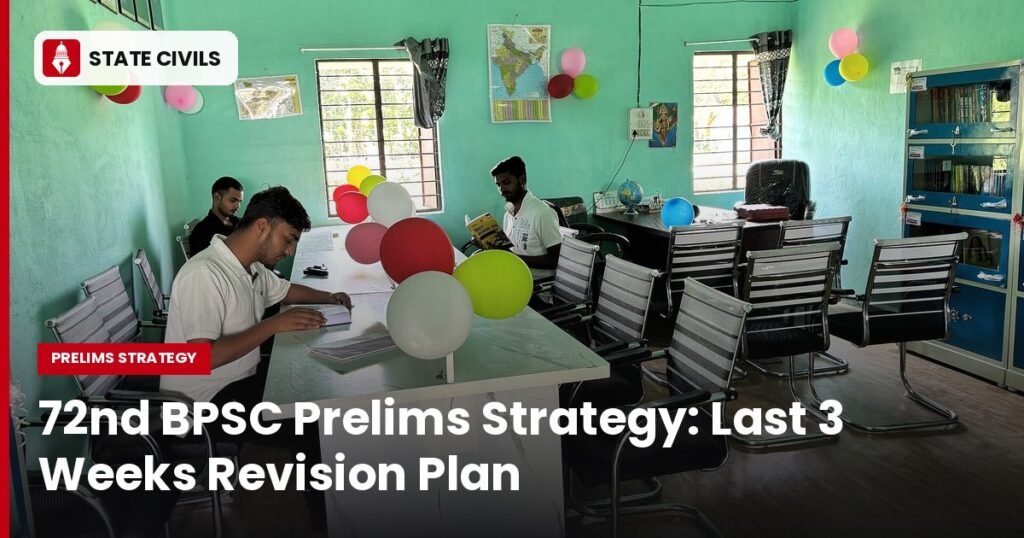
Featured image: Public Library, Bhiswa. Samir Kumar / Wikimedia Commons, CC BY-SA 4.0 (cropped, text added).


1 comment