Can you answer this?
Under India’s flexible inflation targeting framework, the Monetary Policy Committee is deemed to have failed to meet its target if average CPI inflation stays outside the 2–6% band for:
- Two consecutive quarters
- Three consecutive quarters
- Four consecutive quarters
- Six consecutive months
Answer at the end of the post. Send it to a friend and see who gets it right.
Here are today’s Bihar current affairs for BPSC, 26 Nov 2026: Bihar’s first paperless e-Cabinet, a big Patna water project, a sixfold rise in Gram Kachahari funds, a new BPSC chairperson and four national updates.
In this post: 8 updates
- Bihar
- 1. Bihar’s first e-Cabinet clears ₹1,794.32 crore Patna water supply project under AMRUT 2.0
- 2. Gram Kachahari allowance raised sixfold to ₹24,000 per unit from 1 April 2027
- 3. Industrial land in Nalanda, Samastipur and Sheikhpura: 1,294 acres to be acquired
- 4. Harjot Kaur Bamhrah named BPSC chairperson; takes charge on 29 November
- National
- 5. Cabinet approves ₹2,632 crore for India Post: Estates Management and Postal Operations schemes
- 6. ₹11,000 crore scheme to build a construction and infrastructure equipment (CIE) manufacturing ecosystem
- Economy
- 7. RBI November 2026 bulletin: CPI inflation at 6.09% in October, above the tolerance band
- Environment / Science
- 8. MoSPI and Data Security Council of India sign MoU on trusted data sharing for official statistics
- Revise
- Quick revision
- Today’s Mains question
Bihar
1. Bihar’s first e-Cabinet clears ₹1,794.32 crore Patna water supply project under AMRUT 2.0
The state cabinet, chaired by Chief Minister Samrat Choudhary on 25 November, met for the first time under an e-Cabinet system that makes the whole process digital and paperless. It approved 34 proposals. The largest was an administrative sanction of ₹1,794.32 crore for the Patna Water Supply Project (पटना जलापूर्ति परियोजना) under the centrally sponsored AMRUT 2.0 scheme, meant to strengthen drinking-water infrastructure and give the capital a regular supply of clean water. Hindi reports say Ganga water is to reach 75 wards of Patna under the project.
Why it matters for BPSC: Prelims can test AMRUT 2.0 (Ministry of Housing and Urban Affairs) and urban water supply. For Mains GS Paper II, link it to urbanisation in Bihar, e-governance and ‘ease of living’. The paperless cabinet is a good e-governance example for answers on administrative reform.
Prelims fact: The Patna Water Supply Project got ₹1,794.32 crore under AMRUT 2.0 at the 25 Nov 2026 cabinet meeting.
Source: Punjab Kesari (IANS)
2. Gram Kachahari allowance raised sixfold to ₹24,000 per unit from 1 April 2027
The same cabinet raised the annual administrative expenditure allowance of Gram Kachaharis (ग्राम कचहरी), Bihar’s village courts, from ₹4,000 to ₹24,000 per unit. The higher amount applies from 1 April 2027. Hindi papers reported the decision as a sixfold increase in the Gram Kachahari grant. The move should help these village-level bodies meet routine running costs.
Why it matters for BPSC: Gram Kachaharis are a distinctive feature of Bihar’s Panchayati Raj system and a frequent Mains GS Paper II theme on access to justice and local governance. Link it to Article 40 (village panchayats, DPSP) and Article 39A (equal justice). Compare with the state’s push for virtual hearings in revenue courts covered on 24 November.
Prelims fact: Gram Kachahari allowance: ₹4,000 → ₹24,000 per unit per year, effective 1 April 2027.
Source: Amar Ujala
3. Industrial land in Nalanda, Samastipur and Sheikhpura: 1,294 acres to be acquired
The cabinet also sanctioned money to acquire land for industrial development at three places: ₹382.23 crore for 564.37 acres in Brahgawan village of Islampur, Nalanda; ₹261.92 crore for 480 acres across three revenue villages of Khanpur block, Samastipur; and ₹62.37 crore for 250 acres across three revenue villages of Chewara block, Sheikhpura. A separate decision transfers 11.884 decimals of land in Thakurganj block, Kishanganj, to the Union Home Ministry for watchtowers of the 19th and 41st battalions of the Sashastra Seema Bal (SSB).
Why it matters for BPSC: A land bank is the first step in Bihar’s industrial policy; useful for Mains GS Paper II (Bihar economy, industrialisation, land acquisition). The SSB item links to border management on the India–Nepal border (Kishanganj is a border district). See more on the economy topic page.
Prelims fact: The largest parcel is 564.37 acres at Brahgawan, Islampur block, Nalanda (₹382.23 crore).
Source: Punjab Kesari (IANS)
4. Harjot Kaur Bamhrah named BPSC chairperson; takes charge on 29 November
Harjot Kaur Bamhrah, a 1992-batch IAS officer of the Bihar cadre, has been appointed chairperson of the Bihar Public Service Commission. A General Administration Department notification issued in the Governor’s name says the appointment takes effect from 29 November, after she takes voluntary retirement from service on 28 November. Under the rules, the chairperson holds office for six years or until the age of 62, whichever comes first.
Why it matters for BPSC: Very likely in Prelims and Mains GS Paper II (polity): State Public Service Commissions are under Articles 315–323; the Governor appoints the chairperson and members of an SPSC (Article 316), but only the President can remove them (Article 317).
Prelims fact: An SPSC chairperson serves six years or till age 62, whichever is earlier (Article 316).
Source: Patna Press
National
5. Cabinet approves ₹2,632 crore for India Post: Estates Management and Postal Operations schemes
The Union Cabinet chaired by Prime Minister Narendra Modi on 25 November approved two Department of Posts schemes for FY 2026-27 to FY 2030-31. The Estates Management Scheme continues with ₹1,491 crore for building, repairing and upgrading postal buildings and staff colonies. The Postal Operations Scheme (₹1,141 crore) covers mail and parcel network optimisation and rural infrastructure. Together they aim to improve last-mile delivery and e-commerce logistics.
Why it matters for BPSC: Prelims: Department of Posts is under the Ministry of Communications. Mains GS Paper II: post offices as hubs for financial inclusion and service delivery in rural Bihar.
Prelims fact: Estates Management Scheme outlay: ₹1,491 crore (Department of Posts, Ministry of Communications).
Source: NationPress
6. ₹11,000 crore scheme to build a construction and infrastructure equipment (CIE) manufacturing ecosystem
The Union Cabinet also cleared the ‘Scheme for Enhancement of Construction and Infrastructure Equipment (CIE) Manufacturing Ecosystem’ with an outlay of ₹11,000 crore. The Ministry of Heavy Industries will implement it. The aim is to raise domestic manufacturing of construction machinery and components, cut import dependence and set up a dedicated testing facility in India. Operational guidelines are yet to be notified.
Why it matters for BPSC: Mains GS Paper II (Indian economy): links to Atmanirbhar Bharat, capital goods, Make in India and infrastructure-led growth. Bihar’s expressways and bridges are big users of such equipment.
Prelims fact: The CIE manufacturing scheme (₹11,000 crore) is implemented by the Ministry of Heavy Industries.
Source: NationPress
Economy
7. RBI November 2026 bulletin: CPI inflation at 6.09% in October, above the tolerance band
The RBI’s November bulletin, released on 25 November, said the Indian economy stood out amid uneven global growth. Headline CPI inflation rose to 6.09% in October from 5.54% in September, above the upper limit of the Monetary Policy Committee’s tolerance band. Bank credit grew 19.5% year on year as of end-October and deposits nearly 17%. The bulletin noted that the pass-through of the West Asia oil price shock to retail fuel prices has been limited.
Why it matters for BPSC: Prelims: inflation target of 4% with a 2–6% band under Section 45ZA of the RBI Act. Mains GS Paper II: inflation, monetary policy and their effect on household budgets in Bihar.
Prelims fact: India’s CPI inflation target is 4% with a band of 2% to 6%, set by the Union government.
Source: Business Standard
Environment / Science
8. MoSPI and Data Security Council of India sign MoU on trusted data sharing for official statistics
The Ministry of Statistics and Programme Implementation (MoSPI) signed an MoU with the Data Security Council of India (DSCI), a body set up by Nasscom, in New Delhi on 25 November. The partnership covers trusted data-sharing protocols, joint research on data governance, privacy-enhancing technologies and responsible use of AI. The first output will be a joint policy paper on trusted data flows and data management.
Why it matters for BPSC: Mains GS Paper II (science & technology, governance): data governance and privacy. Link with the Digital Personal Data Protection Act, 2023, which the release says is scheduled to come into force in 2027.
Prelims fact: DSCI was set up by Nasscom; MoSPI is the nodal ministry for official statistics.
Source: PIB
Quick revision
- Bihar’s cabinet met paperless under the new e-Cabinet system on 25 Nov 2026 and cleared 34 proposals.
- Patna Water Supply Project: ₹1,794.32 crore under AMRUT 2.0.
- Gram Kachahari allowance: ₹4,000 to ₹24,000 per unit per year from 1 April 2027.
- Industrial land: 564.37 acres at Islampur (Nalanda) for ₹382.23 crore.
- Harjot Kaur Bamhrah (IAS 1992, Bihar cadre) becomes BPSC chairperson from 29 Nov 2026.
- India Post: ₹2,632 crore for two schemes, FY 2026-27 to 2030-31.
- ₹11,000 crore CIE manufacturing scheme, run by the Ministry of Heavy Industries.
- RBI bulletin: CPI inflation 6.09% in October 2026, up from 5.54% in September.
Share today’s revision card with your study group
One image, eight facts. Forward it to your BPSC group.
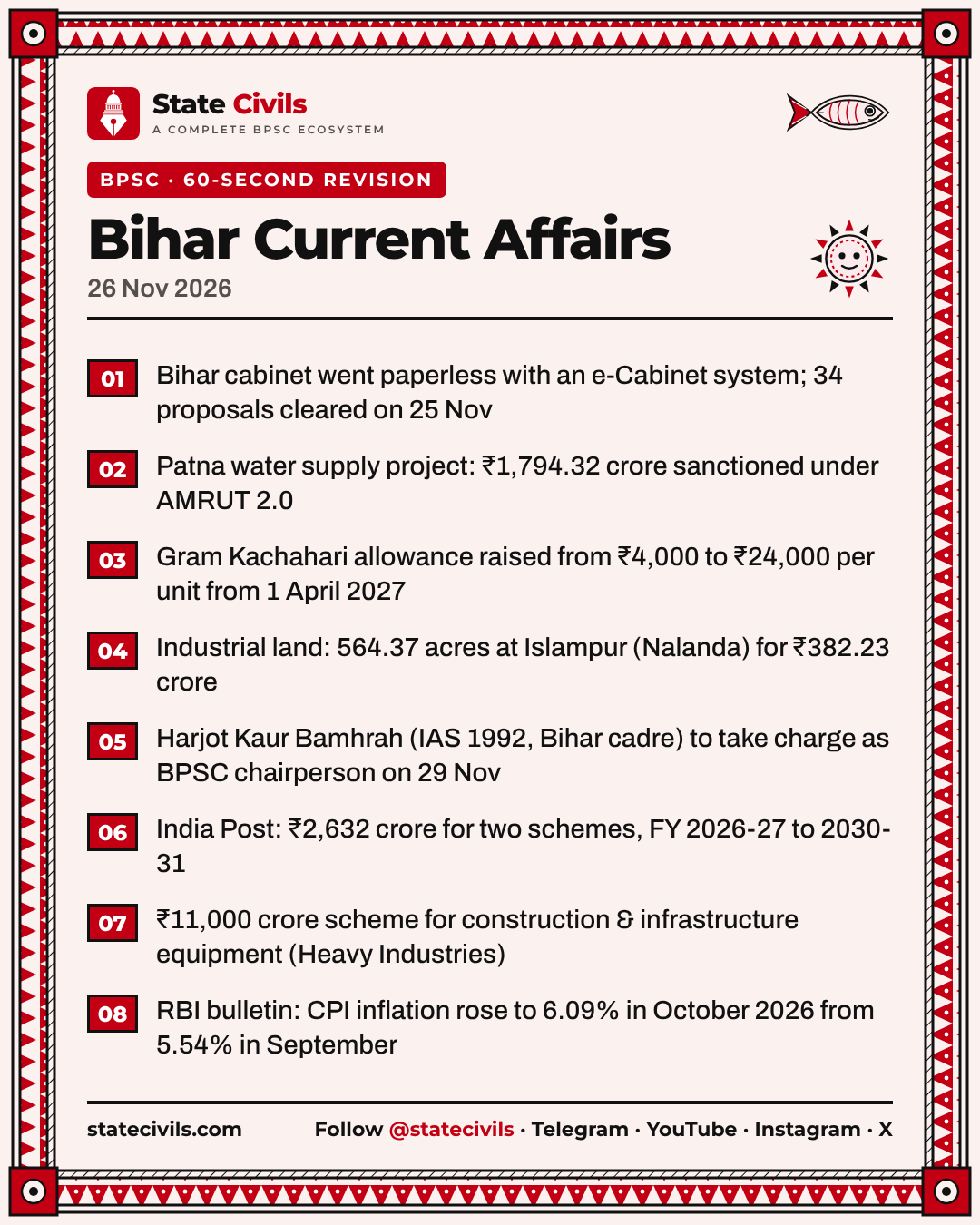
WhatsApp Telegram Facebook X Download card
Get this every morning: join @statecivils on Telegram. Also on YouTube, Instagram and X.
Today’s Mains question
Gram Kachaharis are a distinctive feature of Bihar’s Panchayati Raj system. Examine their role in providing accessible justice at the village level and the challenges they face, with reference to the recent increase in their administrative allowance. (250 words)
Write your answer in 12 minutes, then open the model answer below and compare. Share this post with a study partner too.
Show the topper-style model answer
Decode the question
Directive: Examine
- Role of Gram Kachaharis in accessible, local justice
- Challenges they face
- Significance of the higher allowance and way forward
Keywords to use
Bihar Panchayat Raj Act, 2006Nyaya PanchayatArticle 40Article 39ASarpanchNyaya Mitraaccess to justicealternative dispute resolutionjudicial pendencycapacity building
Introduction
Gram Kachaharis are elected village courts created under the Bihar Panchayat Raj Act, 2006 to settle minor civil and criminal disputes close to home. On 25 November 2026, the Bihar cabinet raised their annual administrative allowance sixfold, from ₹4,000 to ₹24,000 per unit, from April 2027.
Body
Role in accessible justice
- Decide small civil and petty criminal cases at the village level, cutting travel, cost and delay for the rural poor.
- Encourage conciliation and compromise, reducing the load on district courts.
- Elected Sarpanch and Panch members give local legitimacy; women’s reservation in panchayats widens representation.
- Give effect to Article 40 (village panchayats) and Article 39A (equal justice) in Bihar.
Challenges
- Thin funds for stationery, records and hearings; the earlier ₹4,000 a year was barely enough.
- Limited legal training of members and dependence on a Nyaya Mitra for legal advice.
- Weak enforcement of decisions and overlap with police and regular courts.
- Local power equations and caste pressure can affect fairness.
Way forward
- Use the ₹24,000 allowance for proper records, digitised cause lists and regular sittings.
- Train members with the State Legal Services Authority.
- Link Gram Kachaharis to e-governance, like the virtual hearings now held in Bihar’s revenue courts.
- Social audit of decisions through the Gram Sabha.
Diagram (draw this in your answer)
Draw two rows of boxes with arrows; label the top row ‘role’ and the bottom row ‘reform’.
Value addition
- Bihar Panchayat Raj Act, 2006 provides for Gram Kachaharis in every gram panchayat.
- Article 40 (DPSP) asks the State to organise village panchayats; Article 39A promotes equal justice and free legal aid.
- Bihar cabinet, 25 Nov 2026: allowance raised from ₹4,000 to ₹24,000 per unit from 1 April 2027.
- 73rd Constitutional Amendment Act, 1992 gave panchayats constitutional status (Part IX).
Conclusion
Gram Kachaharis can make justice cheap, quick and local if they are funded, trained and monitored. The higher allowance is a good start; pairing it with digital tools and legal training would take Bihar closer to SDG 16 on access to justice for all.
About 248 words without the diagram. Toppers usually score on three things: answering every part the directive asks for, adding Bihar-specific examples and data, and drawing one clean diagram.
Answer to today’s question
(b) Three consecutive quarters. Under the RBI Act, the MPC is deemed to have failed if average CPI inflation stays above 6% or below 2% for three consecutive quarters; it must then report to the Union government with reasons and remedial steps.