Can you answer this?
Under the 24-hour piped water schemes whose foundation was laid on 21 November 2026, which Bihar city will cover the largest number of households?
- Hajipur
- Motihari
- Purnia
- Danapur
Answer at the end of the post. Send it to a friend and see who gets it right.
Bihar current affairs for 22 November 2026, built for BPSC Prelims and Mains: what the PM’s Vaishali programme means for farmers and Bihar’s cities, plus India’s bioeconomy target and the Nepal PM’s visit.
In this post: 6 updates
- Bihar
- 1. PM announces 12 hours of daily electricity for irrigation for Bihar’s farmers
- 2. 100 PM-eBuses flagged off and 26,900 PMAY-Urban families enter new homes at the PM’s Vaishali event
- 3. BUIDCO’s 14 water and sewerage schemes: 24-hour piped water for 2.41 lakh homes in 11 Bihar cities
- 4. Kahalgaon sewerage and STP project opened; new sewerage networks for Begusarai, Bodh Gaya and Biharsharif
- Environment / Science
- 5. BRIC aims to grow India’s bioeconomy to $300 billion by 2030 and $1 trillion by 2047
- International
- 6. Nepal PM Balendra Shah begins two-day India visit; MoUs to be exchanged
- Revise
- Quick revision
- Today’s Mains question
Bihar
1. PM announces 12 hours of daily electricity for irrigation for Bihar’s farmers
Speaking at the Vaishali programme on 21 November, the Prime Minister said a decision has been taken to give Bihar’s farmers 12 hours of power for irrigation. He also said investment agreements worth about ₹2 lakh crore were signed in the state over the past year, and that around 75 lakh farmers in Bihar have received money under PM-KISAN. The scope, start date and cost of the irrigation-power decision were not detailed. The visit itself was previewed in yesterday’s Nitish Setu and investment update.
Why it matters for BPSC: Mains GS Paper II (Bihar economy: agriculture, irrigation and energy). Assured daytime power for pumps can cut diesel costs, support the shift away from diesel pump-sets and raise cropping intensity in a state where most farms are small and groundwater-irrigated.
Prelims fact: PM-KISAN pays eligible farmer families ₹6,000 a year in three equal instalments of ₹2,000 by direct benefit transfer.
Source: IANS via Punjab Kesari
2. 100 PM-eBuses flagged off and 26,900 PMAY-Urban families enter new homes at the PM’s Vaishali event
The package of about ₹34,470 crore unveiled in Vaishali included flagging off 100 electric buses under PM-eBus Sewa and a Griha Pravesh ceremony for more than 26,900 beneficiaries of Pradhan Mantri Awas Yojana–Urban. Power distribution loss-reduction works worth over ₹1,130 crore under the Revamped Distribution Sector Scheme (RDSS) were inaugurated, and the foundation stone was laid for four-laning the Sahebganj–Areraj–Bettiah stretch of NH-139W (over ₹3,800 crore).
Why it matters for BPSC: Prelims (schemes) and Mains GS Paper II (urban development, infrastructure). Ties urban housing, clean public transport and DISCOM reform together; useful for questions on central schemes in Bihar.
Prelims fact: PM-eBus Sewa is run by the Ministry of Housing and Urban Affairs (MoHUA).
Source: PMIndia (Prime Minister’s Office)
3. BUIDCO’s 14 water and sewerage schemes: 24-hour piped water for 2.41 lakh homes in 11 Bihar cities
The foundation was laid for 14 drinking-water and sewerage schemes of the Bihar Urban Infrastructure Development Corporation (BUIDCO), with one more inaugurated, at a total cost of about ₹2,306.27 crore. Over 2.41 lakh households in 11 towns are to get round-the-clock piped water. Purnia has the largest coverage (48,787 homes), followed by Motihari (21,930), Biharsharif (20,450) and Khagaria (20,436); the list also includes Hajipur, Sitamarhi, Samastipur, Saharsa, Danapur, Dehri-Dalmianagar and Kishanganj.
Why it matters for BPSC: Mains GS Paper II (urban governance, Bihar’s infrastructure). Water supply and sanitation are municipal functions in the Twelfth Schedule (Article 243W, 74th Amendment); the schemes are an example of urban local services delivered through a state agency.
Prelims fact: Purnia gets the largest share – 48,787 of the 2.41 lakh households covered.
Source: Prabhat Khabar
4. Kahalgaon sewerage and STP project opened; new sewerage networks for Begusarai, Bodh Gaya and Biharsharif
Within the same BUIDCO package, the ₹45.99 crore sewerage and sewage treatment plant (STP) project at Kahalgaon was inaugurated to stop the town’s untreated sewage from reaching the Ganga. Foundation stones were laid for a ₹375.87 crore sewerage network in Begusarai (about 26,700 houses, 13 MLD STP), a ₹232.90 crore project in Hajipur (7 MLD STP), a ₹92.25 crore network in Bodh Gaya (about 6,000 houses) and a ₹76.66 crore project in Biharsharif.
Why it matters for BPSC: Mains GS Paper II (environment and urban sanitation) and Essay (river health). Untreated urban sewage is the main pollution load on the Ganga in Bihar; STPs in riverside towns like Kahalgaon and Begusarai matter for river ecology and public health.
Prelims fact: Kahalgaon (Bhagalpur district) lies near the ruins of Vikramshila Mahavihara, founded by the Pala king Dharmapala.
Source: Prabhat Khabar
Environment / Science
5. BRIC aims to grow India’s bioeconomy to $300 billion by 2030 and $1 trillion by 2047
Union Science and Technology Minister Jitendra Singh, addressing the fourth annual general meeting of the BRIC Society in New Delhi on 21 November, said the Biotechnology Research and Innovation Council aims to take India’s bioeconomy to 300 billion US dollars by 2030 and one trillion dollars by 2047. He noted that India’s biotech start-up ecosystem now has more than 11,000 start-ups.
Why it matters for BPSC: Prelims (science and technology) and Mains GS Paper II (science and technology, economy). Links to Viksit Bharat 2047 and to Bihar’s potential in agri-biotech, food processing and makhana and fisheries value chains.
Prelims fact: BRIC stands for Biotechnology Research and Innovation Council, an apex autonomous society under the Department of Biotechnology.
Source: All India Radio News
International
6. Nepal PM Balendra Shah begins two-day India visit; MoUs to be exchanged
Nepal’s Prime Minister Balendra Shah begins a two-day visit to India on 22 November. He meets External Affairs Minister S. Jaishankar on arrival in New Delhi and calls on President Droupadi Murmu and Prime Minister Narendra Modi the next day, when MoUs in several areas are to be exchanged. Talks are expected to cover trade and commerce, energy and water resources, and digital connectivity.
Why it matters for BPSC: Mains GS Paper I (current events) and GS Paper II (Bihar’s geography). Bihar shares an open border with Nepal; Kosi and Gandak flood control, cross-border power trade and border trade points directly affect north Bihar.
Prelims fact: India–Nepal relations rest on the Treaty of Peace and Friendship signed in 1950.
Source: All India Radio News
Quick revision
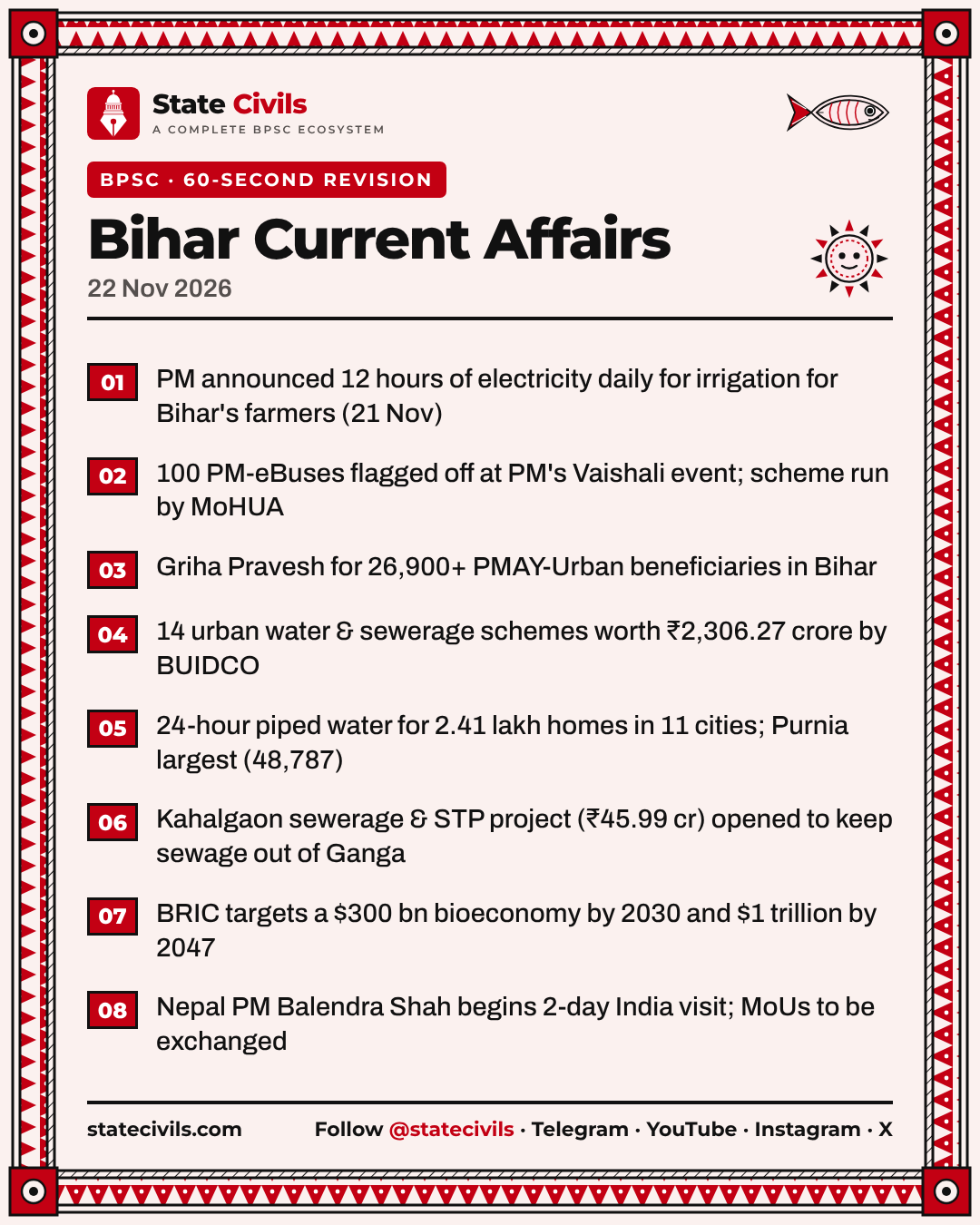
- PM announced 12 hours of electricity daily for irrigation for Bihar’s farmers (21 Nov)
- 100 PM-eBuses flagged off at PM’s Vaishali event; scheme run by MoHUA
- Griha Pravesh for 26,900+ PMAY-Urban beneficiaries in Bihar
- 14 urban water & sewerage schemes worth ₹2,306.27 crore by BUIDCO
- 24-hour piped water for 2.41 lakh homes in 11 cities; Purnia largest (48,787)
- Kahalgaon sewerage & STP project (₹45.99 cr) opened to keep sewage out of Ganga
- BRIC targets a $300 bn bioeconomy by 2030 and $1 trillion by 2047
- Nepal PM Balendra Shah begins 2-day India visit; MoUs to be exchanged
Share today’s revision card with your study group
One image, eight facts. Forward it to your BPSC group.
WhatsApp Telegram Facebook X Download card
Get this every morning: join @statecivils on Telegram. Also on YouTube, Instagram and X.
Today’s Mains question
Examine the role of urban water supply and sewerage infrastructure in improving the quality of urban life in Bihar. Suggest measures to make such projects sustainable, with reference to the recent BUIDCO schemes. (250 words)
Write your answer in 12 minutes, then open the model answer below and compare. Share this post with a study partner too.
Show the topper-style model answer
Decode the question
Directive: Examine + Suggest
- Role of water supply and sewerage in urban quality of life in Bihar
- Challenges in building and running such projects
- Measures to make them sustainable
Keywords to use
74th AmendmentArticle 243WTwelfth ScheduleUrban local bodiesSTP capacity (MLD)Operation and maintenanceGanga pollutionService-level benchmarksCost recoverySDG 6
Introduction
Bihar’s towns are growing fast, but piped water and sewerage have lagged. On 21 November 2026 the foundation was laid for 14 BUIDCO water and sewerage schemes worth about ₹2,306 crore, promising 24-hour piped water to 2.41 lakh households in 11 cities.
Body
Role in urban quality of life
- Health: safe 24×7 water cuts water-borne disease and household spending on treatment.
- Gender and time: fewer hours spent fetching or storing water, mainly by women.
- Environment: STPs at Kahalgaon, Begusarai and Hajipur keep raw sewage out of the Ganga.
- Economy: reliable services make towns like Purnia and Biharsharif more attractive for investment.
Challenges
- Weak finances and staff of urban local bodies; projects run by state agencies with little ULB ownership.
- STPs often run below capacity because house connections lag behind the network.
- Low user charges and poor billing make operation and maintenance hard to fund.
- Flood-prone, high water-table towns raise construction costs and delay work.
Way forward
- Hand over assets with trained staff and clear O&M funds to municipalities.
- Make household connections mandatory and subsidise them for poor families.
- Meter supply, publish service-level data and set fair, graded tariffs.
- Reuse treated wastewater for farms and industry; tie STP payments to output quality.
Diagram (draw this in your answer)
Draw two horizontal chains; put ‘Article 243W’ above the second one.
Value addition
- Water supply and sanitation are municipal functions listed in the Twelfth Schedule under Article 243W (74th Amendment, 1992).
- Purnia gets the largest coverage in the new schemes: 48,787 households.
- Begusarai’s ₹375.87 crore network includes a 13 MLD sewage treatment plant for about 26,700 houses.
- SDG 6 targets safe water and sanitation for all by 2030.
Conclusion
Pipes and plants are only half the job; Bihar’s towns need empowered municipalities that can run them. With connections, metering and clear O&M funding, these schemes can deliver SDG 6 and a cleaner Ganga.
About 234 words without the diagram. Toppers usually score on three things: answering every part the directive asks for, adding Bihar-specific examples and data, and drawing one clean diagram.
Answer to today’s question
(c) Purnia. It has the largest coverage, 48,787 households, among the 11 cities set to get 24-hour piped water under the BUIDCO schemes.