Can you answer this?
The Punah Bharan mobile app, launched by the Union Jal Shakti Minister in October 2026 to identify artificial groundwater recharge zones, was developed by:
- Indian Space Research Organisation (ISRO)
- Central Ground Water Board (CGWB)
- Bhaskaracharya National Institute for Space Applications and Geo-informatics (BISAG-N)
- National Remote Sensing Centre (NRSC)
Answer at the end of the post. Send it to a friend and see who gets it right.
Here are today’s Bihar current affairs for BPSC Prelims and Mains (31 Oct 2026): the PM-Kisan payout in Bihar, Patna’s award-winning sewage plants, a push for space technology in governance, and key Union decisions on manufacturing, groundwater and trade.
In this post: 7 updates
- Bihar
- 1. PM-Kisan 24th instalment: over ₹1,476 crore reaches more than 73 lakh Bihar farmers
- 2. Space Application Adoption Workshop in Patna: TechConnect portal launched, BIRSAC signs MoU with Survey of India
- 3. Patna’s Digha–Kankarbagh sewage treatment project wins IWA Silver Award 2026
- Economy
- 4. Union Cabinet clears ₹10,000 crore Container Manufacturing Promotion Scheme
- 5. Khelo India Sports Goods Manufacturing Scheme approved with ₹1,856.67 crore
- Environment / Science
- 6. Punah Bharan app launched to map groundwater recharge zones
- International
- 7. India and Mexico sign Terms of Reference to launch Preferential Trade Agreement talks
- Revise
- Quick revision
- Today’s Mains question
Bihar
1. PM-Kisan 24th instalment: over ₹1,476 crore reaches more than 73 lakh Bihar farmers
The Prime Minister released the 24th instalment of PM-Kisan (प्रधानमंत्री किसान सम्मान निधि) on 30 October from Gujarat. In Bihar, more than 73 lakh farmer families were to receive over ₹1,476 crore, and a state-level event was held at Gyan Bhawan, Patna. According to the Bihar Agriculture Department, over 9.34 crore farmers across India received more than ₹18,680 crore in this round. Agriculture Minister Vijay Kumar Sinha said Bihar’s farmers have received about ₹33,000 crore under the scheme so far, while missing e-KYC and Farmer IDs still keep many farmers out.
Why it matters for BPSC: Prelims asks about the design of central schemes (amount, instalments, DBT). For Mains GS Paper II, link it to Bihar’s agrarian economy, small landholdings and the role of direct benefit transfer; also see the schemes archive.
Prelims fact: PM-Kisan pays ₹6,000 a year to eligible farmer families in three instalments of ₹2,000 each.
Source: ETV Bharat
2. Space Application Adoption Workshop in Patna: TechConnect portal launched, BIRSAC signs MoU with Survey of India
Chief Minister Samrat Choudhary opened a two-day Space Application Adoption Workshop 2026 at Dr APJ Abdul Kalam Science City, Patna, on 29 October, on the theme ‘Empowering Governance: Leveraging Space-Based Solutions for a Progressive Bihar’. He launched a ‘TechConnect’ portal, and the Bihar Remote Sensing Application Centre (BIRSAC) signed an MoU with the Survey of India. The CM said satellite data can help with floods, since water levels in the Ganga, Son and Gandak depend on flows from Nepal, Madhya Pradesh and Uttar Pradesh, and with land consolidation (chakbandi).
Why it matters for BPSC: Useful for Mains GS Paper II (science and technology in governance; disaster management in Bihar). It fits with the flood plain zoning study of the Kosi, Gandak and Son covered in yesterday’s update on the NIH Roorkee study.
Prelims fact: Survey of India, the partner in BIRSAC’s MoU, was set up in 1767 and works under the Department of Science and Technology.
Source: Patna Press
3. Patna’s Digha–Kankarbagh sewage treatment project wins IWA Silver Award 2026
The Digha and Kankarbagh sewage treatment plants in Patna, built by the Bihar Urban Infrastructure Development Corporation (BUIDCO) under the Namami Gange Mission, won a Silver Award at the International Water Association’s Project Innovation Awards 2026 in the category ‘Exceptional Project Execution and Delivery’. The two plants together treat 150 MLD (Digha 100 MLD, Kankarbagh 50 MLD) and are linked to more than 227 km of sewer lines. They follow the Hybrid Annuity Model with 15 years of operation and maintenance and generate energy from biogas.
Why it matters for BPSC: Covers urban sanitation and river pollution (Mains GS Paper II: Bihar economy and infrastructure; Prelims: environment). The Hybrid Annuity Model is a frequently asked PPP concept.
Prelims fact: Digha STP (100 MLD) and Kankarbagh STP (50 MLD) together treat 150 MLD of Patna’s sewage.
Source: Patna Press
Economy
4. Union Cabinet clears ₹10,000 crore Container Manufacturing Promotion Scheme
The Union Cabinet approved the Container Manufacturing Promotion Scheme (CMPS) with an outlay of ₹10,000 crore, announced in the Union Budget 2026-27. It runs from FY 2027-28 to FY 2039-40: three years to set up units and ten years of production support. The goal is to raise India’s annual container output from about 70,000 TEUs to 7.5 lakh TEUs. Most of the money (₹8,891 crore) is for operational expenditure support, with ₹859 crore for interest subvention. The Ministry of Ports, Shipping and Waterways runs the scheme.
Why it matters for BPSC: Prelims: scheme, ministry and units (TEU = twenty-foot equivalent unit). Mains GS Paper II: logistics costs, Make in India and import dependence in shipping containers.
Prelims fact: CMPS aims to raise India’s annual container production from about 70,000 TEUs to 7.5 lakh TEUs.
Source: The Week
5. Khelo India Sports Goods Manufacturing Scheme approved with ₹1,856.67 crore
The Cabinet chaired by the Prime Minister approved the Khelo India Sports Goods Manufacturing Scheme (खेलो इंडिया स्पोर्ट्स गुड्स मैन्युफैक्चरिंग स्कीम) with ₹1,856.67 crore up to FY 2033-34. It will set up Sports Goods Manufacturing Zones using the BHAVYA scheme and NICDC industrial parks. Anchor investment support and turnover-linked support together get ₹1,130 crore, and ₹105 crore is set aside for international certification.
Why it matters for BPSC: Prelims: outlay, ministry and linked schemes. Mains GS Paper II: labour-intensive manufacturing and exports; aligned with the Khelo Bharat Niti 2025.
Prelims fact: The scheme’s total outlay is ₹1,856.67 crore, running up to FY 2033-34.
Source: DD News
Environment / Science
6. Punah Bharan app launched to map groundwater recharge zones
Union Jal Shakti Minister C.R. Paatil launched the Punah Bharan mobile app on 28 October. It was developed by BISAG-N with the National Water Mission and shows suitable zones for artificial recharge structures within a radius of up to 3 km. A web portal offers village-level recharge zone maps built from rainfall, groundwater level, yield, slope and drainage data.
Why it matters for BPSC: Prelims: environment and technology (groundwater, geospatial tools). Mains GS Paper II: water security; relevant for Bihar’s dry south, where falling water tables are a concern.
Prelims fact: Punah Bharan was developed by BISAG-N with the National Water Mission, Ministry of Jal Shakti.
Source: DD India
International
7. India and Mexico sign Terms of Reference to launch Preferential Trade Agreement talks
India and Mexico signed the Terms of Reference to begin negotiations on a Preferential Trade Agreement (PTA). Commerce Secretary Rajesh Agrawal signed for India. The talks will cover market access for goods, rules of origin, customs and trade facilitation, dispute settlement and technical barriers to trade. The step follows an understanding between PM Modi and President Claudia Sheinbaum at the G7 Summit in Canada in June 2025.
Why it matters for BPSC: Prelims: types of trade agreements (a PTA cuts tariffs on a limited list of goods; an FTA covers most trade). Mains GS Paper II: India’s trade diversification in Latin America.
Prelims fact: A PTA cuts duties on a limited list of goods, unlike a broader FTA or CEPA.
Source: News On AIR
Quick revision
- PM-Kisan 24th instalment: over 73 lakh Bihar farmers got over ₹1,476 crore
- PM-Kisan pays ₹6,000 a year in three instalments of ₹2,000 each
- BIRSAC signed an MoU with Survey of India at Patna’s space applications workshop
- Patna’s Digha (100 MLD) and Kankarbagh (50 MLD) STPs won an IWA Silver Award 2026
- Container Manufacturing Promotion Scheme: ₹10,000 crore; target 7.5 lakh TEU a year
- Khelo India Sports Goods Manufacturing Scheme: ₹1,856.67 crore up to FY 2033-34
- Punah Bharan app (BISAG-N) maps groundwater recharge zones within 3 km
- India and Mexico signed Terms of Reference to start Preferential Trade Agreement talks
Share today’s revision card with your study group
One image, eight facts. Forward it to your BPSC group.
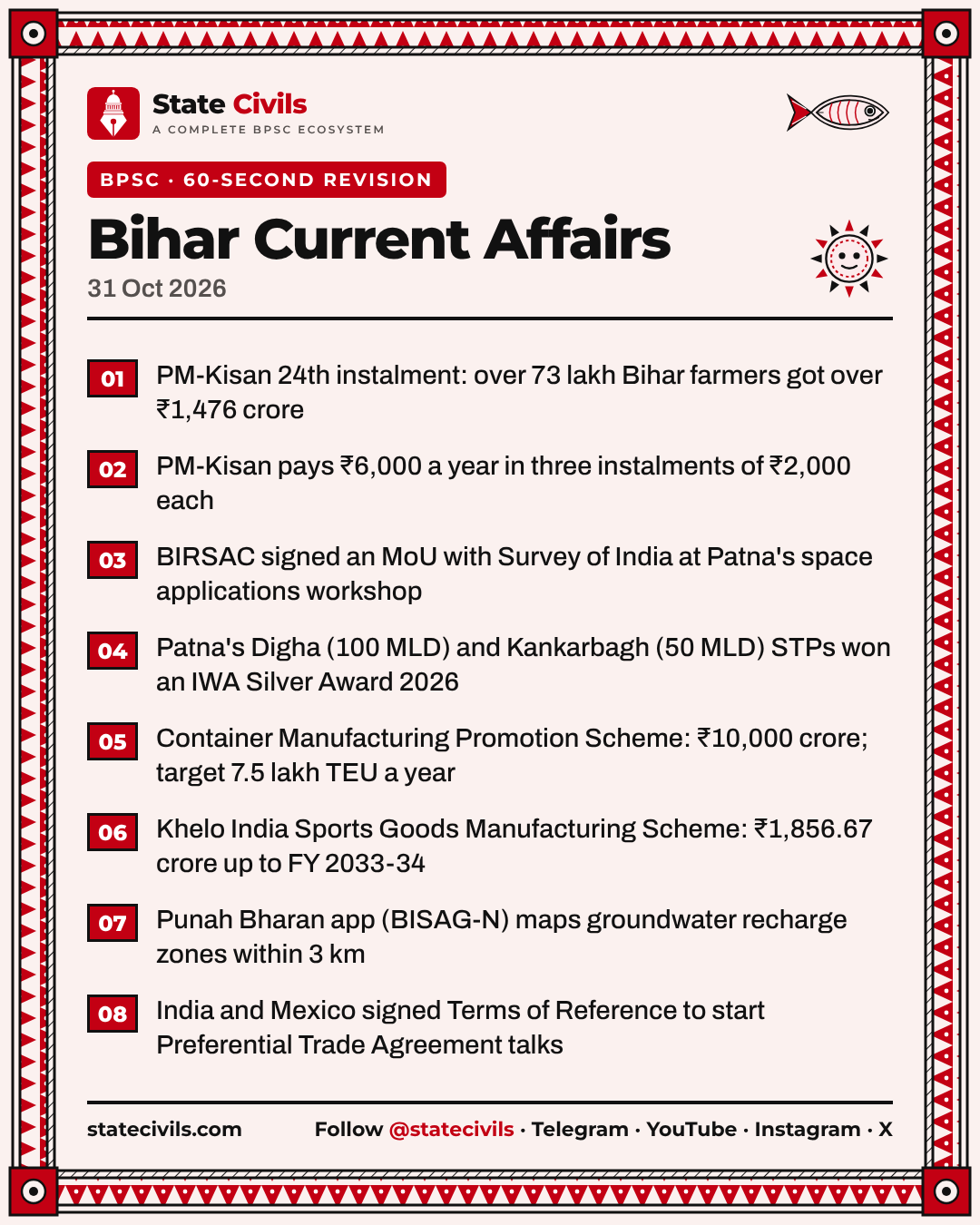
WhatsApp Telegram Facebook X Download card
Get this every morning: join @statecivils on Telegram. Also on YouTube, Instagram and X.
Today’s Mains question
Examine how space-based and geospatial technologies can strengthen disaster management and governance in Bihar. Suggest measures to make their adoption effective. (250 words)
Write your answer in 12 minutes, then open the model answer below and compare. Share this post with a study partner too.
Show the topper-style model answer
Decode the question
Directive: Examine + Suggest
- How space-based and geospatial technologies can improve disaster management in Bihar
- How they can improve wider governance and development in Bihar
- The challenges, and measures to make adoption effective
Keywords to use
Remote sensingGISEarly warningFlood plain zoningBIRSACSurvey of IndiaDisaster Management Act 2005Sendai FrameworkData sharingCapacity building
Introduction
Bihar’s floods are driven by rainfall in Nepal and neighbouring states that the state cannot see from the ground. The October 2026 Space Application Adoption Workshop in Patna, where BIRSAC signed an MoU with the Survey of India, shows the state turning to satellites to close this gap.
Body
Disaster management
- Satellite rainfall and river data from Nepal, Madhya Pradesh and Uttar Pradesh give earlier flood warnings on the Ganga, Son and Gandak.
- Flood plain zoning of the Kosi, Gandak and Son with NIH Roorkee needs precise elevation maps.
- Post-flood damage maps speed relief, crop compensation and silt surveys.
- Drought planning: Bihar saw 32% less rainfall this year; recharge-zone maps like the Punah Bharan app guide water harvesting.
Governance and development
- Land records and chakbandi (land consolidation) become faster and fairer with geo-referenced maps.
- Planning of new townships, roads and power lines using GIS layers.
- Monitoring river health and assets like Patna’s Digha–Kankarbagh STPs.
- Better targeting of farm schemes such as PM-Kisan by linking Farmer IDs with land parcels.
Challenges and way forward
- Weak data sharing between departments: create one state geospatial data platform under BIRSAC.
- Shortage of trained staff in districts: train officers and use engineering colleges and startups.
- Cross-border data from Nepal: real-time sharing under India–Nepal river agreements.
- Privacy and accuracy of land data: ground checks and grievance redressal.
Diagram (draw this in your answer)
Draw two horizontal chains with arrows; label BIRSAC in the middle box.
Value addition
- Disaster Management Act, 2005 created the NDMA and State Disaster Management Authorities.
- Sendai Framework for Disaster Risk Reduction (2015–2030) stresses risk knowledge and early warning.
- Survey of India, set up in 1767, is the oldest scientific department of the Government of India.
- Punah Bharan app (BISAG-N, 2026) maps artificial recharge zones within 3 km.
Conclusion
Space technology can shift Bihar from reacting to floods to preparing for them, and make land and welfare governance more transparent. With shared data, trained staff and cooperation with Nepal, it can support SDG 11 and SDG 13 goals of resilient settlements and climate action.
About 265 words without the diagram. Toppers usually score on three things: answering every part the directive asks for, adding Bihar-specific examples and data, and drawing one clean diagram.
Answer to today’s question
(c) Bhaskaracharya National Institute for Space Applications and Geo-informatics (BISAG-N). It developed the Punah Bharan app with the National Water Mission under the Ministry of Jal Shakti.