Quick answer: For BPSC, the Champaran Satyagraha means Mahatma Gandhi’s 1917 campaign for the indigo farmers of Champaran in north-west Bihar. He defied an order to leave the district, recorded the farmers’ complaints, and joined an official inquiry. Its report led to the Champaran Agrarian Act of 1918, which abolished the tinkathia system.
The Champaran Satyagraha is Bihar’s biggest gift to the national movement, and the Bihar Public Service Commission (BPSC) returns to it often. It fits the Prelims history section and Mains GS Paper I, which covers the modern history of India and Bihar. This guide to the Champaran Satyagraha for BPSC gives you the causes, a dated timeline, the people, the results and ready-made Mains points.
Key facts
- Year: 1917, in the old Champaran district of north-west Bihar (now West and East Champaran).
- Main grievance: the tinkathia system, which forced farmers to grow indigo on 3 kathas out of every 20 (3/20 of their land).
- Rajkumar Shukla and Brajkishore Prasad met Gandhi at the Lucknow session of the Indian National Congress in 1916.
- Gandhi reached Motihari on 15 April 1917 and refused an order to leave the district.
- The government withdrew the case against him on 21 April 1917.
- Gandhi was a member of the Champaran Agrarian Enquiry Committee, chaired by F.G. Sly. It signed a unanimous report on 4 October 1917.
- The Champaran Agrarian Act of 1918 abolished tinkathia.
- Gandhi opened village schools at Barharwa Lakhansen (14 November 1917) and Bhitiharwa (20 November 1917).
What was the Champaran Satyagraha?
The Champaran Satyagraha was a non-violent campaign led by Mohandas Karamchand Gandhi in 1917. It took up the cause of the ryots (tenant farmers) of Champaran, who were squeezed by European indigo planters.
Gandhi had only recently returned from South Africa. Champaran was his first satyagraha in India. The Gandhi Heritage Portal’s chronology marks his refusal to obey the order to leave Champaran on 16 April 1917 as the beginning of satyagraha in India. Gandhi Smriti and Darshan Samiti, a Government of India body, calls it his first victorious non-violent campaign.
Prelims fact: Champaran was split in 1972 into Pashchim (West) Champaran, with headquarters at Bettiah, and Purbi (East) Champaran, with headquarters at Motihari.
Causes of the Champaran Satyagraha
The tinkathia system
Under tinkathia, a tenant had to grow indigo on 3 kathas of every bigha he held. One bigha has 20 kathas, so this meant 3/20 of the land. Dr Rajendra Prasad’s book Satyagraha in Champaran notes that the share was 5 kathas per bigha until about 1867. It was then cut to 3 kathas, which gave the system its name.
Gandhi himself described tinkathia in his autobiography. He wrote that tenants were bound to plant three out of every twenty parts of their land with indigo for their landlord.
Falling indigo prices and new exactions
Indigo had been grown in Champaran since the late 18th century. The first indigo factory came up at Bara village in 1813. By 1850 indigo had replaced sugar as the main crop.
After 1900, synthetic dye from Europe made natural indigo far less profitable. The planters then shifted the burden onto the farmers:
- Tawan: a lump-sum payment, up to Rs 100 per bigha, to release a tenant from growing indigo. Unpaid amounts became handnotes and mortgage bonds at 12% annual interest.
- Sharahbeshi: enhanced rent charged in place of indigo cultivation.
- Abwab: illegal cesses collected by the factories.
Earlier unrest in Champaran
Champaran’s farmers had resisted before Gandhi came. In 1867 tenants of the Lalsariya factory refused to grow indigo. In 1907–08 there was unrest and violence at Sathi and Bettiah. These episodes show that the ground was ready; Gandhi gave the anger a disciplined, non-violent form.
Mains fact: Pir Muhammad Munis wrote a letter titled “Sad Tale” to Gandhi on 27 February 1917. It compared the struggle of Bihar’s farmers with Gandhi’s own experience in South Africa.
How did Gandhi reach Champaran?
Rajkumar Shukla, a farmer from Champaran, kept pressing Gandhi to see the farmers’ suffering for himself. Shukla and the lawyer Brajkishore Prasad met Gandhi at the Lucknow session of the Indian National Congress in 1916. A resolution on the Champaran farmers was passed there. Shukla then followed Gandhi to Kanpur and Sabarmati until he agreed to come.
The Bihar State Tourism Development Corporation lists Murli Bharhawa in West Champaran as Shukla’s birthplace. It is part of the Gandhi circuit today.
Champaran Satyagraha timeline (1917–1918)
Dates matter in BPSC Prelims options. The table below follows the Gandhi Heritage Portal chronology and the Government of India’s Indian Culture portal.
| Date | Event |
|---|---|
| 1916 | Rajkumar Shukla and Brajkishore Prasad meet Gandhi at the Lucknow Congress session |
| 10 April 1917 | Gandhi reaches Patna with Shukla, then Muzaffarpur at night, where J.B. Kripalani receives him |
| 12–13 April 1917 | Gandhi writes to and meets Morshead, Commissioner of Tirhut Division |
| 15 April 1917 | Gandhi reaches Motihari, the district headquarters |
| 16 April 1917 | On the way to Jasaulipatti, he is served an order under Section 144 of the Criminal Procedure Code to leave the district; he refuses |
| 18 April 1917 | Gandhi appears in court at Motihari, pleads guilty and offers no defence; Rajendra Prasad meets him for the first time that night |
| 21 April 1917 | The case is withdrawn; Gandhi is allowed to continue his inquiry |
| 4–6 June 1917 | Talks with Lieutenant-Governor Sir Edward Gait at Ranchi |
| 10 June 1917 | Government resolution sets up the Champaran Agrarian Enquiry Committee, with Gandhi as a member |
| July–September 1917 | Committee sittings at Bettiah, Motihari and Ranchi |
| 4 October 1917 | Gandhi signs the committee’s unanimous report at Ranchi |
| 18 October 1917 | Government of Bihar and Orissa passes a resolution on the report |
| 14 and 20 November 1917 | Schools opened at Barharwa Lakhansen and Bhitiharwa |
| 29 November 1917 | Champaran Agrarian Bill introduced |
| 1918 | Champaran Agrarian Act passed; tinkathia abolished |
Prelims fact: Gandhi was charged under Section 188 of the Indian Penal Code for disobeying the order. The Lieutenant-Governor ordered the case withdrawn.
Gandhi’s method in Champaran: satyagraha in practice
Gandhi did not start with protests or speeches. He started with facts. His team recorded the statements of a large number of farmers, carefully and in writing. Gandhi wrote that the ever-growing number of ryots coming to give statements increased the planters’ anger.
Four features of his method are worth remembering for Mains answers:
- Open civil disobedience: he disobeyed the order to leave, told the officials in advance, and accepted the legal consequence.
- Truth through evidence: the farmers’ statements became the case file that the government could not ignore.
- Working with the state: he wrote to the Commissioner, met the Lieutenant-Governor and agreed to sit on the official committee.
- Constructive work: he followed the agitation with schools, hygiene and village work.
In April 1917 he wrote to Maganlal Gandhi that the situation in Champaran was “worse than in Fiji and Natal”. In his autobiography he called his meeting with the peasants a meeting “face to face with God, Ahimsa and Truth”.
Leaders and associates of the Champaran Satyagraha
Bihar’s own lawyers and teachers did much of the hard work. Many of them later led the freedom struggle in the state. Read our guide to Bihar current affairs for BPSC to see how such history questions are linked to present-day events like anniversaries.
| Person | Role in Champaran |
|---|---|
| Rajkumar Shukla | Champaran farmer who persuaded Gandhi to come |
| Brajkishore Prasad | Lawyer; met Gandhi at Lucknow in 1916 and worked on the inquiry |
| Rajendra Prasad | Lawyer; joined Gandhi at Motihari and later wrote Satyagraha in Champaran |
| Mazharul Haque | Barrister; hosted Gandhi in Patna |
| J.B. Kripalani | Teacher; received Gandhi at Muzaffarpur |
| Ramnavami Prasad | Co-worker in the inquiry |
| Pir Muhammad Munis | Wrote to Gandhi about the farmers in February 1917 |
| Kasturba Gandhi | Helped run the Bhitiharwa school with volunteers |
Officials you should know
- Sir Edward Gait: Lieutenant-Governor of Bihar and Orissa, who agreed to the inquiry.
- W.B. Heycock: District Magistrate of Champaran.
- F.G. Sly: Commissioner of the Central Provinces and chairman of the Enquiry Committee.
- Morshead: Commissioner of Tirhut Division.
- W. Maude: Member of the Executive Council, who introduced the Champaran Agrarian Bill.
Results of the Champaran Satyagraha
The Champaran Agrarian Enquiry Committee
The government set up the committee by a resolution of 10 June 1917. F.G. Sly was its chairman and Gandhi a member. Raja Kirtyanand Singh replaced Raja Harihar Prasad Narayan Singh, who resigned owing to ill health, in July 1917. The committee heard evidence at Bettiah and Motihari and finished its last session at Ranchi in September 1917.
Its unanimous report of 4 October 1917 recommended that:
- the tinkathia system be abolished;
- indigo agreements be voluntary, last no more than three years, and let farmers choose the fields;
- one-fourth of the tawan be refunded to farmers;
- illegal cesses (abwab) be stopped.
The Champaran Agrarian Act, 1918
The government accepted almost all the recommendations. W. Maude introduced the Champaran Agrarian Bill on 29 November 1917, and it became the Champaran Agrarian Act in 1918. In Gandhi’s words, the tinkathia system that had lasted about a century was abolished, and with it the planters’ raj came to an end.
Prelims fact: Only one-fourth (25%) of the tawan was refunded. Questions often test this fraction.
Constructive work: schools and the Bhitiharwa Ashram
Gandhi believed that winning the legal case was not enough. The villages also needed schools, cleanliness and health care. He opened his first school at Barharwa Lakhansen on 14 November 1917. A second school followed at Bhitiharwa on 20 November 1917.
Bhitiharwa is in the Gaunaha block of West Champaran, near Bettiah. Bihar Tourism describes it as the place where Gandhi set up the country’s first basic school for employable education. Today it also hosts a Khadi centre run by the Bihar Khadi Samiti.
Gandhi circuit sites in Champaran
| Place | Link with Gandhi |
|---|---|
| Motihari (East Champaran) | District headquarters where the trial took place |
| Hazarimal Dharamshala, Bettiah | Camp of Gandhi and his team; a state-protected monument |
| Bhitiharwa Ashram | School and centre of social work from November 1917 |
| Amolwa | Gandhi spent a night here on 27 April 1917 |
| Murli Bharhawa | Birthplace of Rajkumar Shukla |
| Brindaban (Champatia block) | Gandhi Seva Sangh conference of 1937, attended by Gandhi and Rajendra Prasad |
Significance of the Champaran Satyagraha
This is the part most useful for Mains GS Paper I and the Essay. Use these points with Bihar examples.
- A new method: it tested satyagraha on Indian soil for the first time and showed that open, non-violent defiance of an unjust order could work.
- Peasants enter national politics: the Congress had largely been a forum of the educated middle class. Champaran brought poor farmers into the movement.
- Rise of Bihar’s leadership: Rajendra Prasad, Brajkishore Prasad and others gained the training that shaped Bihar’s role in the Non-Cooperation and Quit India movements.
- Gandhi’s national standing: success in Champaran, followed by Kheda and Ahmedabad in 1918, made Gandhi the leading figure of Indian politics.
- Reform with evidence: it showed how systematic fact-finding can push the state to change the law.
- Constructive programme: schools and sanitation work began Gandhi’s model of linking politics with social reform.
Mains fact: Champaran (1917, Bihar), Kheda (1918, Gujarat) and Ahmedabad mill workers (1918, Gujarat) are Gandhi’s three early struggles in India. Champaran was the first.
Champaran Satyagraha centenary (2017–2018)
India marked the centenary of the Champaran Satyagraha from April 2017 to April 2018. Gandhi Smriti and Darshan Samiti held opening programmes at Motihari from 10 to 18 April 2017. The Prime Minister launched “Swachhagraha” on 10 April 2017, linking the satyagraha to the cleanliness mission.
The centenary closed at Motihari on 10 April 2018 under the theme “Satyagraha se Swachhagraha”. According to the Prime Minister’s Office, the Prime Minister addressed about 20,000 Swachhagrahis, who are grassroots cleanliness volunteers.
Anniversary links like this are a favourite for current-affairs questions. Follow our Bihar current affairs page to catch them in time.
How to prepare Champaran Satyagraha for BPSC Prelims and Mains
For Prelims
- Learn the dated timeline above. Options often mix up 1916, 1917 and 1918.
- Know the terms: tinkathia, tawan, sharahbeshi and abwab.
- Match people with roles: Shukla, Sly, Gait, Heycock, Kripalani and Rajendra Prasad.
- Remember places: Motihari, Bettiah, Bhitiharwa, Barharwa Lakhansen and Murli Bharhawa.
- Test yourself every day on our daily quiz.
For a complete Bihar GK plan, the Bihar Special for Prelims course covers the history of Bihar in exam order.
For Mains GS Paper I
A strong answer has a short introduction, the causes, the method, the results and the significance, with a balanced conclusion. Add one Bihar figure, one date and one quote. Practise the structure with our guide to BPSC Mains answer writing.
If you are preparing in English, our BPSC English medium preparation guide explains how to handle Hindi terms like tinkathia in English answers. Write the Hindi term once, then explain it in brackets.
Previous year questions
We could not confirm an exact past BPSC question on this topic from an official source, so the questions below are our own. Use them to test the facts in this guide.
Practice question (Prelims): Under the tinkathia system in Champaran, what share of a tenant’s land had to be planted with indigo?
(A) 1/20 (B) 3/20 (C) 5/20 (D) 1/4 (E) None of the above / More than one of the above
Answer: (B) 3/20.
Practice question (Prelims): Who chaired the Champaran Agrarian Enquiry Committee of 1917?
(A) Sir Edward Gait (B) W.B. Heycock (C) F.G. Sly (D) W. Maude (E) None of the above / More than one of the above
Answer: (C) F.G. Sly.
Practice question (Prelims): Consider these statements. 1. Gandhi reached Motihari on 15 April 1917. 2. The Champaran Agrarian Act was passed in 1916. Which is correct?
(A) 1 only (B) 2 only (C) Both 1 and 2 (D) Neither 1 nor 2 (E) None of the above / More than one of the above
Answer: (A) 1 only.
Practice question (Mains GS Paper I): “The Champaran Satyagraha was a turning point for both Gandhi and the Indian national movement.” Discuss, with reference to Bihar’s role.
Practice question (Mains GS Paper I): Explain the exploitation of indigo farmers in Champaran and assess the results of the 1917 satyagraha.
FAQs
Why is Champaran called Gandhi’s first satyagraha in India?
Champaran in 1917 was the first time Gandhi used satyagraha in India after returning from South Africa. On 16 April 1917 he openly refused an order to leave the district. The Gandhi Heritage Portal marks this as the beginning of satyagraha in India.
What was the tinkathia system?
Tinkathia forced a tenant to grow indigo on 3 kathas of every bigha, that is 3/20 of the land, for the planter. It had existed for about a century. The Champaran Agrarian Act of 1918 abolished it.
Who invited Gandhi to Champaran?
Rajkumar Shukla, a farmer from Champaran, persuaded Gandhi to visit. He and Brajkishore Prasad met Gandhi at the Lucknow Congress session in 1916. Shukla then followed Gandhi until he agreed to come in 1917.
What was the result of the Champaran Satyagraha?
An official committee with Gandhi as a member recommended ending tinkathia and refunding one-fourth of the tawan. The government accepted almost all its recommendations. The Champaran Agrarian Act was passed in 1918.
Which leaders of Bihar joined the Champaran Satyagraha?
Rajendra Prasad, Brajkishore Prasad, Mazharul Haque and Ramnavami Prasad were among Gandhi’s co-workers from Bihar. J.B. Kripalani, then a teacher at Muzaffarpur, also helped.
Is the Champaran Satyagraha important for BPSC Mains?
Yes. Mains GS Paper I covers the modern history of India and Bihar, and Champaran is the best-known Bihar chapter of the freedom struggle. Prepare its causes, method, results and significance as a ready answer.
Sources
- Indian Culture portal (Ministry of Culture, Government of India): ‘The Stain of Indigo’ and Gandhi’s Satyagraha in Champaran
- Gandhi Heritage Portal: Chronology, Champaran, April 1917 (also the June, July, September, October and November 1917 pages)
- Gandhi Smriti and Darshan Samiti: Champaran Satyagraha, 100 Years – Major Activities
- Prime Minister’s Office: Satyagraha se Swachhagraha, Motihari, April 2018
- Bihar State Tourism Development Corporation: Gandhi Circuit
- Bihar Tourism (Government of Bihar): Bhitiharwa Ashram
- M.K. Gandhi, An Autobiography: “The Stain of Indigo” and “The Stain Removed”
- Rajendra Prasad, Satyagraha in Champaran (Navajivan Publishing House)
- Britannica: Mahatma Gandhi – Emergence as nationalist leader
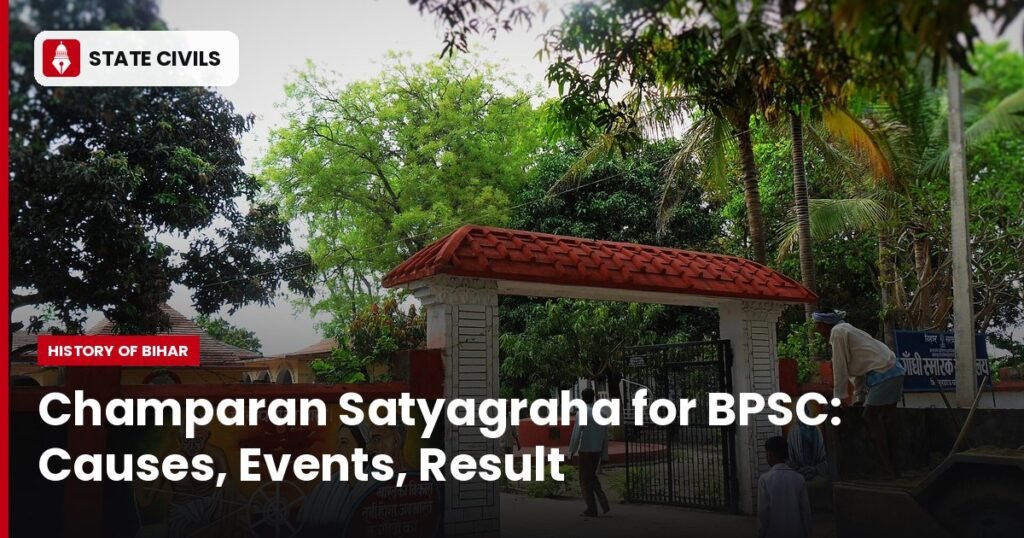
Featured image: Photo: Bhitiharwa Gandhi Ashram, West Champaran, Bihar. Praanshu / Wikimedia Commons, CC BY-SA 4.0 (cropped, text added).