Quick answer: BPSC GS Paper 2 (General Studies Paper II of the Bihar Public Service Commission Mains) is a 300-mark, 3-hour descriptive paper. It covers Indian polity and Bihar’s political system, the Indian and Bihar economy, and the role of science and technology. Score well by learning concepts once, adding Bihar data to every answer and writing timed answers each week.
General Studies Paper II is one of the three merit papers of the Bihar Public Service Commission (BPSC) Combined Competitive Examination Mains. It rewards aspirants who can explain how the Constitution, the economy and technology actually work in Bihar. This guide breaks the paper into study units, gives you official Bihar data to quote, and shows how to write answers that score.
Key facts
- General Studies Paper II is a descriptive (written) Mains paper of 300 marks, as per the BPSC website (as of 2026).
- Each Mains paper lasts 3 hours.
- The BPSC overview lists three areas: Indian Polity, Governance and Bihar’s Political System; Indian and Bihar Economy; and Role and Impact of Science and Technology.
- GS Paper I, GS Paper II and the Essay decide your Mains merit; General Hindi is qualifying.
- The Interview carries 120 marks and is added to your Mains merit marks.
- Bihar data from the Bihar Economic Survey 2025-26 makes economy answers specific.
- Check the notification of your exam cycle, because BPSC can revise the pattern or syllabus.
What is BPSC GS Paper 2?
BPSC GS Paper 2 is the second General Studies paper of the BPSC Mains. It is a written paper, so you answer in full sentences and paragraphs. There are no options to choose from, and presentation matters as much as facts.
The paper carries 300 marks. That is the same weight as General Studies Paper I and the Essay. Prelims marks are not carried forward, so these three papers and the Interview decide your final rank.
General Studies Paper II is often called the “applied” GS paper. Polity, economy and science questions ask how a system works and what it means for Bihar. Pure memory rarely gets full marks here.
Mains fact: The BPSC website describes the Mains as “Descriptive/Subjective Type” with 3 hours per paper. Check the notification of your exam cycle for the exact scheme, number of questions and word limits.
BPSC GS Paper 2 syllabus explained
The BPSC official overview page lists three headings for General Studies Paper II. Each heading is wide, so break it into smaller study units. The table below shows how to read each one.
| Syllabus area (BPSC overview) | What it covers in practice | Bihar angle |
|---|---|---|
| Indian Polity, Governance and Bihar’s Political System | Constitution, Parliament and state legislature, executive, judiciary, federalism, local government, governance issues | Bihar Legislature, Panchayati Raj in Bihar, reservation for women in local bodies, state institutions |
| Indian and Bihar Economy | Growth, planning, agriculture, industry, public finance, poverty, employment, the geography of India’s resources | Bihar GSDP, sector shares, state finances, floods and agriculture, district disparities |
| Role and Impact of Science and Technology | Technology in development, space, IT and e-governance, energy, health, agriculture and environment | Technology use in Bihar’s agriculture, flood management, education and governance |
The detailed syllabus also links the economy section with the geography of India and Bihar. Read the full wording in your exam notification. Our complete BPSC syllabus guide explains every Prelims and Mains paper in one place.
How to prepare Indian polity for General Studies Paper II
Polity is the most predictable block of the paper. The Constitution does not change every year, so a solid base pays off for several attempts. Your job is to add a governance and Bihar layer to that base.
Build the constitutional base
- Start with the NCERT Political Science textbooks of Classes 9 to 12 for clear concepts.
- Then read one standard Indian polity book, chapter by chapter.
- Read the bare text of key Articles: Fundamental Rights, Directive Principles, the Governor, the state legislature and Parts IX and IX-A on local bodies.
- For every institution, note its composition, powers, limits and one current issue.
Add Bihar’s political system
The official heading names “Bihar’s Political System”. This means you must know Bihar’s institutions with exact numbers. Use the table below as your fact base.
| Institution | Fact (verified on official pages) |
|---|---|
| Bihar Legislative Assembly | 243 seats, of which 38 are reserved for Scheduled Castes and 2 for Scheduled Tribes |
| Bihar Legislative Council | Strength of 75 members under the Bihar Reorganisation Act, 2000; Bihar has a bicameral legislature |
| Lok Sabha | 40 seats from Bihar (33 general, 7 Scheduled Caste) |
| Rajya Sabha | 16 seats from Bihar |
| Reorganisation | Jharkhand was formed from Bihar on 15 November 2000 under the Bihar Reorganisation Act, 2000 |
Prelims fact: The Bihar Reorganisation Act, 2000 reduced Bihar’s Rajya Sabha seats from 22 to 16. The other 6 went to the new state of Jharkhand.
Panchayati Raj and local governance in Bihar
Local government is a favourite theme because it joins polity, governance and social change. The 73rd Constitutional Amendment Act, 1992 came into force on 24 April 1993. That is why 24 April is observed as National Panchayati Raj Day. The 74th Amendment, for urban local bodies, came into force on 1 June 1993.
The Bihar Panchayat Raj Act, 2006 reserves up to 50% of seats and posts in panchayats for women. The Government of Bihar states that Bihar was the first state in the country to reserve 50% seats for women in panchayats. Use this example in any answer on women’s empowerment or decentralisation.
Mains fact: A strong local governance answer covers three Fs: funds, functions and functionaries. Explain where each one stands in Bihar, then suggest one reform for each.
Indian and Bihar economy: the heaviest section
The economy section is large, but it becomes manageable once you separate concepts from data. Learn concepts from NCERT economics books and one standard Indian economy book. Then attach the latest Bihar figures to each concept.
Core economy themes to cover
- Growth and development: GDP, GSDP, per capita income, real and nominal growth.
- Planning in India: from the Five-Year Plans to NITI Aayog.
- Agriculture: land holdings, irrigation, food processing, floods and allied sectors.
- Industry: manufacturing, MSMEs, investment and the reasons for Bihar’s low industrial base.
- Public finance: budgets, central transfers, state revenue, capital spending and debt.
- Poverty, employment, migration and human development.
Bihar economy data to quote (Bihar Economic Survey 2025-26)
The Government of Bihar economy page, based on the Bihar Economic Survey 2025-26, gives these figures for 2024-25. Quote them with the year and source so the examiner sees precision.
| Indicator (2024-25) | Value |
|---|---|
| GSDP growth at constant (2011-12) prices | 8.6% |
| GSDP growth at current prices | 13.1% |
| GSDP at current prices | Rs. 9,91,997 crore |
| Per capita GSDP at current prices | Rs. 76,490 |
| Sector shares of GSVA (constant prices) | Primary 18.3%, secondary 26.8%, tertiary 54.8% |
| Capital expenditure share of total state spending | 22.3% (up from 15.8% in 2020-21) |
| Outstanding debt (31 March 2025) | Rs. 3,74,134 crore, 37.7% of GSDP |
Mains fact: The same page shows a wide gap between districts. Per capita GDDP at current prices is highest in Patna at Rs. 2,41,220. Use this to discuss regional imbalance inside Bihar.
Notice the story in these numbers. The secondary sector’s share rose from 21.1% in 2020-21 to 26.8% in 2024-25, led by construction and manufacturing. Capital spending is rising, but the debt ratio also needs watching. Such analysis turns data into marks. For a chapter-wise guide, read our note on the Bihar Economic Survey for BPSC.
Geography of India and Bihar in economy answers
Geography appears inside economy questions on resources, agriculture and disasters. Bihar has an area of 94,163 sq km and 38 districts. Its population was 10,40,99,452 in Census 2011, with a density of 1,106 persons per sq km.
Floods are the most important link between geography and economy in Bihar. The Flood Management Improvement Support Centre of the Bihar Water Resources Department calls Bihar India’s most flood-prone state. It states that about 68,800 sq km, or 73.06% of Bihar’s area, is flood affected.
Prelims fact: Bihar’s Census 2011 sex ratio was 918 females per 1,000 males, and literacy was 61.80%.
Role and impact of science and technology
This section is the least liked and the most scoring for prepared candidates. Questions rarely ask for pure science. They ask how technology changes development, governance and daily life in India and Bihar.
Themes to prepare
- Space and communication: uses of satellites in weather forecasting, flood warning, mapping and education.
- Information technology: e-governance, digital payments, Direct Benefit Transfer and online public services.
- Energy: solar power, energy security and clean fuels.
- Agriculture technology: improved seeds, soil testing, drones and post-harvest storage.
- Health and biotechnology: vaccines, telemedicine and disease surveillance.
- Environment: climate change, pollution control and disaster management technology.
Give every science answer a Bihar example
Link each theme to a Bihar need. Flood forecasting and remote sensing matter in a state where most of the area is flood affected. Technical education matters too: the Indian Institute of Technology (IIT) Patna was established by an Act of Parliament on 6 August 2008.
Follow science and technology news through Press Information Bureau (PIB) releases. Keep a one-page note per theme with a definition, two uses, one challenge and one Bihar example.
How to write high-scoring answers in BPSC GS Paper 2
Good content fails without good presentation. Examiners read hundreds of copies, so make your answer easy to mark. Follow a simple structure for every question.
- Introduction: one or two lines that define the term or give a fact, such as an Article number or a data point.
- Body: short paragraphs or points under clear sub-headings. Cover causes, features, impact and issues as the question demands.
- Bihar angle: add at least one Bihar example, scheme, figure or institution.
- Conclusion: a balanced, forward-looking line with a practical suggestion.
| Directive word | What the examiner wants |
|---|---|
| Discuss | Several sides of the issue, with examples |
| Examine / Analyse | Causes, effects and links, backed by data |
| Critically evaluate | Merits and limits, then your reasoned judgement |
| Explain | Clear concept and how it works |
Use simple diagrams and flowcharts where they help, such as the structure of panchayats or a sector-share chart. Practise with the methods in our BPSC GS Paper 1 guide, which also covers the statistics section.
Best sources for General Studies Paper II (English medium)
Keep your sources few and revise them many times. One good book per area, read three times, beats five books read once.
| Area | Base source | Bihar source |
|---|---|---|
| Indian polity | NCERT Political Science (Classes 9–12), one standard polity book, the bare Constitution | Bihar Panchayat Raj Act, 2006; Bihar Legislature and State Election Commission websites |
| Economy | NCERT economics books, one standard Indian economy book, the Union Budget and Economic Survey | Bihar Economic Survey 2025-26, Bihar Budget |
| Geography in economy | NCERT geography (Classes 11–12) | Bihar Water Resources Department flood pages, state profile |
| Science and technology | NCERT science, PIB releases | Bihar department pages and state news |
Read economy and governance news daily. Our economy current affairs page tracks the topics most useful for this paper. For Bihar facts in English for the Prelims, the Bihar Special for Prelims course gives PDF notes and practice tests.
A 10-week plan for BPSC GS Paper 2
This plan suits a candidate who already has basic Prelims knowledge. Stretch it if you are starting from zero.
| Weeks | Focus | Output |
|---|---|---|
| 1–3 | Indian polity and Bihar’s political system | Notes per institution, 2 answers a day |
| 4–6 | Indian and Bihar economy with Bihar Economic Survey data | Data sheet of 30 key Bihar figures |
| 7–8 | Science and technology themes | One-page note per theme |
| 9 | Full-length timed tests | Two 3-hour tests, self-evaluated |
| 10 | Revision of notes and data sheet | Final revision cards |
Keep 20 minutes a day for objective revision with our free daily quiz. It keeps polity and economy facts fresh while you write answers.
Common mistakes to avoid
- Writing only national content and forgetting the Bihar angle.
- Quoting old data without a year or source.
- Ignoring the science and technology section until the last month.
- Leaving questions unattempted because of poor time management.
- Writing long paragraphs with no headings, which hide good points.
Practice questions
These are practice questions written in the style of General Studies Paper II. They are not previous year questions. Write each one in the time and word limit stated in your exam notification.
- Practice question: “Bihar was the first state to reserve 50% seats for women in panchayats.” Examine the impact of this step on grassroots democracy in Bihar.
- Practice question: Discuss the role of the Governor in a state. Illustrate your answer with constitutional provisions.
- Practice question: The share of the secondary sector in Bihar’s economy has risen since 2020-21. Analyse the causes and suggest ways to sustain industrial growth.
- Practice question: Floods affect about 73% of Bihar’s area. Explain how they affect agriculture and suggest technology-based solutions.
- Practice question: Critically evaluate the role of e-governance in improving public service delivery in Bihar.
FAQs
What is the syllabus of BPSC GS Paper 2?
The BPSC overview lists three areas: Indian Polity, Governance and Bihar’s Political System; Indian and Bihar Economy; and Role and Impact of Science and Technology. The economy section also links with the geography of India and Bihar. Always read the detailed syllabus in your exam notification.
How many marks is BPSC GS Paper 2?
General Studies Paper II carries 300 marks and lasts 3 hours, as per the BPSC website (as of 2026). It is one of the three Mains merit papers, along with GS Paper I and the Essay.
Can I write BPSC GS Paper 2 in English?
English-medium candidates write the General Studies papers in English. Check the notification of your exam cycle for the medium rules and any restrictions. Write in the medium you think in, and practise writing in it from day one.
Which is the most scoring section of General Studies Paper II?
Polity is the most stable section, so a good base gives steady marks. Science and technology can also score well because many candidates neglect it. Bihar data in economy answers makes your copy stand out.
Which Bihar data should I remember for the economy section?
Remember Bihar’s GSDP growth, per capita GSDP, sector shares, capital spending and debt ratio from the Bihar Economic Survey 2025-26. Add area, districts and Census 2011 figures. Always mention the year with each number.
How should I prepare BPSC GS Paper 2 along with the Prelims?
Polity and economy overlap heavily with the Prelims. Study them once in depth and make notes with both crisp facts and analytical points. Write one or two short answers a day even before the Prelims.
Sources
- Bihar Public Service Commission – Overview (Mains pattern and GS Paper II headings)
- Bihar Public Service Commission – official website
- Government of Bihar – Economy of Bihar (based on Bihar Economic Survey 2025-26)
- Government of Bihar – State profile (area and districts)
- Government of Bihar – Reservation to women
- State Election Commission, Bihar – Bihar Panchayat Raj Act, 2006
- India Code – Bihar Reorganisation Act, 2000
- PIB – Bihar Legislative Assembly election note (seat details)
- Rajya Sabha – State-wise seats
- PIB – National Panchayati Raj Day explainer
- Ministry of Housing and Urban Affairs – Annual Report (74th Amendment)
- Invest India – Bihar (Census 2011 figures)
- FMISC, Water Resources Department, Bihar – Flood history
- IIT Patna – History
- NCERT textbooks (free online)
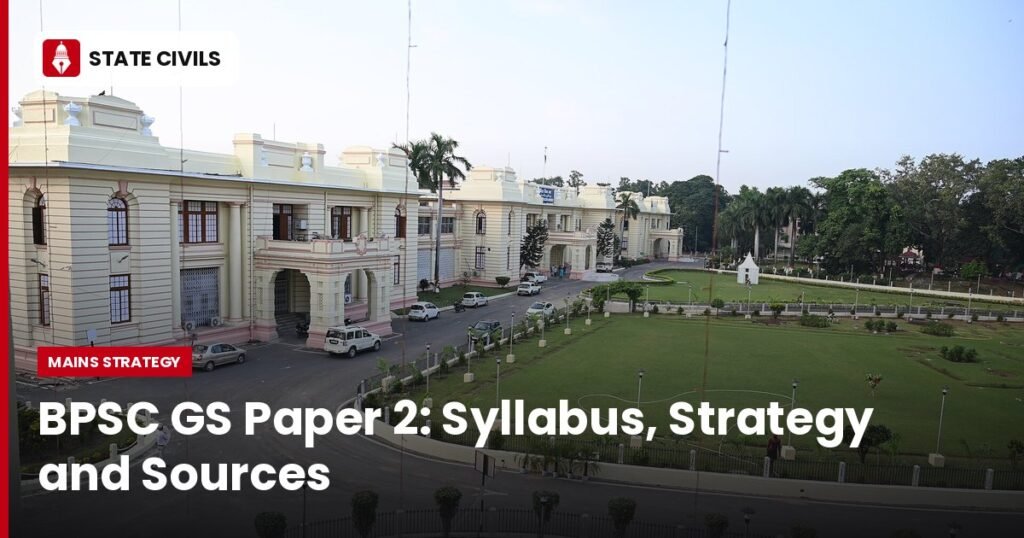
Featured image: Photo: Bihar Vidhan Sabha (Legislative Assembly building), Patna. Itcell.bla / Wikimedia Commons, CC BY-SA 4.0 (cropped, text added).